

Renewing VMware Cloud Foundation means Broadcom's per-core pricing, with a 16-core-per-CPU floor, at roughly $350 (£264) per core per year. Nutanix Cloud Infrastructure bundles its AHV hypervisor free but publishes no price list. Proxmox VE charges per CPU socket, from €120 to €1,100 (£103 to £943) a year, a structurally cheaper unit before any discount. The right route depends on which VCF features you actually use and how much migration risk you can absorb.
Key pointers
- Rebuild your core count from hardware inventory, not last year's socket count. Broadcom licenses every physical core, with a floor of 16 cores per CPU even if the chip has fewer.
- Get the applicable order minimum confirmed in writing. Broadcom's own current core-counting guidance shows only the 16-core-per-CPU rule; a reported 72-core-per-order floor from April 2025 does not appear in that guidance today.
- Ask for VCF, the smaller VVF bundle, Nutanix NCI and Proxmox VE quotes side by side. Each prices on a different unit, so a like-for-like comparison needs the same cluster modelled three ways.
- Budget for the migration project, not just the licence. Backup, replication and DR tooling built for VMware may need re-validating on a new hypervisor.
- Do not assume a small estate escapes the maths. Even a modest cluster can clear a five-figure annual VCF bill once the 16-core floor is applied.
- Request 1, 3 and 5-year quotes before committing. List price is a starting point; volume and term discounts are commonly reported in the 20 to 40% range.
What Broadcom's licensing change means for a UK enterprise
If your organisation has run VMware since before November 2023, your renewal conversation has changed shape twice: once when Broadcom retired perpetual licences and moved everything to subscription, and again as the per-core pricing model has worked its way through UK IT budgets. The practical question for an infrastructure director is not whether the bill has gone up, but which of three routes costs less over the life of the next contract: renew VCF, replatform onto Nutanix Cloud Infrastructure running the AHV hypervisor, or migrate to the open-source Proxmox VE.
A structural point worth flagging early: "Nutanix AHV" is not itself a product you buy. AHV is the free, KVM-based hypervisor bundled into every edition of Nutanix Cloud Infrastructure (NCI); the licence you actually purchase and negotiate is NCI, sold in Starter, Pro and Ultimate editions, priced per physical CPU core with no published list price (nutanix.com). That distinction matters when you are comparing quotes, because the number a Nutanix reseller gives you is an NCI edition price, not a standalone "AHV price".
How the VMware core-licensing bill is actually calculated
The commercial change under Broadcom is simple to describe and easy to underestimate. VCF and VVF licence physical CPU cores across every ESXi host, with a floor: each physical CPU is billed for a minimum of 16 cores even if the chip itself has fewer (Broadcom knowledge base article 313548). A host with a single 8-core CPU is billed as 16 cores; a host with two 8-core CPUs is billed as 32. The floor bites hardest on older, lower-core-count, multi-socket estates, and is irrelevant once you are running modern 32-core-plus processors.
A second, separate claim has caused more confusion than the 16-core floor itself: a reported 72-core-per-order minimum. Distributor memos in late March 2025 described a jump from a 16-core to a 72-core order minimum, effective 10 April 2025. Within roughly two weeks, distributors reported Broadcom had retracted it, while Broadcom told press it had "never announced a price change" (NovaCloud). Broadcom's current published core-counting guidance, checked live on 29 September 2026, describes only the 16-core-per-CPU rule; it does not mention a 72-core order floor. Treat any renewal quote that cites 72 cores as a channel or regional term to confirm in writing, not a documented Broadcom policy.
The scale of the effect depends entirely on hardware shape. At VCF list pricing, three worked examples make the pattern clear:
| Cluster design | Real physical cores | Billable cores | VCF list cost per year |
|---|---|---|---|
| 3 hosts, 1x8-core CPU each | 24 | 48 | $16,800 (~£12,682) |
| 3 hosts, 2x12-core CPU each | 72 | 96 | $33,600 (~£25,364) |
| 6 hosts, 2x24-core CPU each | 288 | 288 | $100,800 (~£76,093) |
Low-core-count, multi-socket hardware pays the floor twice over; high-core-count hardware pays for exactly what it uses. That is the single most useful thing to check before any renewal conversation: what is your real core count, and how far is it below the 16-per-CPU floor.
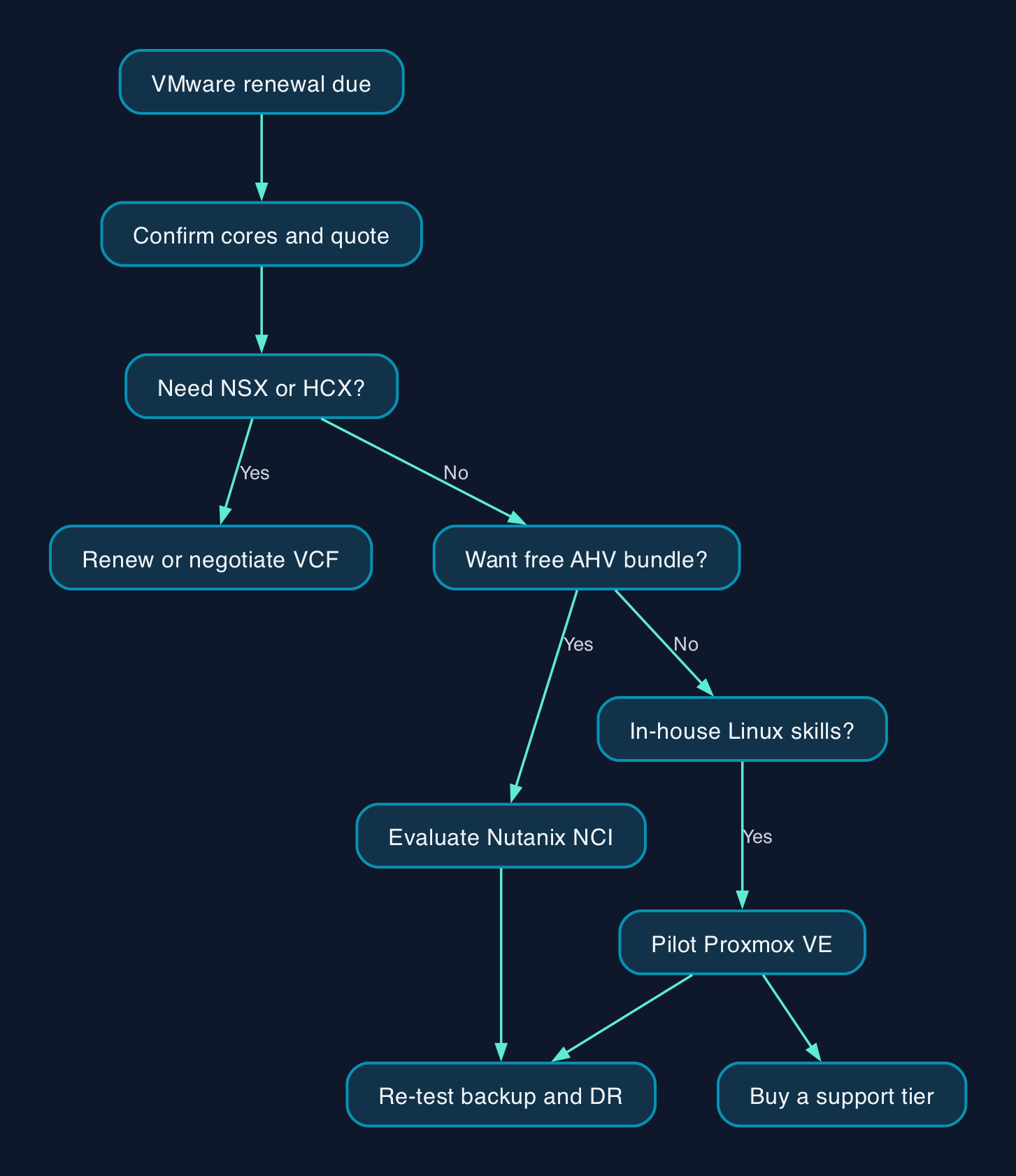
The diagram below sets out the practical decision sequence: confirm your real core count and get a written quote first, then work through what each platform actually replaces before you commit to a term.
Pricing and cost model for each route
All three platforms price differently, which is exactly why a side-by-side worked example is more useful than a single list price. Take a representative UK enterprise cluster: four hosts, each with two 16-core CPUs, giving 128 physical cores and eight CPU sockets in total.
| Route | Pricing unit | List rate | Worked annual cost for this cluster | What it includes |
|---|---|---|---|---|
| VMware Cloud Foundation (renew) | Per physical CPU core | ~$350/core/year (~£264) | 128 cores x $350 = $44,800 (~£33,819) | vSphere, vSAN (1 TiB/core), NSX, HCX, Aria Operations and Automation, all in one subscription |
| Nutanix Cloud Infrastructure, Pro edition | Per physical CPU core | Not published; quote-only | Ask Nutanix or a reseller for a written per-core rate against this exact core count | AOS storage, AHV hypervisor (free), Prism Central Pro, Flow networking, erasure coding, encryption |
| Proxmox VE, Standard support | Per CPU socket | €550/socket/year (~£471) | 8 sockets x €550 = €4,400 (~£3,772) | Full feature set including Ceph software-defined storage, SDN, distributed firewall; differs from Basic/Premium only in ticket allowance and response time |
Figures are list prices excluding VAT, converted at the European Central Bank reference rate of $1 = £0.75489 and €1 = £0.85718 on 29 September 2026 (Frankfurter/ECB). They exclude support uplift beyond the stated tier, professional services, hardware and any negotiated discount, and are not a substitute for a written quote against your actual estate.
On Nutanix, the absence of a published price is the point, not a gap in this research. Third-party benchmarking of reseller-listed contracts puts NCI Pro anywhere from roughly $130 to $650 per core per year depending on support tier and deal size, a spread wide enough that neither figure should be treated as reliable until your own reseller puts a number against your core count (CheckThat.ai; VendorBenchmark). What is verifiable is the structure: AHV is free, NCI is licensed per physical core with no published minimum order, and a 3-node cluster is the smallest supported production deployment.
On Proxmox, the Community tier at €120/socket/year (about £103) gets stable updates but only community-forum, self-service support, which most enterprises will not treat as adequate for production. Basic, at €370/socket/year, includes three support tickets a year with one-business-day response. For workloads that need faster turnaround, Standard (€550/socket/year, 4-hour response, 10 tickets) is the more realistic enterprise floor, and Premium (€1,100/socket/year, 2-hour response, unlimited tickets, 24/7 from 19 October 2026) is the closest match to VCF's always-on support expectation.
What to check before you decide
- Ask your reseller for the exact core count they will quote, the minimum rule they are applying, and whether it is 16 cores per CPU only or includes any order-level floor, in writing.
- Confirm whether your workloads actually use NSX, HCX, Aria Automation or Tanzu. If not, VMware vSphere Foundation (VVF) or a non-VMware platform may cost less without losing anything you use.
- Check whether your backup and replication tools (for example Veeam or Zerto configurations) are certified against Nutanix AHV or Proxmox VE, not just VMware ESXi, before you commit to a migration timetable.
- Ask what "24/7 support" actually covers on each platform: response time, escalation path, and whether out-of-hours cover is already live or, as with Proxmox Premium, arriving on a stated date.
- Get a 1-year, 3-year and 5-year quote for whichever platform you shortlist. Multi-year commitments typically carry a lower per-core or per-socket rate but reduce your ability to change course mid-term.
- Confirm who is doing the migration work if you switch platforms: an internal team, the incumbent reseller, or a specialist partner, and price that labour separately from the licence.
Vendor and option comparison
| Criterion | VMware Cloud Foundation (renew) | Nutanix Cloud Infrastructure (AHV) | Proxmox VE |
|---|---|---|---|
| Pricing unit | Per physical CPU core, annual subscription | Per physical CPU core, annual subscription | Per CPU socket, annual support subscription |
| Published list price | ~$350/core/year (~£264) | Not published; quote-only | €120 to €1,100/socket/year (~£103 to £943) by tier |
| Hypervisor cost | Bundled inside VCF subscription | AHV included free in every NCI edition | Included in every support tier |
| Storage included | vSAN, 1 TiB per licensed core | AOS distributed storage, edition-dependent | Ceph, included in every tier |
| Networking/security add-ons | NSX and HCX bundled into VCF (not VVF) | Flow microsegmentation on Pro and above | Built-in SDN fabrics, distributed stateful firewall |
| Migration effort if switching | None; incumbent platform | Nutanix Move, free, cross-hypervisor tool | Built-in ESXi import in the GUI and API |
| Documented minimums | 16 cores per CPU; disputed 72-core order floor | 3-node minimum for production | No published core or socket minimum |
| Admin skills | Existing VMware/vSphere skills carry over directly | Prism replaces vCenter; retraining needed | Linux/KVM familiarity helps; smaller admin talent pool than VMware |
| Best suited to | Enterprises that actively use NSX, Aria and HCX and can absorb the renewal | Enterprises wanting one bundled, quote-negotiated stack with a free hypervisor | Cost-sensitive enterprises with in-house Linux capability or a supporting partner |
No platform here is a universal winner. An enterprise running Tanzu-based Kubernetes workloads and NSX micro-segmentation loses real functionality by leaving VCF; one running simple VM estates with no software-defined networking dependency may find that functionality was never worth its share of the bill.
Editorial analysis
The most useful number in this decision is not any single vendor's list price; it is the unit each platform prices on. VMware and Nutanix both license physical CPU cores, so a hardware refresh toward higher-core-count, fewer-socket servers reduces your bill under either. Proxmox licenses sockets, so the same refresh has the opposite effect: fewer, denser servers means fewer sockets to license, and the per-socket rate does not change with core count at all. That single structural difference is worth modelling against your actual hardware roadmap before comparing headline prices.
The forced-migration framing in the query is broadly right but the specific mechanism is contested. The 16-core-per-CPU floor is documented, current and confirmed directly on Broadcom's own site. The 72-core-per-order minimum that some reporting still cites was real for roughly two weeks in April 2025 and, on Broadcom's own current guidance, is not currently documented policy. An enterprise budgeting a renewal on the assumption of a 72-core floor may be modelling a cost that no longer applies to their specific order, or may hit it anyway on some channel-specific terms nobody has confirmed. Either way, the number to build a budget from is the one your reseller puts in writing against your actual core count, not a figure from a blog post, including this one.
Sources
- Counting Cores for VMware Cloud Foundation and vSphere Foundation and TiBs for vSAN, Broadcom knowledge base article 313548
- Nutanix Licensing and Cloud Platform Software Options, Nutanix
- Nutanix Move REST API documentation, Nutanix
- Proxmox Virtual Environment Pricing, Proxmox Server Solutions GmbH
- VCF Licensing Explained: Per-Core Minimums and Budget Impact, VMware Made Simple
- Preparing for VMware Licensing Changes: A Cost and Migration Readiness Guide, NovaCloud
- Nutanix Pricing: Plans, Costs and What You'll Actually Pay, CheckThat.ai
- Nutanix Cloud Platform Pricing in 2026, VendorBenchmark
- USD/GBP and EUR/GBP reference rates, Frankfurter (ECB reference rates)
- Minimum number of ESXi hosts required on vSAN clusters for deployment of VCF Management Domain, Broadcom knowledge base article 392993