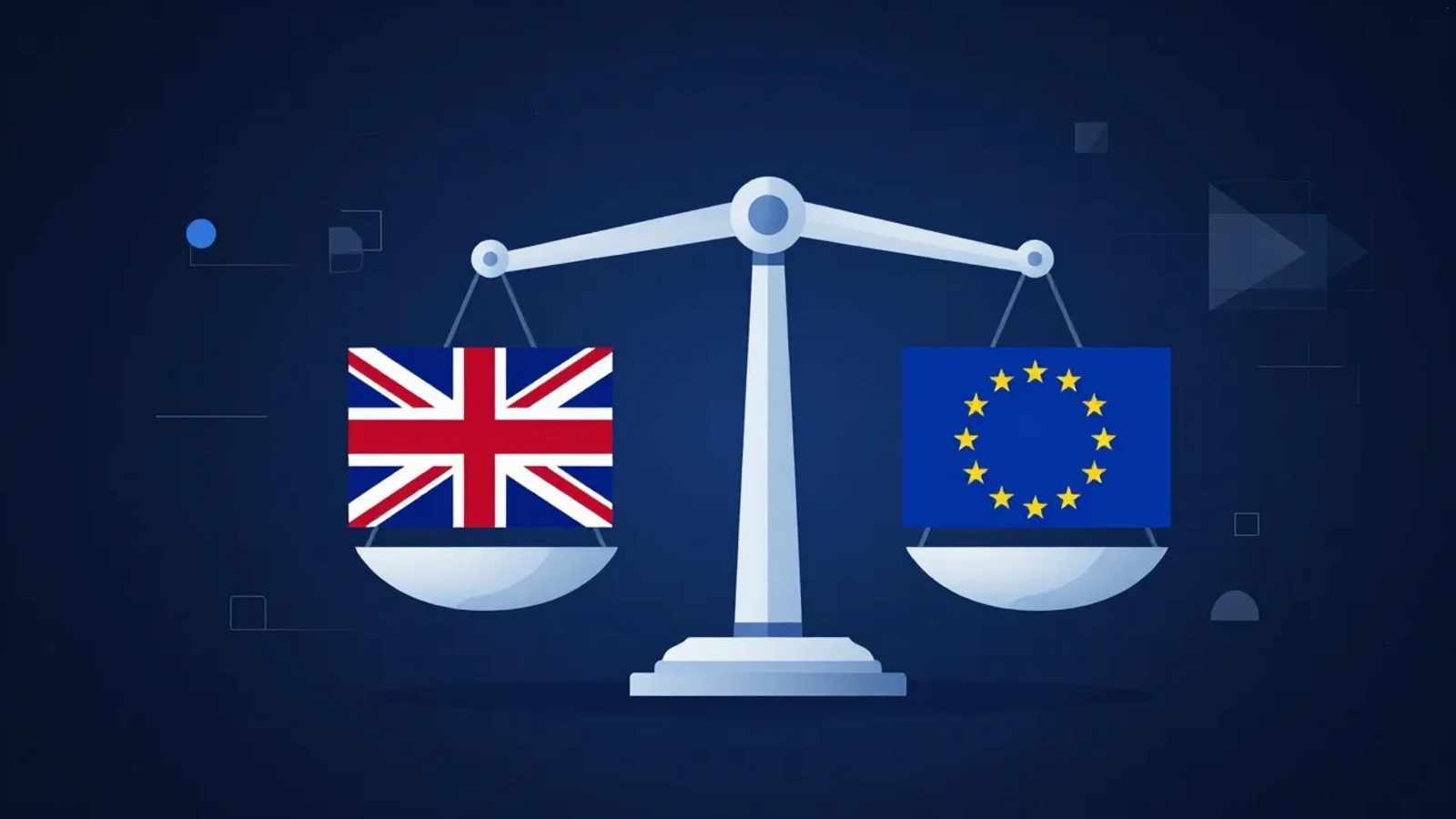

Fundamental Philosophical Differences
The UK and EU have taken fundamentally different approaches to AI regulation. The EU has enacted the world's first comprehensive horizontal AI law—the EU AI Act—with prescriptive requirements and substantial penalties. The UK, by contrast, has deliberately avoided standalone AI legislation, instead empowering existing sectoral regulators to apply principles-based guidance.
This divergence reflects post-Brexit regulatory strategy. The UK Government's AI Regulation: A Pro-Innovation Approach white paper explicitly positions the UK as a more flexible, business-friendly jurisdiction whilst the EU prioritises citizen protection through comprehensive rules.
For UK enterprises, this creates both opportunity and complexity. Domestic operations benefit from lighter-touch regulation, but any organisation serving EU customers or deploying AI affecting EU citizens must comply with the full weight of the EU AI Act.
EU AI Act — Risk-Based Prescriptive Regulation
The EU AI Act, which entered into force on 1 August 2024, establishes a tiered risk classification system with corresponding obligations.
Prohibited Practices (Effective 2 February 2025)
Eight categories of AI practices are now banned outright in the EU, including social scoring systems by public authorities, real-time remote biometric identification in public spaces (with limited exceptions), and AI that exploits vulnerabilities of specific groups.
High-Risk AI Systems
AI systems in areas such as employment, education, law enforcement, and critical infrastructure face extensive requirements including conformity assessments, technical documentation, human oversight, and registration in an EU database.
General-Purpose AI Models
Foundation models and general-purpose AI systems face transparency requirements, and those deemed to present systemic risks must undergo adversarial testing and report serious incidents to the EU AI Office.
UK Approach — Principles-Based Sectoral Regulation
The UK has adopted a fundamentally different architecture. Rather than horizontal legislation, DSIT has established five cross-sectoral principles that existing regulators (FCA, ICO, Ofcom, CMA, etc.) are expected to apply within their domains.
The Five UK AI Principles
- Safety, Security and Robustness – AI systems should function securely throughout their lifecycle
- Appropriate Transparency and Explainability – Users should understand when AI is being used and how
- Fairness – AI should not undermine legal rights or discriminate unfairly
- Accountability and Governance – Clear responsibility for AI outcomes must exist
- Contestability and Redress – Individuals should be able to challenge AI decisions
Recent UK Developments
On 13 January 2025, the UK Government launched its AI Opportunities Action Plan, focusing on economic growth through AI adoption rather than restrictive regulation. This includes AI Growth Zones, new computing infrastructure, and a National Data Library.
Significantly, in February 2025, the UK's AI Safety Institute was renamed the AI Security Institute, signalling a pivot from broad safety concerns (bias, discrimination) toward security-focused risks (weapons development, cyber threats). This aligns the UK more closely with US priorities.
The Data (Use and Access) Act, which received Royal Assent on 19 June 2025, addresses some AI-adjacent concerns but stops short of comprehensive AI regulation.
Key Regulatory Differences Comparison
Understanding the practical differences between the two regimes is essential for compliance planning:
Regulatory Structure: The EU has created a dedicated AI Office within the European Commission. The UK relies on existing sectoral regulators with DSIT providing coordination.
Legal Force: The EU AI Act is binding law with penalties up to 7% of global annual turnover. UK principles are non-binding guidance that regulators may incorporate into sector-specific rules.
Definition of AI: The UK has adopted a broader, more flexible definition designed to be future-proof. The EU definition is more technically precise but may require updates.
Risk Classification: The EU mandates specific risk categories (unacceptable, high, limited, minimal). The UK allows context-specific assessment based on actual outcomes.
Extraterritorial Reach: The EU AI Act applies to any organisation placing AI on the EU market or whose AI affects EU citizens. UK principles apply only to UK-regulated activities.
Compliance Implications for UK Enterprises
Domestic-Only Operations
Organisations operating solely within the UK face a lighter compliance burden. Focus on sector-specific regulator guidance (FCA for financial services, ICO for data protection, etc.) and align AI governance with the five DSIT principles.
EU Market Access
Any UK enterprise serving EU customers or deploying AI affecting EU citizens must comply with the EU AI Act. This includes conducting conformity assessments for high-risk systems, registering in the EU database, and ensuring AI literacy training as required from February 2025.
Dual Compliance Strategy
Enterprises operating in both jurisdictions should consider building to EU AI Act standards as the baseline, since compliance with the stricter EU requirements will generally satisfy UK principles. However, this creates additional cost for domestic-only deployments that could leverage the UK's lighter touch.
Future Outlook and Strategic Recommendations
The UK's approach remains in flux. The Artificial Intelligence (Regulation) Private Members' Bill, re-introduced in the House of Lords on 4 March 2025, would create an AI Authority with binding powers. However, the Government has signalled preference for aligning with US approaches rather than EU-style comprehensive regulation.
Recommendations for UK Enterprises
- Map your AI systems – Identify all AI deployments and classify by risk level using both UK principles and EU categories
- Assess EU exposure – Determine whether any AI systems affect EU citizens or are placed on the EU market
- Engage sector regulators – Monitor guidance from your primary UK regulator (FCA, ICO, Ofcom, etc.)
- Build flexible governance – Implement AI governance frameworks that can accommodate evolving UK and EU requirements
- Monitor legislative developments – Track the AI Regulation Bill and any Government policy announcements
The regulatory divergence between the UK and EU creates genuine strategic choices. UK enterprises must decide whether to accept the complexity of dual compliance or focus their AI deployments on one jurisdiction. For many, the answer will be determined by commercial reality: EU market access often outweighs the administrative burden of stricter compliance.