

A growing UK independent retailer should compare published rate structures, not headline percentages. Stripe charges a flat 1.5% + 20p online and 1.4% + 10p in person. Worldpay charges 1.3% + 20p online for a business with a live ecommerce site. Adyen itemises the interchange fee, its own 0.60% markup and a per-transaction charge separately, rather than blending them into one number. At realistic monthly volumes, the gap between the three runs to hundreds of pounds a month.
Key pointers
- Stripe and Worldpay publish a flat rate you can calculate before signing up. Adyen's standard pricing itemises the interchange fee, a 0.60% markup and a $0.13 per-transaction charge separately instead.
- On £15,000 of monthly online card sales at a £25 average ticket, Stripe costs about £345 a month (2.30% effective) against roughly £315 (2.10% effective) for Worldpay's Full package.
- UK-regulated consumer debit interchange is capped at 0.2% and consumer credit at 0.3%. Adding Adyen's own published 0.60% markup and its $0.13 fee, the same online volume works out at about £180 a month (1.20% effective) for debit-heavy sales.
- Worldpay only publishes online-gateway rates. Its physical card-machine pricing is individually quoted, not listed on its site.
- Adyen's minimum monthly invoice is not published; it varies by industry and business model and is only confirmed through a sales conversation, which can outweigh the lower headline rate at low volume.
- Card merchant fees are VAT-exempt in the UK, so none of the percentages below carry VAT on top.
- Commercial and business-issued cards fall outside the interchange cap, so a retailer with a lot of trade-account or company-card customers will see a higher blended rate on any of the three.
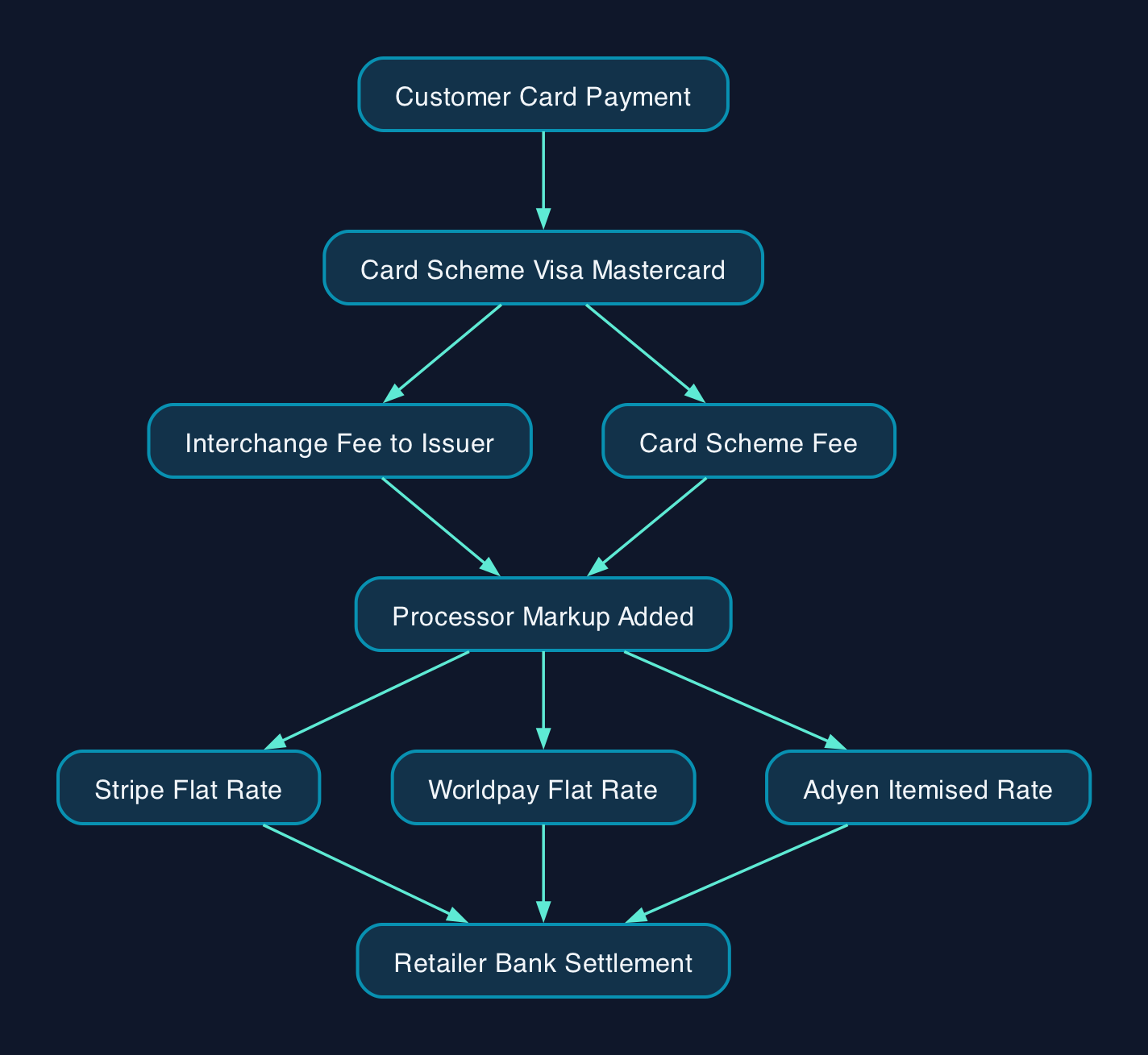
How a Card Fee Is Actually Built
Every card sale splits into pieces before it reaches a retailer's bank account: the interchange fee, set by Visa or Mastercard and paid to the customer's card-issuing bank, the card scheme's own charges, and the payment provider's markup for processing the transaction. Stripe's and Worldpay's standard, self-serve plans blend all of this into one flat percentage plus a fixed amount, so a retailer can work out the exact cost of a sale in advance without a quote. Adyen's standard published pricing itemises the pieces instead, listing a fixed $0.13 fee, the interchange rate, and its own 0.60% markup separately for Mastercard and Visa, which it calls Interchange++ pricing. Stripe and Worldpay both also offer a similar interchange-plus structure, but only as a negotiated option for larger or platform merchants, not as their standard online rate.
For a UK-issued consumer debit or credit card, the interchange piece is capped by law. The Payment Systems Regulator confirms the retained Interchange Fee Regulation "currently limit[s] interchange fees to 0.2% of the value of a transaction for consumer debit cards (including prepaid cards), and 0.3% for consumer credit cards" where the merchant, acquirer and card issuer are all UK-based. That cap does not extend to commercial or business-issued cards, which cost issuers more to process and are priced without a ceiling.
Pricing and Cost Model
Online rate, worked at real volume
A retailer taking £15,000 a month online, at a £25 average transaction (600 sales), on consumer debit cards, would pay:
| Provider | Rate | Fixed fee cost | Percentage cost | Monthly total | Effective rate |
|---|---|---|---|---|---|
| Stripe, standard UK cards online | 1.5% + 20p | £120 (600 x 20p) | £225 (1.5% of £15,000) | £345 | 2.30% |
| Worldpay eCommerce, Full package | 1.3% + 20p | £120 | £195 (1.3% of £15,000) | £315 | 2.10% |
| Adyen, published Mastercard/Visa list price | $0.13 + capped 0.2% debit interchange + 0.60% markup | £60 (600 x 10p, converted from $0.13 at the 29 September 2026 USD/GBP reference rate of 0.75489) | £120 (0.8% of £15,000: 0.2% capped interchange plus Adyen's 0.60% markup) | £180 | 1.20% |
The Adyen figure uses its published Mastercard and Visa list price, the capped interchange rate for consumer debit cards, and the current USD to GBP reference rate, not a confirmed quote. Adyen does not publish the minimum monthly invoice it applies on top, which "varies by industry or business model" and is confirmed only through its sales team. That minimum invoice, not the itemised rate itself, is what decides whether Adyen actually beats a flat-rate provider at a given retailer's real volume. A card mix weighted more towards consumer credit, which carries a 0.3% capped interchange rate instead of 0.2%, would add roughly £15 to the Adyen total above.
In-person rate
Stripe is the only one of the three that publishes a flat in-person rate on its website. On £10,000 of monthly card-machine sales at a £25 average ticket (400 sales), Stripe Terminal's published 1.4% + 10p works out at £180 a month (£140 on the percentage, £40 on the fixed fee), an effective rate of 1.80%. Worldpay's card-machine pricing has "no upfront cost, and pricing is tailored to your business depending on your payment needs", with no percentage published on the site. Adyen does not publish a separate in-person figure either; its Interchange++ pricing applies per transaction regardless of channel, so a written quote is the only way to confirm the in-person total.
Assumptions
The £15,000 online and £10,000 in-person monthly figures, the £25 average transaction, and the debit-heavy card mix are illustrative assumptions for this article, not a specific retailer's real trading figures. A retailer with a higher average transaction size will see the fixed-fee element shrink relative to sales, narrowing the gap between all three providers, because the fixed pence-per-transaction charge matters less as ticket size rises.
Vendor and Option Comparison
| Criterion | Stripe | Worldpay | Adyen |
|---|---|---|---|
| Online rate | Published flat rate, 1.5% + 20p standard UK cards | Published flat rate, 1.3% + 20p (Full package) or 1.5% + 20p (Essential package) | Published itemised rate: $0.13 plus interchange plus a 0.60% markup for Mastercard and Visa |
| In-person rate | Published flat rate, 1.4% + 10p (EEA-issued cards via Stripe Terminal) | Not published; individually quoted card-machine pricing | Not published as a separate figure; same itemised model applies |
| Monthly or setup fee | None on standard Payments plan | None on standard pay-as-you-go plan | None, but a minimum invoice applies, amount confirmed only by Adyen's sales team |
| Onboarding | Self-serve sign-up | Self-serve for the online gateway; card machines are quoted individually | Sales-led; Adyen asks a business to speak to its sales team rather than self-signup |
| Best suited to | A retailer that wants to calculate its exact card-processing cost before it takes its first sale | A retailer already running or about to launch a live ecommerce site, taking mostly consumer Visa and Mastercard | A retailer with steady, predictable monthly volume that wants the itemised formula, and is prepared to confirm the minimum invoice by quote |
| Who should not choose it | A retailer whose volume is high and steady enough that a lower itemised rate would clearly beat 1.5% + 20p once confirmed | A retailer that wants the lowest possible in-person rate confirmed on the website before applying | A retailer with low or unpredictable volume, where an unconfirmed minimum invoice could erase the itemised rate's advantage |
None of the three is a universal winner. A retailer with modest or unpredictable online volume is better served by a published flat rate it can check against its own invoices without a sales call. A retailer with steady, higher volume and the time to review an itemised statement each month has more room to benefit from Adyen's published formula, provided the minimum invoice does not cancel out the saving.
Editorial analysis
The three providers are not really competing on the same axis. Stripe and Worldpay compete on how low a flat rate they can publish and let a business sign up to immediately. Adyen competes on itemised pricing tied to the actual interchange rate, which this article's modelled £15,000 online volume shows working out cheaper before any minimum invoice is added. That caveat matters: Adyen does not publish the minimum invoice, so the modelled 1.20% effective rate is not a guaranteed final cost, only the published formula applied to an assumption. For a retailer still working out its monthly card volume, or one that wants to model a cost before signing a contract, the flat-rate providers remain the easier starting point, because every number needed is already on the page. Adyen's model is worth the sales conversation once a retailer's volume is large and stable enough to be confident the minimum invoice will not outweigh the rate advantage.
Sources
- Stripe UK pricing and fees - Stripe
- Adyen pricing for supported payment methods - Adyen
- Worldpay eCommerce pricing - Worldpay
- Worldpay card machines - Worldpay
- HMRC VAT Finance Manual, VATFIN3160 - HMRC
- The IFR, interchange fee caps - Payment Systems Regulator
- USD to GBP reference rate, 29 September 2026 - Frankfurter, European Central Bank reference rates
- Getting Your Small Business Online, UK E-commerce and Digital Presence Guide - Compare the Cloud