


Self-host Qdrant or Weaviate if you want an exit route and your own choice of region from day one; use managed Pinecone if nobody on your team wants to run infrastructure. Pinecone Builder costs $20 a month flat, while Weaviate Flex starts at $45 and Premium offers prepaid contracts with predictable spend. Qdrant's $85 example bill is an illustration, not a starting price; its actual bill depends on your cluster size.
Key pointers
- Pinecone Builder costs $20 a month flat; Weaviate Premium also offers predictable spend through prepaid contracts.
- Qdrant Cloud publishes no fixed price; ask any Qdrant sales contact for a quote against your expected vCPU, RAM and disk, not just vector count.
- Weaviate's Free plan is genuinely free forever, but it caps out at 100,000 objects, 1GB memory and 10GB disk, and only runs on AWS in two regions.
- Only Pinecone's free Starter plan is pinned to `us-east-1`; every paid Pinecone tier, including Builder at $20 a month, now offers a full choice of available AWS, Azure or GCP regions.
- Qdrant is Apache-2.0 licensed end to end; Weaviate's core is BSD-3-Clause, while features under the separate Weaviate licence require a licence key.
- Pinecone Enterprise offers BYOC with its data plane in your own AWS, GCP or Azure account and a Pinecone-managed control plane; Pinecone Local is a Docker emulator for development only.
- For a B2B service supplied by a non-UK supplier, reverse-charge treatment depends on where the supplier and customer belong and whether HMRC's conditions are met, not the billing currency.
- If cost predictability matters more than a polished console, ask whether your workload fits any of the three vendors' free tiers before paying for anything.
What Self-Host Versus Managed Actually Means Here
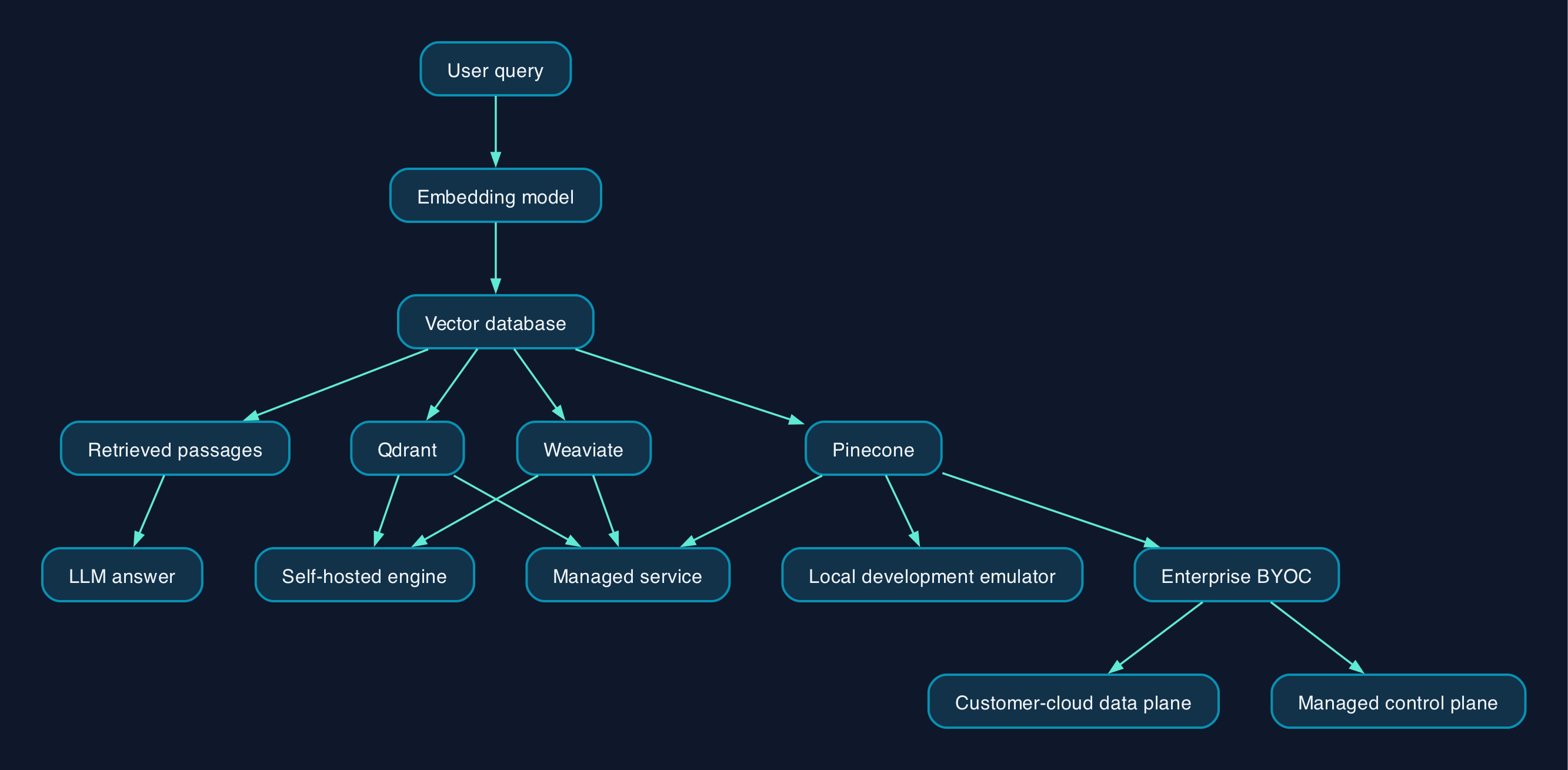
A RAG chatbot has three moving parts a founding engineer has to own: the embedding step that turns text into vectors, the vector database that stores and searches those vectors, and the language model that turns a retrieved passage into an answer. This article is about the middle piece only.
Pinecone, Qdrant and Weaviate all solve the same core problem: given a query embedding, find the nearest stored embeddings fast. Where they differ is who runs the database and what you can do if you want to stop paying them.
Pinecone is a managed service, but it has both local development and customer-cloud deployment options. Pinecone Local is downloadable as a Docker image for development and testing without connecting to a Pinecone account. It is an in-memory emulator, not the production engine, and its records do not persist after it stops. Enterprise customers can use Pinecone BYOC to deploy the data plane in their own AWS, GCP or Azure account while retaining Pinecone's managed control plane.
Qdrant and Weaviate are open-source engines with managed clouds layered on top. The managed bill is a convenience charge, not the only door. You can run either one in Docker on a laptop, in CI, on a server you own, or pay the vendor to run it for you, and the client code your application uses stays the same either way. That matters for a founding engineer more than most feature comparisons, because the decision that is expensive to reverse is not which features you use, it is whether you can leave.
Pricing and Cost Model
Every price below is quoted in US dollars, as published by the vendors, as of 30 September 2026. Your GBP cost depends on the exchange rate and billing arrangements.
Pinecone charges for storage plus read and write units. Its four tiers are Starter (free, up to 2GB storage, capped read/write units, AWS `us-east-1` only), Builder ($20 a month flat, up to 10GB storage, higher caps, full choice of available AWS, Azure or GCP regions), Standard ($50 a month minimum usage, unlimited storage at $0.33 per GB per month, any available AWS, Azure or GCP region), and Enterprise ($500 a month minimum usage, 99.95% uptime SLA, Bring Your Own Cloud, private endpoints). Storage and other usage charges count towards the Standard and Enterprise minimums: Pinecone's cost documentation gives a Standard example where $20 of usage produces a $50 bill, while $100 of usage produces a $100 bill. Builder usage beyond its included limits is blocked rather than billed. Import from object storage costs $0.25 per GB, backups $0.10 per GB per month, and restores $0.15 per GB, all on Standard and Enterprise. Region choice is the one place the free tier is genuinely restrictive: only the paid tiers give you anything outside AWS `us-east-1`.
Qdrant Cloud has a genuinely free forever tier (0.5 vCPU, 1GB RAM, 4GB disk, single node) and then meters paid clusters by vCPU, memory and storage, billed hourly. Qdrant's own pricing page does not publish a per-unit rate; it sends you to a calculator. Its billing documentation gives one worked example instead: a cluster that costs $85 in a month, converted to 8,500 Resource Usage Units if you pay through a cloud marketplace. Treat that $85 as an illustration of how the bill is built, not a quote for your workload; the actual number depends on the vCPU, RAM and disk you provision.
Weaviate Cloud has a genuinely free forever plan: $0 a month, one cluster per user, up to 100,000 objects, 1GB memory and 10GB disk, one collection with up to three tenants, on AWS in two regions only. Beyond those limits, Flex starts at a $45-a-month minimum, covering vector-dimension usage from $0.00465 per million dimensions and storage from $0.12 per GiB, on AWS or GCP in seven regions. Weaviate's current Premium card and comparison table require contacting sales, so the FAQ's $400 figure should not be treated as a current published minimum. Premium offers prepaid contracts with predictable spend and a choice of shared or dedicated deployment. Its dimension rates start lower, at $0.003875 per million shared or $0.002718 per million dedicated; shared storage starts at $0.10 per GiB, while dedicated storage starts at $0.1505 per GiB, above Flex's starting rate. Premium Shared uses AWS or GCP across seven regions; Premium Dedicated adds Azure and offers approximately 40 regions. The dimension metric is worth watching: it scales with vector count multiplied by embedding width, so a heavier embedding model raises the bill even with the same number of documents.
For a modest, steady workload past a free tier's caps, Pinecone Builder's $20 flat fee is below Weaviate Flex's $45 minimum, provided the workload fits Builder's limits. Qdrant's $85 example cannot establish its position in that comparison: obtain a price for the cluster you actually need. Weaviate Premium's prepaid contracts provide another route to predictable spend, with pricing agreed through sales.
If you'd rather run the database yourself, Qdrant's Apache-2.0 licence and Weaviate's BSD-3-Clause core mean the open-source software itself is free; you still pay for infrastructure and operations. Weaviate's repository licence places code in the `wl` directory under the separate Weaviate licence and requires a licence key to enable those features; it does not establish that the key must be paid for, so check the terms for the features you need. Pinecone offers a different arrangement: Enterprise BYOC places its production data plane in your cloud account, with Pinecone continuing to manage the control plane, upgrades, scaling and maintenance. Pinecone Local is for development and testing, not a production self-hosting alternative.
For a B2B service supplied by a non-UK supplier to a UK business, the reverse charge applies when HMRC's conditions are met. The suppliers are not uniformly US-based: Qdrant's service agreement names Qdrant Solutions GmbH in Germany. Under HMRC's reverse charge rules, the supplier must belong outside the UK, the business customer must belong in the UK, and the non-exempt service must have a UK place of supply; the requirement for existing UK VAT registration applies specifically to services outside the B2B general rule. For general-rule services received from overseas, an unregistered UK business must include their value when assessing its VAT registration liability, and those purchases can themselves trigger registration, as HMRC's guidance explains. Where the reverse charge applies, you account for the output tax yourself and may reclaim it as input tax, subject to the normal recovery rules; the supplier does not account for UK output tax on that supply. Confirm this with your accountant before you set up billing: the treatment depends on where the supplier and customer belong, not the billing currency.
Self-Hosting Qdrant or Weaviate Versus Managed Pinecone
| Criterion | Pinecone | Qdrant | Weaviate |
|---|---|---|---|
| Hosting model | Managed service; Enterprise BYOC; local Docker emulator for development only | Open source, self-host or managed cloud | Open source core, self-host or managed cloud |
| Licence | Proprietary | Apache-2.0 | BSD-3-Clause core; features under the separate Weaviate licence require a licence key |
| Free tier | Free Starter plan, `us-east-1` only | Free Tier, forever, with limited provider and region choices | Free plan, forever, capped at 100,000 objects, AWS only (2 regions) |
| Cheapest paid plan | Builder, $20/month flat | No published flat rate; quote depends on cluster resources | Flex, from $45/month |
| Region choice | Free tier: `us-east-1` only. Builder and above: all available AWS/Azure/GCP regions | Free Tier choices are limited; Standard offers a broad choice across AWS, Azure and GCP | Free: AWS, 2 regions. Flex and Premium Shared: AWS or GCP, 7 regions. Premium Dedicated: AWS, GCP or Azure, approximately 40 regions |
| Filtering | Metadata filtering, less visibility into index interaction | Pre-filtering, dense and sparse vectors, several sparse encoders | Pre-filtering, native BM25 and BM25F hybrid search |
| Exit if you outgrow it | Enterprise BYOC keeps Pinecone in your cloud account; leaving the engine requires adapting retrieval code | Export or point the same client at a self-hosted cluster | Export or point the same client at a self-hosted cluster |
Qdrant's cluster documentation explicitly limits free-tier provider and region choice; it does not establish that a UK or EU region is available free. The pre-filtering comparison is described in Layerbase's assessment of the three engines.
None of the three is a universal winner. Choose Pinecone if nobody on your team wants to run infrastructure; Builder's flat $20 is straightforward to budget for within its limits, and unlike the free Starter plan it isn't pinned to a US region. Enterprise BYOC provides a route to running the data plane in your own cloud account while retaining the managed service. Choose Qdrant if you want to keep the exit door open, need to control where the data physically sits from day one through self-hosting, or would rather start on a free tier while you validate the product. Choose Weaviate if hybrid keyword-plus-vector search is closer to your actual product than a nice-to-have, and either its free-plan limits or the $45-a-month Flex floor fits your current scale; Premium offers prepaid contracts where predictable spend matters.
Editorial analysis
A founding engineer with no dedicated infrastructure hire should weight the exit question above the entry price. Pinecone's $20 Builder fee and Weaviate's $45 Flex minimum are published entry points; Qdrant's $85 example is not a comparable starting price. Pinecone Local supports local development, and Enterprise BYOC puts the data plane in your cloud account, but neither provides an independently operated open-source production engine. Moving away from Pinecone therefore requires adapting the retrieval integration to another engine, while Qdrant and Weaviate allow you to retain their engine when moving between managed and self-hosted deployments. For a chatbot that is still being validated, testing the actual workload against each free tier's limits is a reasonable way to defer infrastructure commitments until the product has real usage.
Sources
- Pinecone pricing
- Understanding Pinecone cost
- Local development with Pinecone Local
- Pinecone Bring Your Own Cloud
- Qdrant cloud and vector database pricing
- Qdrant billing and payments
- Creating a Qdrant Cloud cluster
- Weaviate vector database pricing
- Qdrant Apache-2.0 licence
- Weaviate repository licensing
- Qdrant Cloud service agreement
- HMRC reverse charge rules for services
- HMRC place of supply of services and reverse charge guidance
- Layerbase comparison of Pinecone, Weaviate and Qdrant