
The UK's analogue phone network switches off on 31 January 2027, and in July 2026 Openreach said about 1.5 million lines had still not moved to a digital service, including roughly 350,000 serving business premises. The phones themselves are the easy part. The harder question, and the one most of the switch-off coverage skips, is what happens to everything else that quietly rides on those lines: lift emergency phones, fire and intruder alarm signalling, telecare units, door entry systems, card terminals, franking machines, fax lines, CCTV connections and the last of the copper broadband. This article sets out what is happening and when, what stops working, how to find out what you actually have, and a checklist for the months that remain.
What is happening to the PSTN and when
BT Group is retiring the public switched telephone network (PSTN), the analogue system that has carried UK landline calls for over a century, on 31 January 2027, and Openreach is withdrawing every wholesale product that depends on it, grouped under the umbrella of Wholesale Line Rental (WLR). Every analogue phone line in the country, whichever provider bills for it, sits on this infrastructure or on a parallel network being retired on a similar timescale.
The network is being retired because it is worn out, not because anyone wants the upheaval. Spare parts and the engineering skills to maintain analogue exchanges are increasingly scarce; guidance from the Department for Science, Innovation and Technology records Ofcom's finding that service hours lost to customers on the PSTN rose 60 per cent in 2023 compared with 2022 as faults became harder to fix. Openreach said in a June 2026 interview that the PSTN still accounts for roughly 1 per cent of British energy usage, a century-old network burning power to serve a shrinking fraction of its former load. The replacement, voice carried over broadband, known as VoIP or all-IP, is cheaper to run, easier to maintain and comes with features analogue lines never had.
The date has moved once and, on every recent statement, will not move again. The milestones so far:
| Date | Milestone |
|---|---|
| 2017 | Industry announces its intention to retire the PSTN, originally by December 2025 |
| 5 September 2023 | National "stop sell", Openreach stops taking new orders for WLR analogue lines and the broadband products that ride on them |
| December 2023 | The government's PSTN Charter, major providers commit to protections for telecare users and vulnerable customers |
| May 2024 | BT confirms the revised switch-off date of 31 January 2027, largely over telecare safety concerns |
| September 2025 | Openreach launches its Prove Telecare service and a temporary analogue-style stopgap product for lines that cannot yet move |
| 1 April 2026 | Wholesale WLR rental rises 20 per cent |
| 1 July 2026 | A further rise of 40 per cent |
| 1 October 2026 | A final 40 per cent rise, doubling legacy line rental against 2025 rates |
| 3 August 2026 | Openreach begins piloting Emergency Voice Access, a voice-only fallback, in Salisbury and Mildenhall |
| 31 January 2027 | PSTN retired; WLR products withdrawn |
The price escalator deserves attention on its own. Openreach's price notice set the basic WLR rental at £10.65 a month before the increases began; by 1 October 2026 the cumulative rises will have doubled it against 2025 rates. In February 2026 Openreach stated plainly that in some cases it is already cheaper to be on the new all-IP products than to remain on old WLR services. Staying put now costs more than moving.
Ofcom wrote to industry in January 2026 setting out its expectations for the final phase of migration, and Openreach's director of all-IP, James Lilley, said in July 2026 that "the PSTN switch-off is now just six months away and there is no extension to the deadline". In February 2026 Openreach confirmed that all technical barriers to migration, including protections for vulnerable telecare users, had been resolved and the deadline was locked.
How many analogue lines are still to migrate
Openreach's July 2026 update put the number of lines still on legacy copper at about 1.5 million, of which roughly 350,000 serve business premises. The programme started with more than 16 million WLR lines to move, so the overwhelming majority of the country has already switched, but the remainder is falling at a pace that leaves little slack before January 2027.
The run-down through 2026, from Openreach's own statements: roughly 2.8 million lines in February, about 2.5 million in April, 1.9 million in June and 1.5 million by late July. In April 2026 the migration was running at around 44,000 lines a week; even at that pace, Openreach acknowledged in June 2026 that some lines, probably in the high tens of thousands, will still be live when the deadline arrives.
The pattern in who remains matters more than the raw count. Openreach has said the last lines tend to belong to customers who do not want to move or who have "more niche products" on the end of the line, which is precisely the non-phone estate this article is about. A business that has not been contacted about migration is not safe; it is more likely to be with a smaller or slower provider, and Openreach's advice in February 2026 was blunt: if your provider has not contacted you, ask why.
What stops working when the PSTN is switched off
Anything delivered over an analogue WLR line stops working when the line is withdrawn. That covers three groups: voice, broadband, and the connected devices most businesses have forgotten they own.
Voice. Analogue single lines and multi-lines go, and so does ISDN, the digital-over-copper service many older phone systems (PBXs) still use for trunks. A phone system with ISDN30 trunks needs SIP trunks or a hosted replacement before the deadline.
Broadband. Copper broadband that requires a phone line ceases too. ADSL ends with the PSTN. FTTC (fibre to the cabinet) sold as an add-on to a WLR phone line also ends, though the same street cabinet technology lives on as SOGEA, a standalone product that delivers the broadband without the analogue phone service. A business on FTTC does not lose its broadband technology; it loses the analogue line the service was sold on top of, and needs re-providing on SOGEA or, better, full fibre.
The forgotten estate. This is where the practical risk sits, because these devices were installed by different contractors, appear on different budgets, and often are not in anyone's IT inventory:
| Device estate | Why it is on the PSTN | Who to ask |
|---|---|---|
| Lift emergency phones | Lifts must connect trapped passengers to a 24-hour answering service; the line is usually a dedicated analogue circuit in the lift motor room | Lift maintenance contractor |
| Fire alarm signalling | Older digital communicators dial an alarm receiving centre (ARC) over an analogue line when the panel triggers | Fire alarm maintainer and ARC |
| Intruder alarms | Same pattern, a dialler or dual-path signalling unit with a PSTN path | Alarm company and ARC |
| Telecare and warden call | Pendant alarms and monitored care systems dial a monitoring centre over analogue tones that do not always survive VoIP conversion | Telecare service provider |
| Door entry and access control | Entry panels in older buildings dial a concierge or resident over a phone line | Door entry installer or managing agent |
| Card terminals and EPOS | Older payment terminals authorise transactions over a dial-up analogue connection | Payment provider |
| Franking machines | Many re-credit and update over an analogue line | Franking machine supplier |
| Fax | Entirely PSTN-dependent; needs an online fax service or retirement | Whoever still admits to using it |
| CCTV and building systems | Legacy CCTV, building management systems and monitoring kit with dial-out alerting | Installer or facilities contractor |
The scale is not hypothetical. In February 2026 Openreach said its data showed more than 12,000 lift lines and around 500 lines serving CCTV networks still needed to be upgraded, and those are only the lines Openreach can identify as such. Many special-purpose lines are recorded simply as ordinary analogue circuits, invisible until they go quiet.
A warning on adapters: plugging an analogue device into an adapter port on a router (an analogue terminal adapter, or ATA) often works for a phone or fax, but alarm and telecare signalling uses tones that are not guaranteed to survive the conversion to VoIP. Openreach offers free compatibility testing at its test labs precisely because "it rings" is not the same as "it signals correctly at 3am when the panel triggers". Devices that protect life, lift phones, fire signalling, telecare, should be tested or replaced with equipment designed for IP or mobile signalling, not quietly bridged.
What happens to a line that has not migrated by January 2027
For a business line, the sequence is escalating cost and then withdrawal. Openreach's February 2026 statement said that providers and businesses that fail to migrate "will face these higher charges before losing service altogether as the network is phased out", the doubling of wholesale rental by 1 October 2026 lands first, and the service itself follows the network into retirement after 31 January 2027.
Residential lines get a softer landing. Openreach's senior manager for all-IP migrations, Juliette Scott, said in June 2026 that there "won't be a big bang on 1 February 2027" for consumers, and from 3 August 2026 Openreach is piloting Emergency Voice Access (EVAc), a temporary, voice-only fallback for unmigrated lines. in the Salisbury and Mildenhall exchange areas. EVAc carries no broadband, and lines flagged as serving critical national infrastructure or vulnerable customers are handled through separate processes. Business lines are not covered by that fallback. A business that reaches February 2027 on analogue should expect loss of service, not a grace period.
There is one legitimate stopgap: in September 2025 Openreach introduced a temporary analogue-style product (Pre-Digital Phone Lines) for lines that genuinely cannot yet move. It is arranged through your provider, intended as a bridge rather than a destination, and does not remove the need to migrate.
How to find out what you have - the line audit
Start from the money, not the technology: gather twelve months of telecoms bills across every site, cost centre and service charge, and list every line rental you are paying, because a line that is billed exists even if nobody can say what it does. Most businesses that run this exercise find lines they did not know they had, the fax number from two office moves ago, the lift line billed to facilities, the alarm circuit inside a maintenance contract.
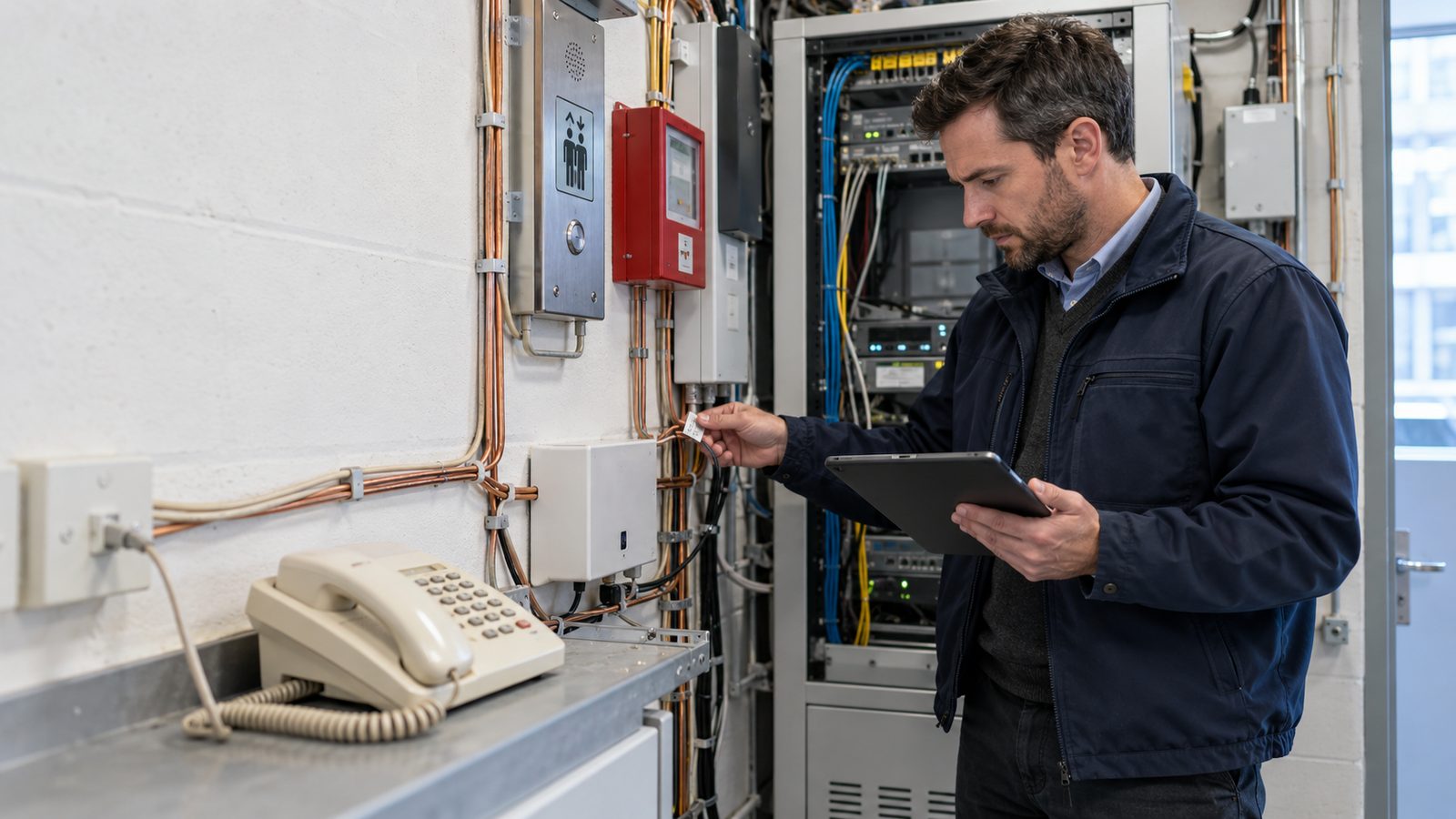
Then walk the estate. Check comms rooms, risers, lift motor rooms, plant rooms, reception desks and back offices for phone sockets with anything plugged into them. If the audit takes you into the comms cupboard, it is worth knowing what else lives there, our small office server guide covers the rest of a typical small-business comms room.
Third, ask every maintainer in writing. Your lift contractor, fire alarm company, alarm receiving centre, telecare provider, payment provider and franking supplier each know whether their equipment signals over an analogue line and what their supported migration path is. This is a coordination job across several suppliers, and the failure mode is each one assuming another is handling it, the same gap we described in making a multi-vendor IT arrangement work without gaps between providers. Name one owner for the switch-off inside your business and give them a deadline well before January.
Finally, test before you trust. Openreach runs free compatibility testing at its test labs for equipment that needs to work over all-IP networks, and its own advice to businesses is a three-step process: review your assets, test the equipment, switch to a digital service. If you are unsure whether a line or device is affected, ask your service provider, do not assume you are safe.
What are the migration options
The requirement decides the product; there is no single right answer.
For phone service, the mainstream replacement is hosted VoIP, telephony delivered over broadband, bought per user per month, with the phone system running in the provider's cloud. Businesses with a PBX they want to keep can replace ISDN trunks with SIP trunks instead. Hosted seats are a recurring per-user cost, so benchmark them the way you would any per-user service, our MSP pricing and procurement benchmarking guide covers how UK buyers compare per-user-per-month pricing. Before signing, read the contract with the same eye you would apply to any IT support agreement, the red flags are the same: hidden costs, weak SLAs and painful exit clauses. Consumer and micro-business lines are typically moved to the provider's own digital voice service, with the handset plugged into the router.
For broadband, a business losing ADSL or WLR-based FTTC needs SOGEA (the same cabinet broadband without the analogue line) or full fibre (FTTP) where it has been built. Full fibre is available from Openreach and from alternative network providers, the altnets, which have built their own fibre in many towns and cities; the digital migration applies to them too, and operators including Openreach, CityFibre and CommunityFibre signed a Network Operator Charter in March 2024 committing to protections for telecare customers during the upgrade. Where several providers have built, compare on coverage at your address, contract terms and service levels.
For the device estate, the honest answer is device by device. Modern lift alarms, fire and intruder signalling units and telecare hubs are available with mobile (4G/5G) signalling, IP signalling, or dual-path combinations of the two, which removes the dependency on any fixed line and is the route most maintainers now recommend for life-safety equipment. Simpler devices, a fax, an older phone in a store room, can often run through an ATA, tested first. Card terminals and franking machines generally have straightforward IP or mobile replacements from the same supplier. Number porting is routine: existing numbers move to the new service.
Plan for power. An analogue phone drew its power from the exchange and worked in a blackout; a VoIP phone works only as long as the router and switch have power. Ofcom requires providers to offer customers who depend on their landline a free solution, battery back-up or equivalent, giving at least one hour of access to emergency services in a power cut, and the PSTN Charter signatories have committed to work beyond that minimum. For a business, one hour is a floor, not a plan: put the router, switch and any signalling equipment on a UPS sized for a realistic outage, and fold the scenario into the same thinking as your backup and disaster recovery planning.
What protections exist for telecare and vulnerable users
The strongest protections in the migration apply to telecare users, and they bind the providers rather than the customer. Under the PSTN Charter, agreed with the government in December 2023 and updated on 22 January 2026, the major providers committed that no telecare users will be migrated to digital landlines without the provider, the customer or the telecare company confirming a compatible and functioning telecare solution is in place, and that non-voluntary migrations would not proceed without confidence that vulnerable people are protected. A Telecare Action Board of around 30 organisations from government, telecare and the regulated sector has operated since January 2024 to identify and protect these users.
The population affected is large: the Local Government Association estimates 1.8 million people in the UK use telecare services, many connected through council adult social care or housing services. Openreach's contribution is its Prove Telecare service, launched in September 2025, which lets providers confirm a telecare device works before a line is migrated, the barrier Openreach credits with clearing the way to lock the 2027 date.
Care operators should read these protections precisely. The charter binds communications providers on how customers are migrated; it does not migrate anyone's equipment for them. A care home, sheltered housing scheme or housing association still owns the job of confirming with its telecare and nurse-call suppliers that every device has a tested digital or mobile pat, the protections buy an orderly migration, not an exemption from it.
Which sectors carry the most exposure
Hospitality concentrates the problem in older buildings: card terminals in the bar, a lift installed decades ago, guest-room phones on an analogue PBX, a fire panel dialling an ARC, and a franking machine in the office. Seasonal trading makes the timing awkward, a hotel that ignores this until December faces engineer lead times colliding with its busiest period and a hard deadline five weeks later.
Property and building management has the widest surface: lift lines, door entry, fire and intruder signalling, sprinkler and plant monitoring across a portfolio. Multi-tenant buildings add an ownership trap, the line serving the lift or the entry panel may be billed to the freeholder, the managing agent or a service charge account nobody reviews, and each party may assume it is someone else's problem. The Openreach figure of more than 12,000 unmigrated lift lines in February 2026 is, in practice, a property management statistic.
Care settings combine the telecare estate with everything above, lift lines, fire signalling, door entry, under a regulator that expects continuity of resident safety systems. The charter protections cover how lines are migrated; the operator still has to drive its equipment suppliers to a tested solution, and should start with the telecare provider rather than the phone company.
Retail is a multi-site version of the same audit: a legacy alarm line, an EPOS or card terminal connection and sometimes an ADSL circuit in each branch, often inherited through acquisitions and recorded nowhere. Multiply a modest per-site fix by an estate and it becomes a programme with procurement lead times.
For the MSPs and IT providers who serve these sectors, the switch-off is a service opportunity hiding in plain sight, the line audit, migration project and ongoing hosted telephony are exactly the kind of recurring, outcome-based work we have argued MSPs should be selling instead of chasing hardware margin.
The checklist before January 2027
This month
- Name one owner for the switch-off in your business, with authority across IT, facilities and finance.
- Pull twelve months of telecoms bills for every site and cost centre; list every line rental you pay.
- Ask your provider, in writing, which of your services are WLR-based and what their migration plan and date for you is. If they have not contacted you, treat that as a warning sign in itself.
- Walk every site: comms rooms, lift motor rooms, plant rooms, receptions. Record every phone socket with something plugged into it.
By autumn 2026
- Write to every maintainer - lift, fire, intruder, telecare, door entry, EPOS, franking, asking what of theirs signals over analogue lines and what their supported replacement is. Set a reply deadline.
- Decide the voice replacement: hosted VoIP seats, SIP trunks to an existing PBX, or the provider's digital voice service for simple lines. Benchmark per-user pricing and check contract exit terms before signing.
- Re-provide any ADSL or WLR-based FTTC broadband on SOGEA or full fibre. Order early, engineer visits are the bottleneck, and Openreach has warned that waiting shrinks the pool of available appointments.
- Move life-safety signalling, lift phones, fire and intruder ARC paths, telecare, to IP, mobile or dual-path equipment through the maintainer. Do not bridge these through an ATA untested; use Openreach's free test labs where compatibility is uncertain.
- Specify battery back-up: UPS for routers, switches and signalling kit, sized for a realistic power cut, not the one-hour regulatory floor.
Before 31 January 2027
- Test everything end to end: make the lift phone call the answering service, trigger a test signal from the fire and intruder panels to the ARC, run a telecare test call, take a card payment, send whatever still gets faxed.
- Port your numbers to the new service and confirm the old WLR lines are ceased, a line that quietly keeps billing is money down the drain, and a line you forgot is a device you forgot.
- Update your continuity plan: note what now depends on broadband and power, and what the fallback is (mobile signalling, UPS run-time, a second connection) if either fails.
A business that completes steps 1 to 4 this month will find the rest is a manageable procurement exercise. A business that starts in December 2026 will be negotiating for engineer appointments everyone else booked first, five weeks before the network it depends on is switched off.
Sources
This article draws on Openreach's public statements on the PSTN switch-off, principally its February 2026 statement (which carries the 2.8 million remaining-lines figure, the lift and CCTV line counts, the WLR price schedule and the Review, Test, Switch guidance) and its July 2026 update putting remaining lines at 1.5 million; Openreach's June 2026 interview remarks on the closing months of the programme; Ofcom's guidance on moving landline phones to digital technology, including its rules on emergency access and power-cut resilience; the Department for Science, Innovation and Technology's guidance on the UK transition from analogue to digital landlines and the Public Switched Telephone Network Charter of December 2023, updated 22 January 2026; BT Wholesale's stop-sell notices; and the Local Government Association's briefing on telecare. Figures are dated in the text; line counts change monthly and were current at the dates given.