The Question Nobody Wants to Answer
Imagine walking into the office tomorrow and everything is gone. Customer records. Invoices. That proposal you've been working on. Years of emails. All of it.
Could you recover? How long would it take? Would your business survive?
According to the UK government's Cyber Security Breaches Survey, 32% of businesses experienced a cyber attack in the past year. Ransomware—where criminals encrypt your files and demand payment—is increasingly targeting small businesses precisely because they often don't have proper backups.
But it's not just hackers. Hard drives fail. Laptops get stolen. Coffee gets spilled. Offices flood. Things go wrong.
The good news: protecting yourself is simple and cheap. The bad news: you have to actually do it.
The 3-2-1 Rule (The Only Thing You Need to Remember)
Backup experts have one golden rule. It's called 3-2-1:
- 3 copies of your data
- 2 different types of storage
- 1 copy somewhere else (off-site)
Why three copies? Because drives fail. Having two copies means one can fail and you're still safe. Having three means even bad luck won't wipe you out.
Why two different types? If you back up to two identical hard drives and both are faulty, you've lost everything. Different storage types (hard drive plus cloud, for example) reduces this risk.
Why off-site? If your office burns down, floods, or gets burgled, a backup in the same building is useless. You need a copy somewhere else.
According to the National Cyber Security Centre, following the 3-2-1 rule is one of the most effective defences against ransomware.
What You Actually Need to Back Up
Not everything needs backing up. Focus on:
Critical (must have):
- Customer and client records
- Financial data (accounts, invoices, receipts)
- Contracts and legal documents
- Any work you couldn't recreate
Important (should have):
- Emails
- Work in progress
- Policies and procedures
- Staff records
Nice to have:
- Software installers (you can usually re-download)
- Operating systems (can be reinstalled)
Most small businesses have 10-100GB of truly critical data. That's not much—and it's cheap to back up.
The Simplest Backup Setup
Here's what to do if you just want something that works:
Step 1: Use cloud storage for everything (Copy 1)
If you're using Microsoft 365 or Google Workspace, your files are already backed up—as long as you save them to OneDrive or Google Drive, not just your computer.
Make "save to cloud" the default. Tell everyone on your team: if it's not in the shared drive, it's not safe.
Cost: Included in Microsoft 365 (from £4.90/user/month) or Google Workspace (from £5.20/user/month).
Step 2: Get an external hard drive (Copy 2)
Buy a USB hard drive. 2TB costs about £50-70. Once a week, plug it in and copy your important folders.
Even simpler: use backup software that does this automatically. Windows has built-in backup; Macs have Time Machine. Both work fine.
Keep this drive somewhere secure in the office.
Cost: £50-70 one-time.
Step 3: Use a cloud backup service (Copy 3 + Off-site)
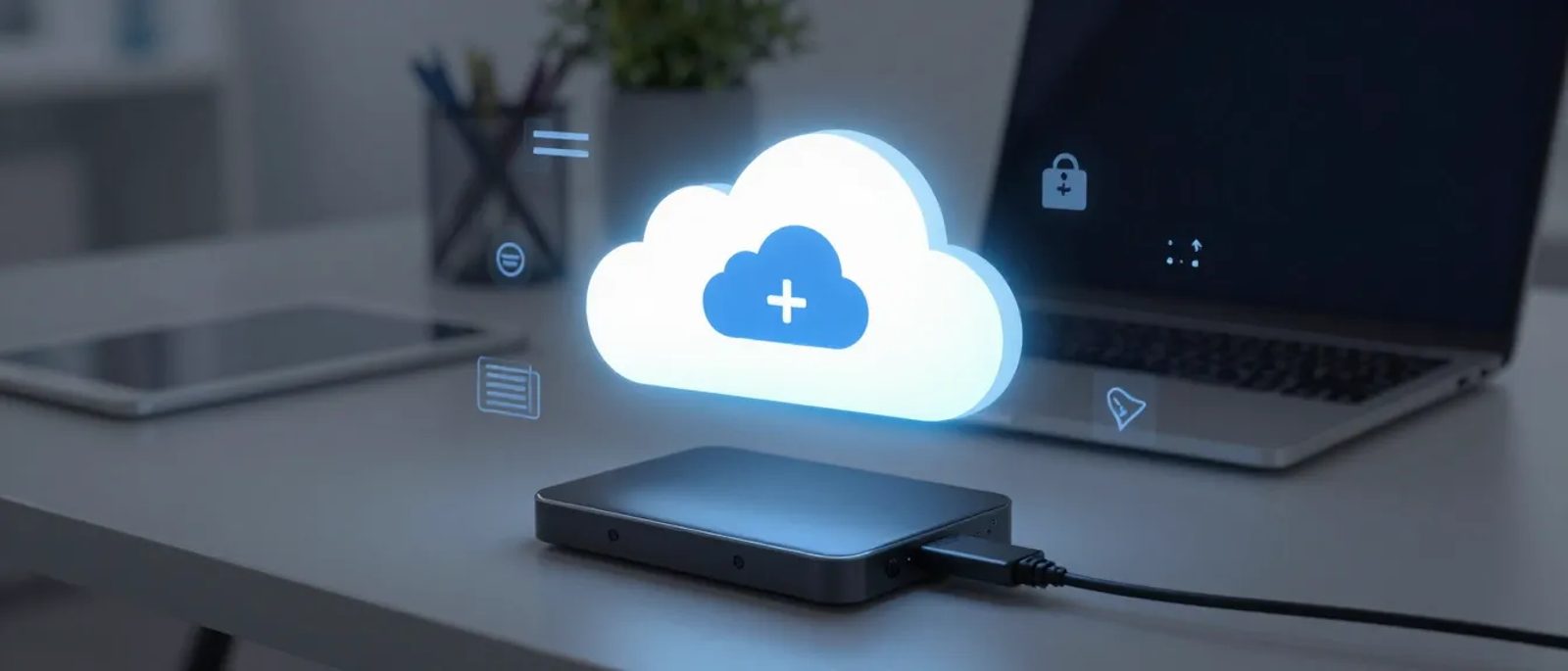
Cloud backup services automatically copy your files to secure servers somewhere else. If everything else fails—ransomware, theft, fire—you can get it back.
Good options:
- Backblaze (around £6/month per computer) - Simple, unlimited storage
- Carbonite (around £8/month) - Easy to use, good for non-technical people
- IDrive (around £5/month for 5TB) - Good value, works across multiple devices
Install it, let it run, forget about it. It backs up continuously in the background.
Cost: £5-8/month.
Total cost: About £60-100/year for complete protection. That's less than the cost of one lost day's work for most businesses.
If You Have a Small Server or NAS
If you've got shared files on a NAS or server, you need to back that up too:
Option 1: Sync to cloud
Most NAS devices (Synology, QNAP) can sync folders to cloud services like Backblaze B2, Google Cloud, or Amazon S3. This happens automatically.
Cost: Around £5/month per terabyte stored.
Option 2: Second NAS at another location
Some businesses put a second NAS at someone's home or another office. The two sync automatically. If the office is burgled, the home copy is safe.
Cost: £300-500 for another NAS, plus the data connection.
Option 3: Regular USB drive swap
Old school but works: two external hard drives. Swap them weekly, keeping one off-site (a director's home, a bank safe deposit box). Low tech, but reliable.
Cost: £100-150 for two drives.
Testing Your Backups (Really Important)
Having backups is useless if they don't actually work.
Every few months:
1. Try restoring a random file from each backup
2. Check that the restored file opens and isn't corrupted
3. Make sure you could actually access your off-site backup if you needed to
According to backup provider statistics, about 30% of backup attempts fail to restore correctly—usually because nobody ever tested them.
What About Ransomware?
Ransomware is malicious software that encrypts your files and demands payment (usually in Bitcoin) for the key to unlock them.
Backups protect you because you can say "no" to the ransom and restore from backup instead.
But there's a catch: if your backup is connected to your network when ransomware hits, it might encrypt the backup too.
Protection:
- Cloud backup services like Backblaze keep multiple versions of files, so you can restore from before the attack
- Air-gapped backups (physically disconnected drives) can't be encrypted remotely
- Test your restore process so you know it works
The NCSC says businesses with good backups typically recover from ransomware in days. Those without can take months—if they recover at all.
Real-World Disasters and What Survives
Laptop stolen:
- Lost: Everything on the laptop
- Survives: Anything saved to cloud storage, anything backed up
- Lesson: Save to cloud by default, encrypt laptop hard drives
Hard drive fails:
- Lost: Everything on that drive
- Survives: Cloud files, external backup, any network-stored files
- Lesson: Drives fail eventually—always have copies elsewhere
Ransomware attack:
- Lost: Everything connected to the network at the time
- Survives: Off-site cloud backup (if it keeps versions), disconnected backup drives
- Lesson: Air-gapped or versioned cloud backup is essential
Office fire:
- Lost: Everything in the building, including on-site backups
- Survives: Off-site backup only
- Lesson: Off-site backup isn't optional
Accidental deletion:
- Lost: Deleted files (duh)
- Survives: Anything with version history or recycle bin
- Lesson: Cloud services with version history let you restore deleted files
The Minimum You Should Do Today
If you do nothing else, do these three things:
1. Check your cloud storage is actually being used
Are files being saved to OneDrive/Google Drive, or just to people's local computers? Check and fix this today.
2. Get an external hard drive
Copy your important files to it weekly. Keep it somewhere safe.
3. Sign up for Backblaze or similar
Install on every computer with important files. Takes 10 minutes. Runs automatically.
That's 3-2-1 backup sorted. It protects you against the most likely disasters for minimal cost and effort.
What to Spend
Bare minimum: £0-50/year
- Use existing cloud storage properly
- One external hard drive
- Free cloud backup tier (limited space)
Recommended: £100-200/year
- Cloud storage (Microsoft 365 or Google Workspace)
- External hard drive for local backup
- Cloud backup service for off-site protection
For peace of mind: £300-500/year
- All of the above, plus
- Second external drive rotated off-site
- Or NAS with cloud sync
- Or managed backup service
The Bottom Line
Backup is boring. Nobody wants to think about it. But the businesses that survive disasters are the ones that prepared for them.
The 3-2-1 rule covers you: three copies, two types of storage, one off-site. Follow it, and most disasters become inconveniences rather than catastrophes.
Cloud services have made this cheap and easy. There's no excuse anymore for losing business data to hardware failure, theft, or ransomware.
The best time to set up backup was years ago. The second best time is today. It takes about an hour to get a solid system in place. Spend that hour now, and you might save your business later.