There is no single winner. BT Business suits a multi-site business that wants one supplier for connectivity, voice and mobile, backed by BT's own national fibre backbone. Zen Internet suits a business that wants a published starting price and UK-based support bought directly. Gamma suits a business already running, or planning to run, Gamma-powered voice, bought through an accredited reseller rather than from Gamma itself. Pricing across all three is broadly comparable once SLAs are matched, so the decision comes down to support, contract terms and how each one handles call failover between sites.
Key pointers
- The PSTN switch-off is fixed for 31 January 2027; as of late September 2026, Openreach still had 1.2 million UK lines to migrate, including 350,000 business premises, so start quotes now.
- Ask every supplier for a written excess construction charge (ECC) figure before signing; on a rural or new-build site this can add £15,000 to £50,000 to the deal.
- Zen Internet publishes a starting price of £48 a month (ex VAT); BT publishes £245 a month for its lowest BTnet tier on a 60-month term. Gamma remains fully quote-only.
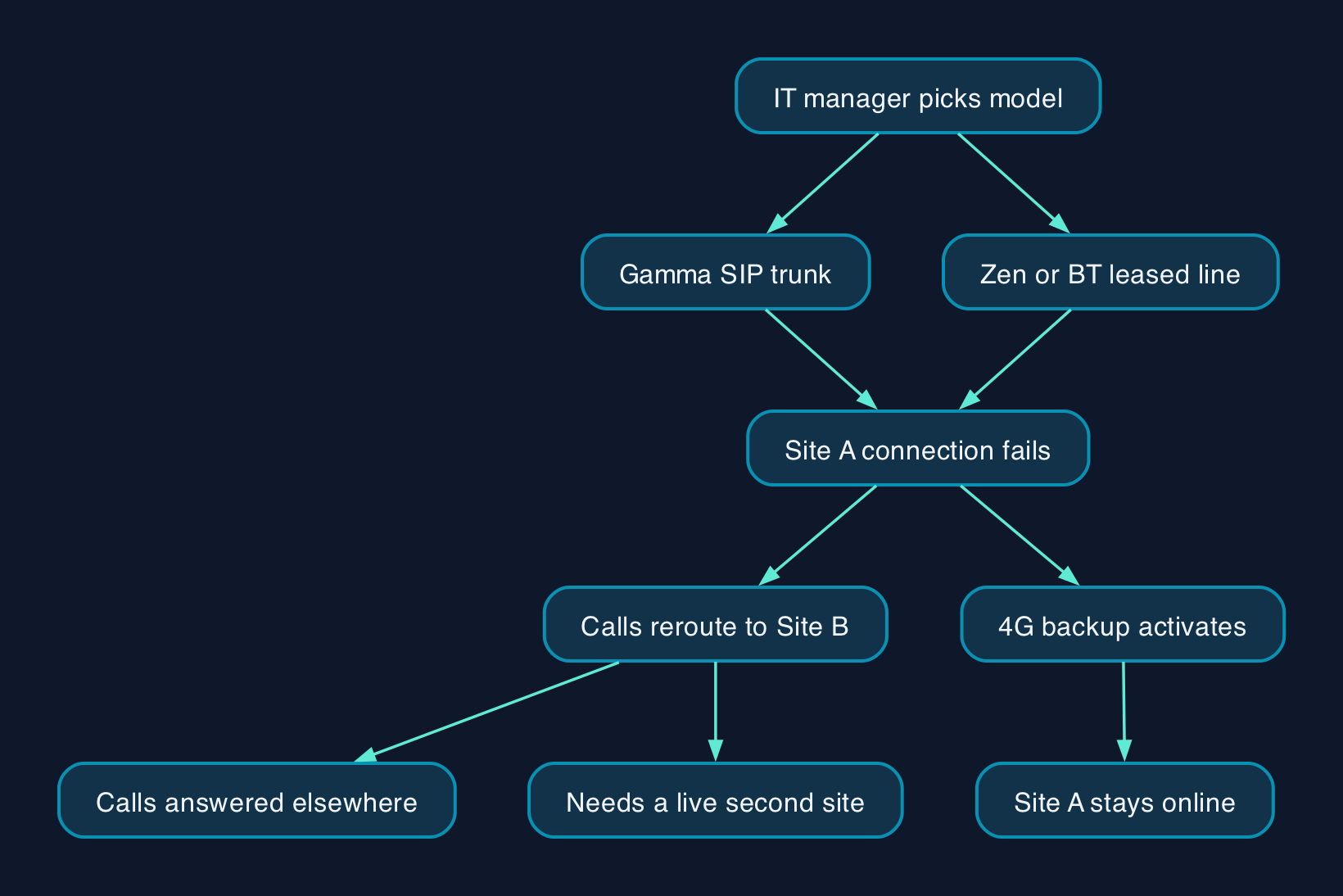
- Decide your call failover model before you compare suppliers: Gamma reroutes calls between two live sites on its SIP platform. Zen and BT sell 4G backup as an add-on to their broadband products, not their leased lines, so ask specifically what resilience a leased line quote includes.
- Gamma is sold mainly through accredited resellers and managed service providers; budget time to find and vet a partner, not just the network.
- Get quotes from at least three providers for the same speed tier. Published market comparisons show the spread can be around £150 a month even at identical speeds.
- Do not assume Openreach's emergency fallback service protects a multi-site phone system. It is designed for single eligible lines, not ISDN or multiline business setups.
- A leased line SLA is only useful if it carries service credits. Ask what percentage of the monthly fee is refunded, and how fast, when the target is missed.
What multi-site connectivity means for the switch-off
For a business with several sites, the PSTN switch-off is not just a phone problem. Alarms, door entry systems, card payment terminals and analogue backup lines on the old copper network can all stop working once your local exchange migrates. Openreach is running the migration exchange by exchange up to the January 2027 deadline, and its temporary EVAc fallback (see Fast Facts) is a last resort for single eligible lines that miss the deadline. It explicitly does not extend the same protection to ISDN trunks or multiline business setups, so a multi-site business running ISDN between offices has more reason to migrate ahead of time rather than after.
For a multi-site IT manager, this forces two separate decisions that often get bundled together. The first is the physical connection at each site: do you need a leased line, or is business-grade full-fibre broadband enough? The second is what happens to calls when a site loses its connection, or loses power, since a digital phone line depends on your router and mains electricity in a way an old analogue handset did not.
For the wider compliance checklist, including what to do about alarms, telecare and other connected devices, see Compare the Cloud's PSTN switch-off January 2027 business checklist. This piece focuses specifically on the connectivity and call-failover supplier decision for a multi-site business.
A leased line is worth the extra cost when a site depends on real-time voice, hosted line-of-business apps, or transfers large files between offices. It is a dedicated, symmetric, uncontended circuit with a financially backed SLA, unlike a shared broadband connection. For a smaller site that mostly browses, video-calls and uses cloud apps, a full-fibre broadband line with a 4G backup circuit is often enough, and considerably cheaper.
How leased lines and call failover fit together
The connection and the phone system are two different resilience problems, and Gamma, Zen and BT solve them in different ways.
Gamma's approach is built around its voice platform. If you run Gamma SIP trunks or Horizon at two or more sites, Gamma can reroute inbound and outbound calls from an affected branch to a working one automatically, with no call-forwarding fee. That protects the phone system even if the local data connection at one site fails completely, but it depends on having a second live Gamma-connected site to fail over to.
Zen and BT instead protect the connection itself, at the site where the problem happens, though both sell this as an add-on to their broadband products rather than their leased lines. Zen's 4G backup product uses a multi-network 4G SIM in the router and currently pairs with Zen's Business SOGEA broadband, with Full Fibre broadband support to follow. BT's 4G Assure works the same way but plugs into BT's Business Smart Hub broadband router. Neither supplier describes these as compatible with a full leased line; for a leased line, both Zen (up to a 100% resilience option) and BT (BTnet's own "resilience options" that "keep you working even if disaster strikes your main line") offer additional protection, but the exact mechanism, whether that is a diverse second circuit or something else, needs confirming with the supplier at quote stage.
A multi-site business with a genuine resilience requirement often ends up combining a leased line's own resilience tier, or a 4G-backed broadband connection at smaller sites, with a voice platform capable of rerouting calls between sites if a whole location goes down, whichever supplier delivers each part.
Pricing and cost model
None of the three suppliers publishes a single price list that covers every site type, because leased line pricing depends on distance from the nearest fibre point, speed and contract length.
| Supplier | Published starting price | How you buy | Advertised SLA |
|---|---|---|---|
| Gamma | Not published; quote-only | Mainly through accredited resellers and MSPs | SIP voice platform 99.999%; leased line SLA is quote-dependent |
| Zen Internet | From £48/month, ex VAT | Direct from Zen | 99.9% standard, 100% resilience option |
| BT Business | From £245/month, lowest 30/50 Mbps tier, 60-month term | Direct from BT, or through a BT authorised partner | 100% availability SLA on BTnet |
For context, comparison site Selectra's 2026 market survey of UK leased line providers (a mix of resellers, not any one supplier here) puts typical 36-month, ex-VAT pricing at roughly £200 to £400 a month for 100 Mbps, rising to £350 to £700 a month for 1 Gbps, plus a possible excess construction charge, or ECC, where civil works are needed to reach the site. Providers typically absorb the first £2,800 of civil works into the install fee; above that, on a rural site or a new-build business park, the ECC is passed on and can run to £15,000 to £50,000. Ask each supplier for a written ECC assessment for every site before you sign anything, and treat any quote without one as provisional.
Assumptions. The table above covers the connection only. For a multi-site rollout, add: any call failover product (Gamma SIP rerouting, or a 4G-backed broadband connection at smaller sites, from £50 a month for Zen's own 4G backup add-on), a leased line resilience tier at sites that need one, and staff or partner time to manage the migration across sites. VAT at the standard UK rate is charged on top of every figure above.
Rollout checklist for a multi-site switch
- List every site and every device on the old copper network. Include alarms, door entry, lift lines, card machines and analogue backup lines, not just desk phones.
- Confirm the PSTN migration date for each exchange with your current provider; some sites may move before others.
- Get an ECC assessment in writing for every site, especially rural or newly built ones, before comparing headline prices.
- Choose the failover model per site: call rerouting to a second live site (Gamma-style), a 4G backup circuit at the same site (Zen or BT-style), or both.
- Check power resilience at each site. A digital phone line needs mains power at the router; do not assume Ofcom's landline protections cover a business site, and agree your own battery or UPS solution where losing calls in a power cut is not acceptable.
- Order early. A brownfield leased line typically takes 45 to 90 working days; a rural or new-build site can take 6 to 9 months, so book installs well before January 2027.
- Pilot the failover before go-live. Physically pull the primary connection at one site and confirm calls and data genuinely move to the backup path.
- Train reception and site staff on what happens during a failover, including any temporary number or routing change.
- Get the SLA and service credit terms in writing, not just the advertised uptime percentage, before signing.
- Keep the old copper line live until the new service is proven, then formally cancel it to avoid double-paying.
Vendor and option comparison
| Criteria | Gamma | Zen Internet | BT Business |
|---|---|---|---|
| How you buy | Mainly through accredited resellers and MSPs, rarely direct | Direct from Zen | Direct from BT, or through a BT authorised partner |
| Published starting price | Not published; quote-only | From £48/month ex VAT | From £245/month, lowest wire tier, 60-month term |
| Underlying network | Openreach fibre (most sites) | Openreach fibre, plus CityFibre Ethernet options | Openreach fibre plus BT's own backbone |
| Leased line SLA | Quote-dependent | 99.9% standard, 100% resilience option | 100% availability SLA on BTnet |
| Call failover model | Automatic SIP rerouting between sites, 99.999% platform SLA | Leased line resilience option (mechanism confirmed at quote); separate 4G backup add-on for broadband, from £50/month | BTnet's own resilience options (mechanism confirmed at quote); separate 4G Assure add-on for broadband |
| Fast-install option | Not applicable to leased lines | Not published for leased lines | BTnet Express, up to 30 Mbps, live in about six weeks |
| Best suited to | Businesses already running, or planning, Gamma voice across multiple sites | Businesses wanting a published entry price and UK-based support without a reseller layer | Businesses wanting one supplier for connectivity, voice and mobile, with a fast-install fallback |
| Watch out for | You are buying from a reseller, not Gamma; vet the reseller's own support and SLA pass-through | Advertised uptime is 99.9% by default; the 100% option costs more | Headline SLA applies to BTnet; confirm the same terms extend to BTnet Express and any bundled mobile failover |
No single supplier wins on every criterion. A business that already runs Gamma voice, and has two sites that can genuinely fail over to each other, gets a call-resilience feature the other two do not replicate directly. A business that wants a straightforward, self-service quote and a published headline price should start with Zen. A business that wants one account for leased lines, mobile SIMs and a fast-install fallback product should start with BT Business.
Editorial analysis
The PSTN deadline creates a genuine forcing function, but it should not be used to justify rushing into whichever supplier answers the phone first. The real decision for a multi-site business is less about the wire and more about what happens in the minutes after a site goes dark. Gamma's model assumes you have, or are willing to build, a second resilient site to route calls to; that is a strong option for a business with two comparable offices, and a weaker one for a business with a single head office and small satellite sites that could not realistically absorb a rerouted call volume. Zen and BT's site-level resilience, whether that is a leased line resilience tier or a 4G-backed broadband connection at a smaller site, is simpler to reason about, but it only protects the connection at that site, not the wider risk of a call centre or reception desk being unreachable for other reasons.
Given that install times of 45 to 90 working days are the norm, and can stretch to nine months on harder sites, the practical advice is to treat the January 2027 deadline as a planning constraint for late 2026 ordering, not a trigger for a rushed decision now.
Sources
- Openreach, Switching off the Public Switched Telephone Network (PSTN) across the UK
- gov.uk, UK transition from analogue to digital landlines
- ISPreview, Openreach confirm post-January 2027 measures for UK analogue phone switch-off
- Selectra, Leased lines 2026: prices, providers and when a UK business still needs one
- Netify, Broadband Reseller Companies UK
- Zen Internet, Reliable Leased Line Connections From Zen
- Zen Internet, Business connectivity product launches to prepare UK businesses for 2027 copper switch off
- Zen Internet, 4G Backup for Business
- BT Business, Ethernet: business-class connectivity
- BT Business, UK business internet: a dedicated BTnet leased line
- BT Business, Always on internet to rely on
- Gamma, SIP Trunking & Inbound Call Management
- Compare the Cloud, PSTN switch-off January 2027 UK business checklist