
Dext and Sage AutoEntry both turn client receipts and invoices into digital accounting entries, but they charge in opposite ways. Dext bills per client company, from £2.50 a month on its Solo plan with a 5-client minimum, while its Essentials and Advanced business tiers start at £16.50 and £17.50 per client at their 10-client minimum. AutoEntry bills per document through credit bundles from £15.45 a month, with unlimited client companies on every plan. The cheaper choice depends on your document volume per client, not the headline price.
Key pointers
- Work out your practice's real document volume per client before comparing prices. AutoEntry's credit cost jumps with bank statement pages (3 credits each), which can push a low-invoice, high-statement client into a much more expensive plan.
- Dext's Solo plan (£2.50 per client a month, 5-client minimum) is built for self-employed and landlord clients doing Making Tax Digital for Income Tax, not general business bookkeeping.
- Dext's Essentials and Advanced business tiers publish a per-client rate that falls as client numbers rise, from £16.50 and £17.50 per client at 10 clients to £12.00 and £13.00 at 20. Run your actual client mix through dext.com/uk/partner/build-plan before you price a client package.
- AutoEntry pools credits across unlimited client companies and unlimited users on every plan, so a quiet month for one client can cover a busy month for another.
- Ask both vendors what happens when you exceed your allowance. AutoEntry allows up to 200% credit overage automatically added to your next bill; check what Dext charges beyond its client-count tiers.
- If you resell either tool to clients, decide upfront whether you are passing the software cost through, building it into your fee, or absorbing it, because the per-client and per-credit models scale very differently as your book grows.
- Both vendors quote accuracy figures rather than an independent benchmark. Treat them as marketing claims, not audited results.
What Receipt Capture Means for a Small Practice
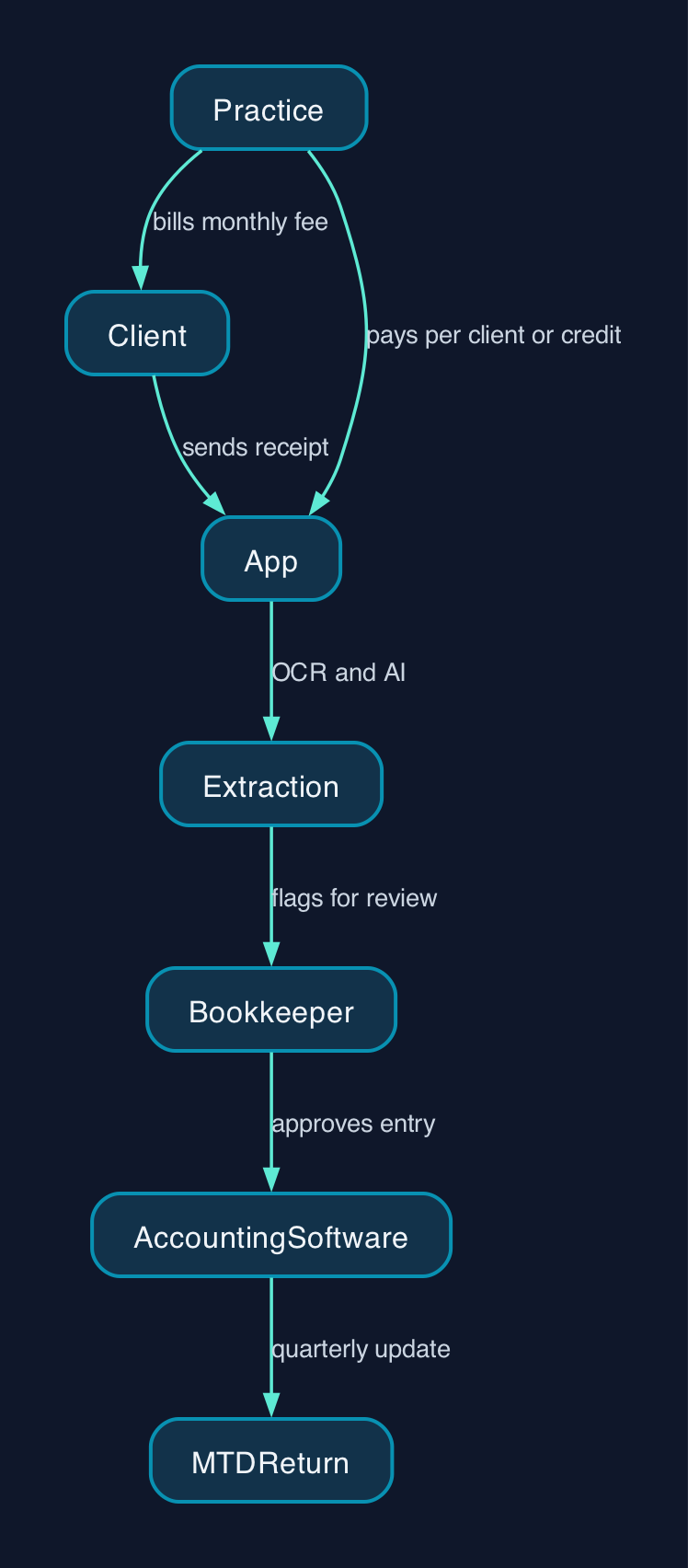
A small UK accountancy or bookkeeping practice offering automated receipt and invoice capture is really reselling two things to its clients: a mobile app or email inbox the client uses to send documents, and a background extraction engine that turns those documents into coded entries in Xero, QuickBooks or Sage without a member of staff retyping them. The practice pays the software bill and usually folds it into a monthly bookkeeping fee.
That decision has become more pressing because of Making Tax Digital for Income Tax (MTD ITSA). HM Revenue & Customs requires sole traders and landlords with qualifying income above £50,000 to keep digital records and submit quarterly updates from 6 April 2026, dropping to £30,000 from 6 April 2027 and £20,000 from 6 April 2028. A practice that already automates capture for its incorporated clients has an obvious next step: extend the same workflow to the self-employed and landlord clients who now need digital records too, rather than building that habit from scratch under deadline pressure.
Dext and AutoEntry solve the same underlying problem: getting paper and PDF documents into digital accounting records with minimal manual keying. The difference that actually affects your margin is how each one charges for it.
How Dext and AutoEntry Price Their Practice Plans
Dext, priced per client company
Dext sells three practice tiers: Solo, Essentials and Advanced. Solo is the only one with a published flat rate: from £2.50 per client a month, excluding VAT, on an annual subscription billed monthly, with a 5-client minimum, so the smallest Solo commitment is £12.50 a month. Solo is built around self-employed and landlord clients, with features such as quarterly HMRC updates, cash and accruals basis reporting, and jointly let property support, which makes it a natural fit for the MTD ITSA workload described above.
Essentials and Advanced are aimed at general business bookkeeping clients and both carry a 10-client minimum. Dext's pricing page now shows a per-client rate that falls with volume: at 10 clients, Essentials costs £16.50 per client a month (£165 in total) and Advanced £17.50 (£175), while at 20 clients the rates drop to £12.00 (£240) and £13.00 (£260), all excluding VAT on an annual subscription billed monthly. Monthly billing costs more. For a mixed book, Dext's online plan builder asks how many business clients the practice has, how many self-employed or landlord clients, and which optional features (data health and insights, ecommerce support) those clients need, before it generates a monthly total.
Trade coverage that ran a set of typical client counts through Dext's own plan builder in June 2026, before Dext's most recent price review, put practice-plan costs at roughly £190 to £240 a month for 10 clients and £391 a month for 50 clients (Receiptflow). Dext's live pricing card now supersedes that range at 10 clients, so treat the older figures as history and run your own client mix through Dext's build-a-plan page before you commit a client to a monthly fee based on it.
On top of the base plan, Dext charges £2.50 per client a month to add MTD for Income Tax support to an Essentials or Advanced client, and £5 per client a month for its AI Assist add-on, which handles categorisation learning and tax-treatment suggestions.
AutoEntry, priced per document through credits
AutoEntry charges differently. Every plan includes unlimited users and unlimited client companies, and the bill is set by a monthly credit allowance rather than a client count. Confirmed live on AutoEntry's UK pricing page:
- Bronze: 50 credits, £15.45 a month
- Silver: 100 credits, £27.65 a month
- Gold: 200 credits, £51.95 a month
- Platinum: 500 credits, £119.35 a month
- Diamond: 1,500 credits, £331.50 a month
- Sapphire: 2,500 credits, £518.25 a month
All figures exclude the UK's 20% standard rate of VAT. Every document consumes a different number of credits: a standard purchase or sales invoice costs 1 credit, an invoice with line-item extraction or a supplier statement costs 2 credits, and a bank or credit card statement costs 3 credits per page. Unused credits roll over for 90 days. AutoEntry allows up to 200% credit overage by default, with extra credits added to the next bill at a higher pence-per-credit rate than the plan price; AutoEntry advises contacting your account manager if you expect to exceed your allowance regularly, and plans can be upgraded or downgraded at any time.
A worked example
Take a practice with 20 clients, where each client generates an average of 15 purchase and sales invoices and 2 pages of bank statement a month. That is 20 clients x 15 invoices x 1 credit, or 300 credits, plus 20 clients x 2 pages x 3 credits, or 120 credits: 420 credits a month in total. That sits above Gold's 200 credits but under Platinum's 500, so this practice needs Platinum at £119.35 a month, working out at roughly £5.97 per client a month. The same 20 business clients on Dext Essentials would cost £240 a month, or £12.00 per client, at Dext's published annual rate. A single client who also submits 10 pages of bank statement a month adds 30 more credits on their own, which is enough to tip a practice near a tier boundary into the next one up.
By contrast, if those same 20 clients were self-employed or landlord clients only needing MTD ITSA support on Dext Solo, the bill would be a flat £50 a month, or £2.50 per client, because Solo does not price by document volume. That comparison only holds for MTD-only clients: Solo does not cover the fuller bookkeeping capture that Essentials and Advanced, or AutoEntry's credit plans, are built for.
Comparing Dext and Sage AutoEntry
| Criterion | Dext | Sage AutoEntry |
|---|---|---|
| Pricing model | Per client company, plus a per-client minimum on every tier | Per document, through a shared monthly credit allowance |
| Published UK rate | Solo £2.50 per client (5-client minimum); Essentials £16.50 and Advanced £17.50 per client at 10 clients, falling to £12.00 and £13.00 at 20 | All six tiers published: £15.45 to £518.25 a month |
| Business tiers | Essentials and Advanced, 10-client minimum, per-client rate falls as client numbers rise | No separate business tier; higher credit plans cover more volume |
| Client companies included | Priced per client added | Unlimited on every plan |
| Users included | Not stated as unlimited on Dext's practice tiers | Unlimited on every plan |
| Line-item extraction | Included, some add-ons priced separately | Included on every plan, at 2 credits per document |
| Accuracy claim | 99.9% (Dext's own figure) | Up to 99% (AutoEntry's own figure) |
| Owner | IRIS Software Group (from December 2024) | Sage (since September 2019) |
| Accounting integrations | Xero, QuickBooks, Sage, 36+ platforms, 11,500+ banks | Xero, QuickBooks, FreeAgent, KashFlow, Clear Books, Sage products |
| Best fit | Practices with fewer, higher-volume clients who want one MTD-ready product across self-employed and business clients | Practices with many lower-volume clients, or workloads that swing month to month |
Neither vendor publishes an independent audit of its extraction accuracy, so treat the 99.9% and "up to 99%" figures as marketing claims rather than a like-for-like benchmark. Ask each vendor for their error-correction workflow, not just their headline number, since both tools rely on the bookkeeper checking and approving extracted data before it posts.
Editorial Analysis
For a small practice weighing the two, the honest starting point is your document mix, not the plan name. A firm whose clients mostly hand over tidy monthly invoices will do well on AutoEntry's credit model, because low-volume clients cost very little and unused credits carry forward. A firm whose clients generate long bank statements, multiple pages a month, will burn through AutoEntry credits fast and may find Dext's per-client structure easier to budget against, now that Essentials and Advanced rates are published.
The MTD ITSA deadline changes the calculation for anyone with self-employed or landlord clients. Dext Solo gives a cheap, purpose-built option for that specific group at £2.50 a client, separate from whatever a practice already pays for its incorporated clients' bookkeeping. AutoEntry has no equivalent named MTD tier; its credit model applies the same way regardless of client type, which can be simpler to explain to clients but does not offer the same targeted discount for low-complexity MTD-only filers.
Whichever product a practice chooses, the pricing structure should match how the practice actually bills clients. A flat per-client software cost is easy to pass straight through in a monthly fee. A shared credit pool is harder to attribute to one client's invoice, so practices reselling AutoEntry-based capture need a clear internal rule for how they split that cost, or they risk under-charging their highest-volume clients. Practices that already use AI tools alongside Xero or Making Tax Digital workflows should weigh a capture tool decision against that wider stack, not in isolation; see our comparison of ChatGPT Business and Microsoft 365 Copilot for a UK accountancy practice for how those choices interact.
Sources
- Dext Pricing (UK) - Dext (IRIS Software Group)
- Build your plan - Dext - Dext (IRIS Software Group)
- Dext - Online Bookkeeping Software for Small Businesses - Dext (IRIS Software Group)
- AutoEntry Pricing - AutoEntry (Sage)
- AutoEntry Integrations - AutoEntry (Sage)
- IRIS Software Group Announces Intent to Acquire Dext Software Ltd. - IRIS Software Group, 3 December 2024
- Sage announces acquisition of AutoEntry - Sage Group plc, 27 September 2019
- Before you use this guide - Use Making Tax Digital for Income Tax - HM Revenue & Customs
- VAT rates - HM Revenue & Customs
- Dext Pricing and MTD ITSA: What It Actually Costs Your Practice in 2026 - Receiptflow, 26 August 2026
- ChatGPT Business vs Microsoft 365 Copilot for a UK Accountancy Practice Running Xero and Making Tax Digital - Compare the Cloud