Dell, HP and Lenovo all sell Device as a Service (DaaS) subscriptions for business laptops, but none publish a fixed UK monthly rate, so there is no single answer to whether DaaS beats buying outright. What is checkable is the cash price of a comparable laptop from each vendor today, the tax and VAT treatment of each route, and the contract terms that decide whether a subscription is actually cheaper once support and refresh are included. Get quotes on the same spec before deciding.
Key pointers
- Ask Dell, HP and Lenovo for a DaaS quote on the exact same spec, quantity and term you would use for an outright purchase. None of the three publish a fixed UK per-device rate, so only a like-for-like quote tells you which is cheaper.
- Dell's Latitude 5455 and HP's EliteBook 640 G11 (16GB/512GB) both list at just over £1,300 inc VAT on each vendor's own UK site, but Dell's own online pricing is dynamic and moved between checks during research; recheck the live price before budgeting.
- Buying outright lets a VAT-registered business reclaim the VAT immediately and claim the Annual Investment Allowance, deducting the full cost from taxable profits in the year of purchase, HMRC confirms.
- DaaS shifts VAT onto each monthly service payment instead, and none of the capital sits on your balance sheet as an owned asset.
- Dell's APEX PCaaS page states the customer can renew or return the equipment to Dell Financial Services at the end of the contract, unlike hire purchase or outright buying, where the business owns the kit.
- Lenovo's own published case study for one UK reseller claims a 15% lower total cost of ownership on TruScale DaaS versus CapEx purchasing; treat that as a vendor case study result, not a guaranteed figure for your fleet.
- Budget for the parts a headline lease rate leaves out: an option-to-purchase fee of £150 to £500 on hire purchase, and secure data destruction of £15 to £40 a device at end of term.
- Read the return-notice clause before signing. Missing the window on an operating lease or DaaS agreement can trigger an automatic 12-month extension you did not plan for.
What Device as a Service Means for a Mid-Market Refresh
A mid-market IT procurement manager standardising laptops across, say, 100 to 250 staff faces the same underlying choice whether the fleet is 100 or 500 machines: buy the hardware and own it, or pay a provider a recurring fee that bundles the hardware with support, management and a scheduled refresh. DaaS is the second option applied specifically to end-user devices. Dell calls its version APEX PC as a Service, HP calls its Device as a Service, and Lenovo calls its TruScale Device as a Service; all three describe broadly the same shape, a subscription that folds the device, its software, deployment, support and eventual retirement into one monthly payment per user, with no large upfront outlay.
The buying decision is not really "lease versus buy" in the traditional sense, because DaaS is closer to a fully managed service than a plain finance lease. Outright purchase and hire purchase both put the asset, or the right to own it, on your books. An operating lease and DaaS both keep the asset off your books and hand back the refresh problem to the provider, but DaaS adds device management, support and end-of-life handling that a plain lease does not include as standard. That extra scope is exactly why none of the three vendors publish a flat per-device rate: the price depends on the device spec, the support tier, the management platform (Microsoft Intune versus a vendor's own tooling), the term length and the fleet size, all of which change what is actually being quoted.
For a 150-device refresh, HP's own Fleet Flexibility terms and Lenovo's stated bid-portal process both point the same way: get the DaaS provider to quote against the same spec, quantity and term you would use for a straight purchase, then compare the two numbers side by side, including what happens to the hardware at the end.
Pricing and Cost Model
What a comparable laptop costs today
Because Dell, HP and Lenovo publish list prices for their laptops but not for their DaaS subscriptions, the only verifiable starting point is the cash price of a comparable machine. The two prices below were checked directly against each vendor's own live UK product data on 29 September 2026 and are inclusive of VAT. Lenovo's configure-to-order ThinkPad listings returned different prices and specs on repeat checks during this research, in line with Lenovo's own note that cart prices are "subject to change until the order is submitted," so no equally stable Lenovo figure is included here; get a fixed quote directly from Lenovo or a reseller for the exact spec you want.
| Vendor | Model | UK list price (inc VAT) | Note |
|---|---|---|---|
| Dell | Latitude 5455, 14-inch | £1,326.72 | Dell's own online pricing is dynamic; an earlier check during research showed £1,166.09 for the same listing |
| HP | EliteBook 640 G11, Core Ultra 5, 16GB/512GB | £1,319.99 | Consistent across repeat checks |
Spread over the same 36-month refresh cycle the question asks about, the capital cost alone, before any finance margin or service fee, works out at roughly £36.85 a month for the Dell (at its most recently checked price) and £36.67 a month for the HP. HP's own site confirms the second figure directly: it offers that exact EliteBook on 0% interest finance at £36.67 a month over 36 months, which is simply its own cash price divided by the term, not a DaaS lifecycle subscription with support and refresh built in.
A worked example
Assumptions. A 150-device fleet, refreshed on a 3-year cycle, at a blended average of £1,323.36 per device inc VAT across the two vendor list prices above.
Outright purchase, capital cost: 150 × £1,323.36 = £198,504.00 inc VAT (£165,420.00 ex VAT, with £33,084.00 of VAT).
A VAT-registered business reclaims that £33,084.00 of VAT as input tax, and the full £165,420.00 ex-VAT cost qualifies for the Annual Investment Allowance, deductible from taxable profits in the year of purchase, comfortably inside HMRC's £1 million annual cap. Set against that: the business now owns 150 laptops that need internal or third-party support for three years, and that have shed most of their resale value by the time the refresh comes round again, since laptop resale values drop quickly.
DaaS on the same 150 devices has no equivalent published figure to plug into that sum. What the evidence does establish is the shape of the comparison, covered in full under "Which Route Suits a Mid-Market Business" below: Lenovo's published case study for reseller BSL-IT claims a 15% lower TCO on TruScale DaaS against CapEx purchasing for that customer base specifically, not as a guaranteed industry figure. Dell's own APEX PCaaS material goes further, stating the offer is structured so the total of the monthly contract payments comes out lower than the cash price of the hardware over a 36-month term, for purchases within a minimum and maximum transaction size that a 150-device deal would typically clear. That is Dell's own promotional claim rather than an independently verified saving, and offer windows, eligibility and the exact currency thresholds change between Dell's regional briefs, so it is worth confirming current terms directly with Dell or an authorised reseller before budgeting against it.
VAT and tax treatment
The four routes are not taxed the same way. On an outright purchase or hire purchase, VAT is charged upfront on the full price and a VAT-registered business reclaims it as input tax on its next return; on an operating lease or a DaaS subscription, VAT is charged on each rental or service payment as it is invoiced instead, according to IT reseller Servnet. Capital allowances follow a similar split: outright purchase and hire purchase both qualify for the Annual Investment Allowance, letting a business deduct the full cost from taxable profits in the year of purchase up to HMRC's £1 million cap, while a DaaS subscription is treated as a service cost rather than a capital purchase, so there is no asset to claim allowances against in the first place. This is not tax advice; check the treatment that applies to your business with your accountant, particularly if your accounting period does not run to a full 12 months, which changes the AIA amount available.
Migration and Rollout Checklist
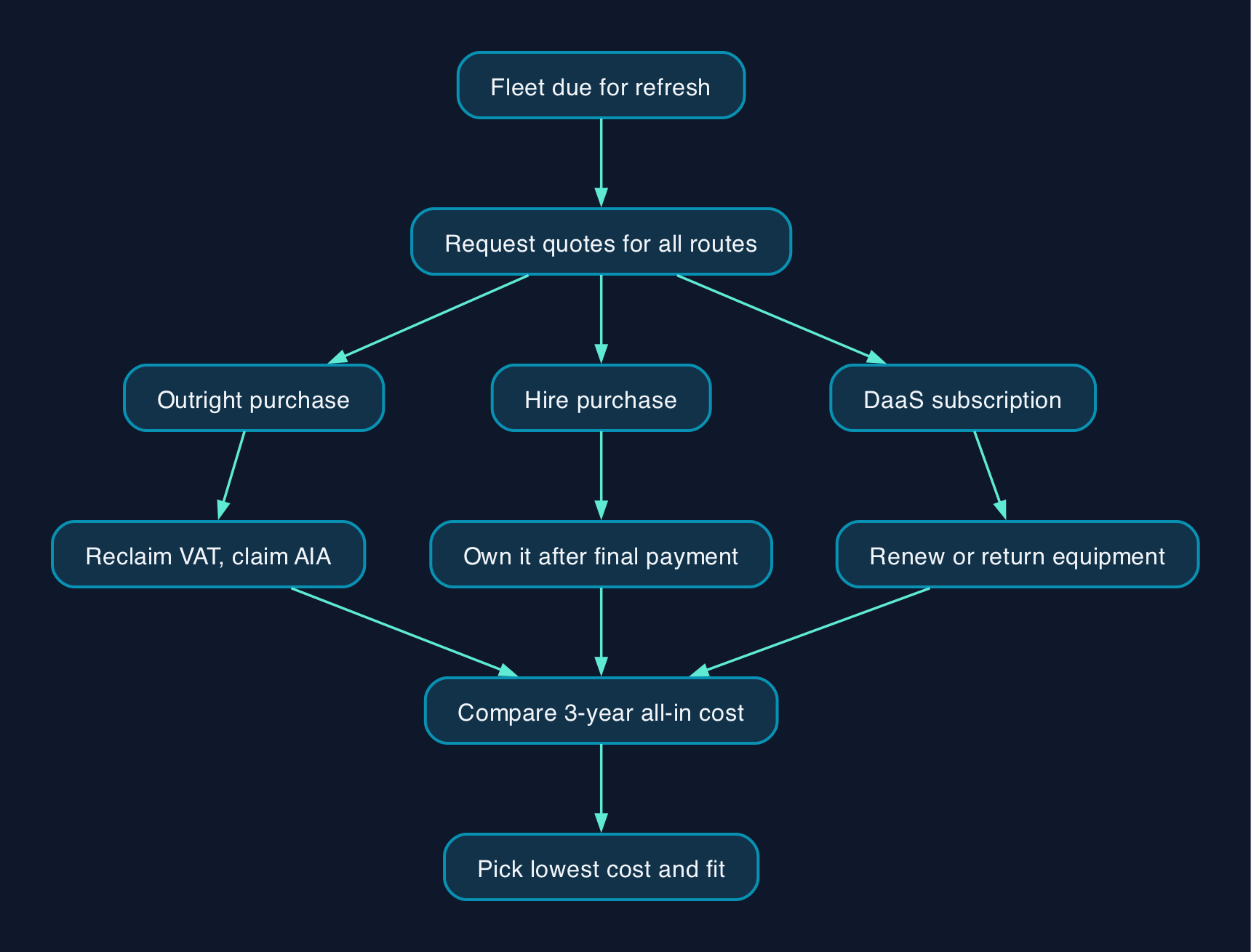
- Agree the target spec, quantity and 3-year (or other) term first, then request quotes for outright purchase, hire purchase and DaaS from Dell, HP and Lenovo (or their resellers) against that identical brief, so the comparison is like-for-like.
- Ask each DaaS quote to state, in writing, what is included: the device, warranty tier, on-site or courier support, endpoint management platform, insurance, and secure data wipe and disposal at end of term.
- Ask what happens at the end of the contract. Dell's own terms say the customer may renew or return the equipment; confirm the same for HP and Lenovo, and check whether early termination or mid-term device swaps carry a charge.
- Check the notice period for returning leased or DaaS hardware. Missing it can trigger an automatic contract extension, a documented risk on operating leases generally.
- Confirm who manages joiners and leavers during the contract term, and whether swapping a faulty or unwanted device counts against any fleet-flexibility allowance the provider offers.
- Get the VAT and capital allowance treatment confirmed in writing by your accountant for the specific route chosen, before signing, since it changes the real cash cost.
- Pilot the winning route with a small batch of devices and a handful of users before committing the full fleet, testing deployment time, support responsiveness and how a faulty unit is actually replaced.
- Before existing devices are returned or disposed of, confirm the secure data destruction process and get written evidence it took place, budgeting roughly £15 to £40 a device if this is charged separately.
Vendor and Option Comparison
| Outright purchase | Hire purchase | Dell APEX PCaaS | HP DaaS | Lenovo TruScale DaaS | |
|---|---|---|---|---|---|
| Ownership | Immediate | Yes, after final payment | No; renew or return to Dell Financial Services at term end | Financed via HP Financial Services; terms vary by plan | No; devices returned for data sanitisation and refresh at term end |
| VAT | Reclaimed upfront on the full price | Paid upfront on the full price | Charged on each monthly payment | Charged on each monthly payment | Charged on each monthly payment |
| Published UK pricing | Yes, on each vendor's own site | Set by the finance provider, not the vendor | No fixed rate; quote-based | No fixed rate; enterprise pricing through channel partners | No fixed rate; customised per agreement, quoted via bid portal |
| What is bundled | Hardware only | Hardware only | Hardware, software and lifecycle services in one payment | Hardware plus HP TechPulse analytics and Service Experts management | Hardware plus advisory, provisioning, support, management and retire-and-refresh |
| Best suited to | Cash-rich buyers who want the asset on the balance sheet and are comfortable managing support themselves | Buyers who want to own the asset eventually but prefer to spread the capital cost | Businesses standardising on Dell who want lifecycle services bundled with financing | Businesses wanting device analytics and proactive fault management alongside the hardware | Businesses wanting device management from advisory through to certified-refurbished refresh |
| Think twice if | Internal IT has no spare capacity for support and eventual disposal | The option-to-purchase fee and total interest are not compared against a straight lease or DaaS quote | You cannot get a written like-for-like quote against outright purchase to check the saving Dell advertises | You need a fixed, published per-device rate for budgeting without a quote | You are treating Lenovo's 15% TCO case-study figure as a guaranteed saving for your own fleet |
Which Route Suits a Mid-Market Business
A mid-market business with spare internal IT capacity, a VAT-registered position that can use the Annual Investment Allowance in full, and no interest in bundled device analytics has the strongest case for outright purchase or hire purchase. The full £165,420.00 ex-VAT cost in the worked example above comes straight off taxable profits in the year of purchase, and the VAT is reclaimed almost immediately, so the real cash-flow gap against a subscription is smaller than the headline capital figure suggests, once tax is accounted for.
A business that wants the refresh problem solved alongside the funding problem, that lacks spare IT capacity to manage 150-plus devices for three years, or that values Dell's, HP's or Lenovo's bundled analytics and support has the stronger case for DaaS, provided a written quote confirms it actually beats the outright-purchase number for the same spec and term.
Editorial analysis. The honest answer to whether DaaS is cheaper than buying outright is that nobody, including this article, can say without a quote, because none of the three vendors publish a rate card. What can be said is that the vendors' own promotional and case-study material (Dell's "pay less than cash" framing, Lenovo's 15% TCO case study) consistently describes DaaS as competitive with, rather than automatically cheaper than, ownership, and Funding Agent's independent read is that DaaS usually beats the cheapest hire purchase deal but rarely the cheapest lease. That suggests DaaS earns its place on service and risk transfer, not on guaranteed lowest cost, and a procurement manager should request quotes on that basis rather than assuming either route wins by default.
Sources
- Dell APEX PC as a Service
- Dell Payment Solutions: PCaaS Offer
- HP Device as a Service (DaaS)
- HP EliteBook 640 14-inch G11 Business Laptop PC
- Lenovo's TruScale Device as a Service
- ThinkPad T Series, our flagship laptops for business
- BSL-IT: Empowering UK businesses to modernize IT
- Latitude laptops, Dell UK
- The Top 10 IT Asset Lifecycle Management Companies
- How to Finance Servers, Laptops and Office Tech for Growing Companies
- IT Hardware Financing 2026: Monthly Cost of the Price Surge
- Claim capital allowances: Annual investment allowance