Yes, for most UK small businesses it is worth moving backups off AWS S3, or adding a second copy elsewhere. AWS charges $0.09 per GB (about £0.07) to move data out past the 100GB monthly free allowance, while Backblaze B2 and Wasabi both bundle free egress into their storage price. Self-hosted MinIO carries no vendor egress fee, but only pays off once you already run the server it needs. The right choice depends on how often you actually restore.
Key pointers
- AWS S3 in London (eu-west-2) charges $0.09 per GB, about £0.07, once you pass the 100GB of free monthly egress every AWS account gets; a full restore of a 2TB backup can add over £130 to a single month's bill.
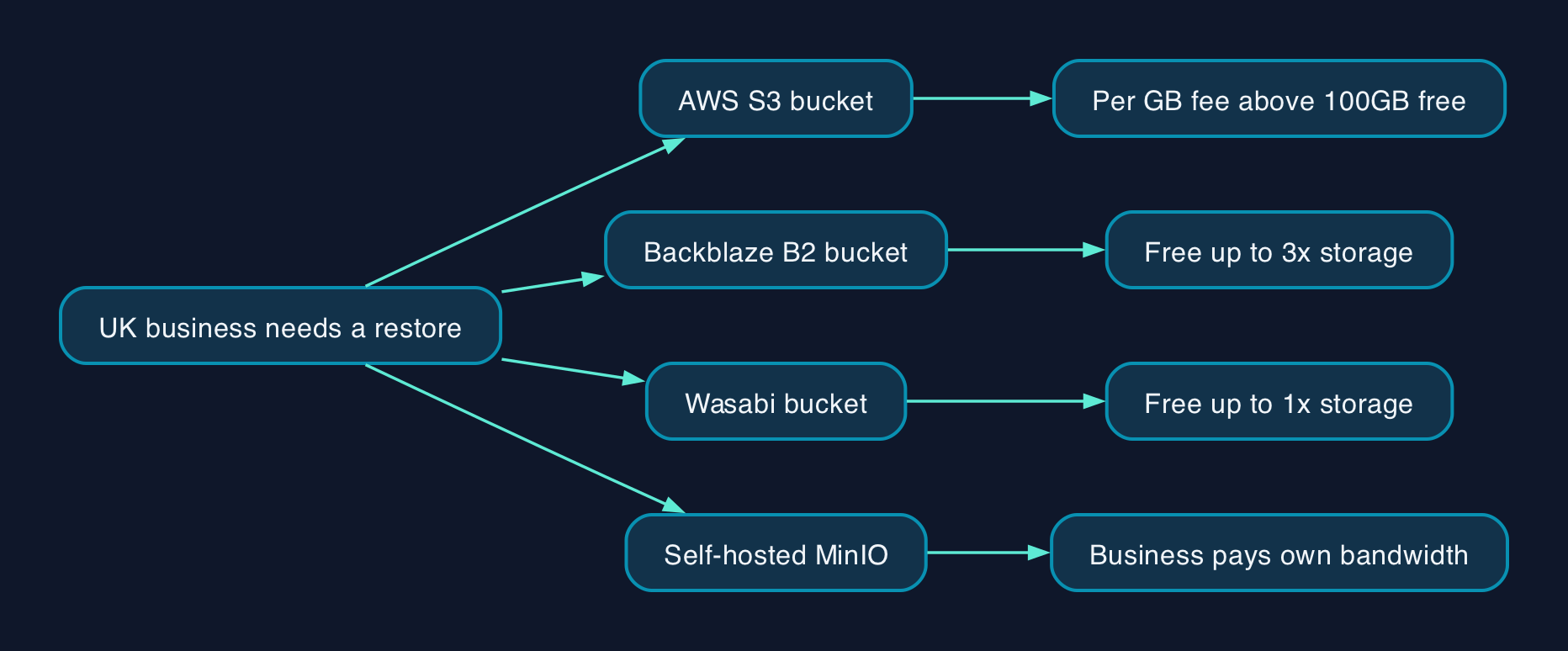
- Backblaze B2 gives free egress up to three times your average monthly storage, so a 2TB restore from a 2TB account is normally free.
- Wasabi gives free egress up to the amount you have stored each month under a "reasonable use" guideline, so the same 2TB restore sits right at the edge of that allowance.
- Self-hosted MinIO has no vendor egress meter because you own the server and the connection, but its free community edition now ships as source code only, not a ready-made binary.
- Wasabi is the only one of the three with UK regions; Backblaze's nearest region to the UK is Amsterdam, and AWS's own London region is where the egress fee applies in the first place.
- Ask any provider for its exact free-egress threshold and minimum storage duration before you commit; Wasabi's pay-as-you-go minimum is 90 days, which suits backups you rarely delete early anyway.
- None of these alternatives removes the need for an independent, tested second copy of your backups; egress fees are a cost problem, not a resilience one.
Why AWS S3 Egress Charges Catch UK Businesses Out
Object storage pricing has three moving parts: what you pay to put data in, what you pay to keep it there each month, and what you pay to take it out again. On AWS S3, putting data in is free and keeping it in eu-west-2 costs $0.024 per GB a month. Taking it out to the internet is the part that surprises people. Every AWS account gets 100GB of that free each month, and after that AWS charges $0.09 per GB, confirmed for the London region through AWS's own worked example for its Ireland region at the same $0.09 rate and independently through AWS's Price List API.
For a business that only ever uploads backups and never downloads them in bulk, this never shows up. It shows up the moment you actually need the data back: a ransomware recovery, an office move, a new IT provider pulling the whole estate, or simply running the restore test that a sensible backup and disaster recovery plan calls for. That is exactly when a bill built on a small monthly storage charge turns into one with a four-figure egress line, and it is why "egress-fee avoidance" has become its own buying decision rather than a footnote to "which cloud storage is cheapest".
Backblaze B2 and Wasabi are both S3-compatible object stores, so the same backup software that talks to AWS S3 (Veeam, Duplicati, rclone, restic and most NAS backup agents) can usually point at either with a changed endpoint and access key. Self-hosted MinIO is different in kind: it is software you install and run yourself, on your own server or a rented one, so there is no vendor meter on egress at all because there is no vendor billing you for bandwidth.
How the Providers Handle the Egress Bill
AWS meters every gigabyte leaving S3 to the internet, with a small monthly free allowance and a per-GB charge above it that only gets cheaper at volumes most small businesses never reach.
Backblaze B2 folds free egress into the storage price itself. The rule is free egress up to three times your average monthly storage, so a business storing 2TB can download up to 6TB in a month, comfortably enough for both routine restore tests and a genuine full recovery, before any egress charge applies.
Wasabi advertises "no fees for egress or API requests", but its own pricing FAQ sets a "reasonable use" ceiling equal to whatever you have stored: download more than your stored volume in a month and Wasabi says your use case "is not a good fit" for the policy and reserves the right to limit the account. For a 2TB backup and a 2TB recovery in the same month, that sits right on the line rather than comfortably inside it, which is worth knowing before you rely on the wording alone.
Self-hosted MinIO removes the vendor meter altogether. What replaces it is whatever you are already paying for: a server or NAS with enough disk, and the upload and download capacity of your office broadband or a rented server's connection. If that server is a VPS or dedicated box rented from a hosting provider, check that provider's own bandwidth allowance and overage charges separately, because some hosts do meter outbound traffic even though MinIO itself does not.
What This Actually Costs, Worked Through
Take a UK small business storing 2TB of backups (server images, database dumps and file shares) and compare two months: a typical month where it runs a 300GB restore test, and an incident month where it has to pull the whole 2TB back after a ransomware attack or a hardware failure.
| Item | AWS S3 (eu-west-2) | Backblaze B2 | Wasabi |
|---|---|---|---|
| Storage price | $0.024/GB/month (about £0.018) | $0.00695/GB/month (about £0.0052) | $0.00799/GB/month (about £0.0060) |
| Storage cost for 2TB | £37.10/month | £10.74/month | £12.35/month |
| Free egress allowance | 100GB/month, account-wide | Up to 3x average monthly storage | Up to 1x average monthly storage ("reasonable use") |
| Egress price beyond the free allowance | $0.09/GB, about £0.068 (next 10TB) | $0.01/GB, about £0.0075 | Not a published per-GB rate; excess use is reviewed |
| Minimum storage duration | None for S3 Standard | None | 90 days (Pay-as-you-Go) |
Assumptions: 2,048GB stored throughout; exchange rate £1 = $1.325, Bank of England spot rate, 28 September 2026; prices exclude VAT; figures use each provider's own published Pay-as-you-Go rate, not a committed-term discount.
In the typical month, the 300GB restore test uses 200GB of chargeable AWS egress after the 100GB free allowance, adding $18.00 to the storage bill for a total of £50.68. Backblaze B2 and Wasabi both keep the same 300GB comfortably inside their free-egress allowances, so their bill is just the storage cost: £10.74 and £12.35.
In the incident month, pulling the full 2TB back costs AWS $175.32 in egress on top of storage, for a total of £169.41 that month alone. Backblaze B2's 2TB recovery still sits inside its 3x (6TB) free-egress allowance, so the bill stays at £10.74. Wasabi's 2TB recovery lands exactly at its 1x free-egress guideline, so it should also stay free, but a business that does this often should expect Wasabi to ask about the pattern rather than assume it always will be.
MinIO is not in this table because there is no per-GB vendor bill to compare. Its real cost is the server and disks you buy once (or already own), the power to run them, and the upload and download headroom of whatever connection reaches that server, none of which is metered by MinIO itself.
MinIO, Backblaze B2 and Wasabi Compared
| Factor | AWS S3 | MinIO (self-hosted) | Backblaze B2 | Wasabi |
|---|---|---|---|---|
| Who runs it | AWS | Your business, on your own or rented hardware | Backblaze | Wasabi |
| S3 API compatibility | Native | Native | Native | Native |
| Software cost | Pay-per-use, no licence fee | Free community edition; source-only build now required | Pay-per-use, no licence fee | Pay-per-use, no licence fee |
| Free egress | 100GB/month account-wide, then metered | Not applicable; you pay for your own bandwidth | Up to 3x average monthly storage | Up to 1x average monthly storage, reasonable-use guideline |
| UK region | Yes (eu-west-2, London) | Wherever you host it, including on UK soil | No UK region; nearest is Amsterdam | Two UK regions |
| Who manages patching and updates | AWS | You (or a partner you pay) | Backblaze | Wasabi |
| Suits a business that... | Already runs the rest of its stack on AWS and rarely restores in bulk | Already has server hardware, in-house or MSP Linux skills, and wants zero vendor egress cost | Wants an S3-compatible drop-in with generous free egress and minimal admin | Wants UK-hosted, S3-compatible storage with predictable, mostly-free egress |
| Who should not choose it | A business that regularly restores large volumes without checking the free tier | A business with no spare IT time or hardware budget, since AGPLv3 community builds now need compiling from source | A business that needs data to stay on UK soil specifically | A business whose monthly downloads routinely exceed what it stores |
Self-hosting MinIO used to mean downloading a single binary and running it. Since MinIO marked its GitHub repository "no longer maintained" and moved the free tier to a source-only build, an IT-literate owner without a Go toolchain or comfort with Docker will need a developer or managed service provider to get it installed and kept patched, which is a real cost even though the software itself carries no purchase price. The free AIStor tier is also capped at a single-node deployment; if you outgrow one server, moving to a resilient multi-node cluster means an Enterprise Lite or Enterprise subscription, at which point MinIO stops being free.
Editorial Analysis
Given the figures above, the practical order for most UK small businesses paying unexpected S3 egress charges is: check whether Backblaze B2 or Wasabi covers the gap first, and only look at self-hosted MinIO if you already have the hardware and the in-house or MSP skills to run it.
Backblaze B2's 3x free-egress allowance is the most forgiving of the three for a business that cannot predict exactly how much it will need to restore in a bad month, and its API-compatible endpoint means most backup software needs only a configuration change, not a rebuild of the backup process. Wasabi's UK regions matter if data residency on UK soil is a specific requirement, but its tighter 1x egress allowance means a business that restores heavily, or tests recovery at scale every month, should read the reasonable-use wording carefully rather than assume it behaves exactly like Backblaze's.
Self-hosted MinIO is the only option with genuinely no vendor egress meter, which makes it attractive on paper for a business expecting to restore often. In practice it shifts the cost from a line on a cloud bill to a line in the IT budget: hardware, a resilient internet connection, and someone who can install, patch and monitor it, made a little harder now that the free edition is source-only. A business that already runs its own Linux server or NAS with spare capacity, and has staff or a partner comfortable with that work, can make it pay off quickly. A business without either is usually better served by Backblaze B2 or Wasabi, at least as a first move.
None of these three removes the need for an independent second backup copy in a different location or provider. Egress fees are a cost problem to manage, not a reason to run a single, unmonitored copy of a business's only backups.
Sources
- S3 Pricing, Amazon Web Services
- AWS Price List API, Amazon S3 offer file
- AWS Price List API, AWS Data Transfer offer file
- AWS Europe FAQs, Amazon Web Services
- minio/minio, GitHub
- AIStor Subscriptions and Pricing, MinIO
- B2 Cloud Storage Pricing, Backblaze
- Backblaze Pricing and Product Updates, Backblaze
- Where are the Backblaze Cloud Storage Data Centers, Backblaze
- Wasabi Pricing, Wasabi Technologies
- May 2026: Wasabi Pricing, Wasabi Technologies
- Minimum Storage Duration Policy, Wasabi Technologies
- Pricing FAQs, Wasabi Technologies
- Service URLs for Wasabi's Storage Regions, Wasabi Technologies
- Tax Collection for Wasabi Hot Cloud Storage, Wasabi Technologies
- Statistical interactive database, exchange rates, Bank of England
- Backing Up Your Business and What Happens If Everything Gets Deleted?, Compare the Cloud