
Choose Google’s developer platform when your company needs AI inside its own software, with application-controlled requests, connections and testing. Keep Gemini Apps on the shortlist when staff can complete the job within a ready-made assistant. Google now places Vertex AI services under Gemini Enterprise Agent Platform. For a UK small or mid-sized business, the deciding factor is whether a custom workflow justifies the engineering and ongoing support it requires.
Decide whether you need an assistant or an application
The useful distinction is where the work happens and who controls it.
For this buying decision, treat Gemini Apps as the staff-facing option. First establish whether the relevant Workspace edition already provides the access your team needs. Google’s work-account guidance lists different access levels and connections to Workspace applications, so a requirement involving company information does not automatically justify a custom build.
The developer platform becomes more compelling when your software must submit requests, process responses and decide what happens next. Google’s content-generation API provides the programmatic interface and request controls for that approach.
Consider a hypothetical UK engineering supplier. If an employee needs occasional help drafting a response, assess the assistant first. If a quotation portal must accept an enquiry, retrieve approved product information, produce a structured draft and route it to a salesperson, assess a custom application.
That proposed portal needs more than a model. Someone must maintain the product connection, enforce access permissions, handle failures and prevent an unapproved draft becoming a customer commitment.
CTC’s buying recommendation is to choose the platform when those workflow requirements are valuable enough to fund a named technical owner. If nobody can own releases and incidents, resolve that staffing or support gap before commissioning the application.
For UK procurement, require a GBP cost schedule and an explicit location assessment. The supplied evidence does not establish UK processing or storage availability for a particular model and configuration. Make that a selection check rather than treating the product name as a residency guarantee.
How a custom tool would work
A sensible starting architecture is a small application that calls a managed model API. Google’s platform overview describes managed model access alongside customisation and evaluation options. Start with the least operationally demanding route that meets the requirement.
The following is a proposed responsibility model, not a claim that Google supplies a complete business application.
| Component | Proposed responsibility | Acceptance check |
|---|---|---|
| Staff interface | Your development team or delivery partner builds the workflow | Users can complete the agreed task without using a developer console |
| Sign-in and access | Your application owner decides who can use each function and record | An unauthorised user cannot retrieve another user’s restricted information |
| Business-system connection | Your integration owner selects and retrieves approved information | The application uses the intended records and handles unavailable systems |
| Model request | Your backend sends instructions and permitted context | Test requests produce usable responses within agreed limits |
| Validation and approval | Your application checks outputs and routes consequential actions for review | Invalid responses and unapproved actions are blocked |
| Operations | A named internal owner or contracted provider handles releases and incidents | An alert, escalation route and recovery procedure have been exercised |
Google’s API specification supports tool declarations and response schemas. Treat those as building blocks. In the proposed design, your application still checks permissions and validates a model’s proposed action before executing it.
Only move to a separately deployed model when you can explain the requirement it satisfies. Google’s deployment documentation shows that custom containers introduce concerns such as shared memory and startup checks. Those are engineering responsibilities to include in a supplier’s scope.
Pricing and the full cost model
The available evidence does not support a current GBP price comparison between Gemini Apps and Gemini model usage on the platform. It lacks the relevant UK subscription prices, model-specific generative AI rates and VAT treatment. No numerical saving or break-even claim is justified.
Google’s general platform pricing page lists USD prices and directs customers paying in another currency to the applicable currency-specific SKUs. Its AutoML training and prediction prices should not be substituted for Gemini API rates.
Use the following cost model to request comparable proposals.
| Cost component | Gemini Apps route | Custom application route |
|---|---|---|
| Product access | Confirm existing Workspace entitlement and any required upgrade | Confirm the selected model’s charging units, rates and consumption terms |
| Initial work | Account configuration, permitted-use rules and staff training | Application development, integration, access controls and testing |
| Information preparation | Staff procedures for selecting suitable material | Data preparation, retrieval design and maintenance of source connections |
| Ongoing operation | Administration, training and review of staff use | Model consumption, application hosting, monitoring, maintenance and support |
| Failure handling | A documented manual process when the assistant is unavailable | Error handling, retries, escalation and a tested fallback |
| Exit | Confirm information export and staff transition requirements | Include source-code handover, configuration, data export and replacement testing |
Assumptions for a comparable quotation
Use the same business task, expected workload, service hours and contract period for each proposal. Ask suppliers to state GBP charges, VAT treatment, minimum commitments, exclusions and who pays for changes.
For the custom route, request separate prices for the pilot, production launch and ongoing operation. Specify ownership of the cloud account, code and credentials before work begins.
Compare total cost per completed business task, including human review and failed attempts. A low model charge does not establish a low operating cost if staff spend substantial time correcting the output.
Check app capacity before commissioning software
An application limit can explain a workflow problem, but it does not by itself establish the need for a custom build.
In the supplied Workspace access table, Google lists these Thinking-model limits.
| Workspace access grouping | Published maximum Thinking prompts per day |
|---|---|
| Pro access grouping, including Business Standard and Business Plus | 300 |
| AI Expanded Access | 600 |
| AI Ultra Access | 1,500 |
These are “up to” limits in the supplied research, not guaranteed throughput or API allowances. Google says limits may change. Use them to investigate whether staff need different app access; do not convert them into a platform cost estimate.
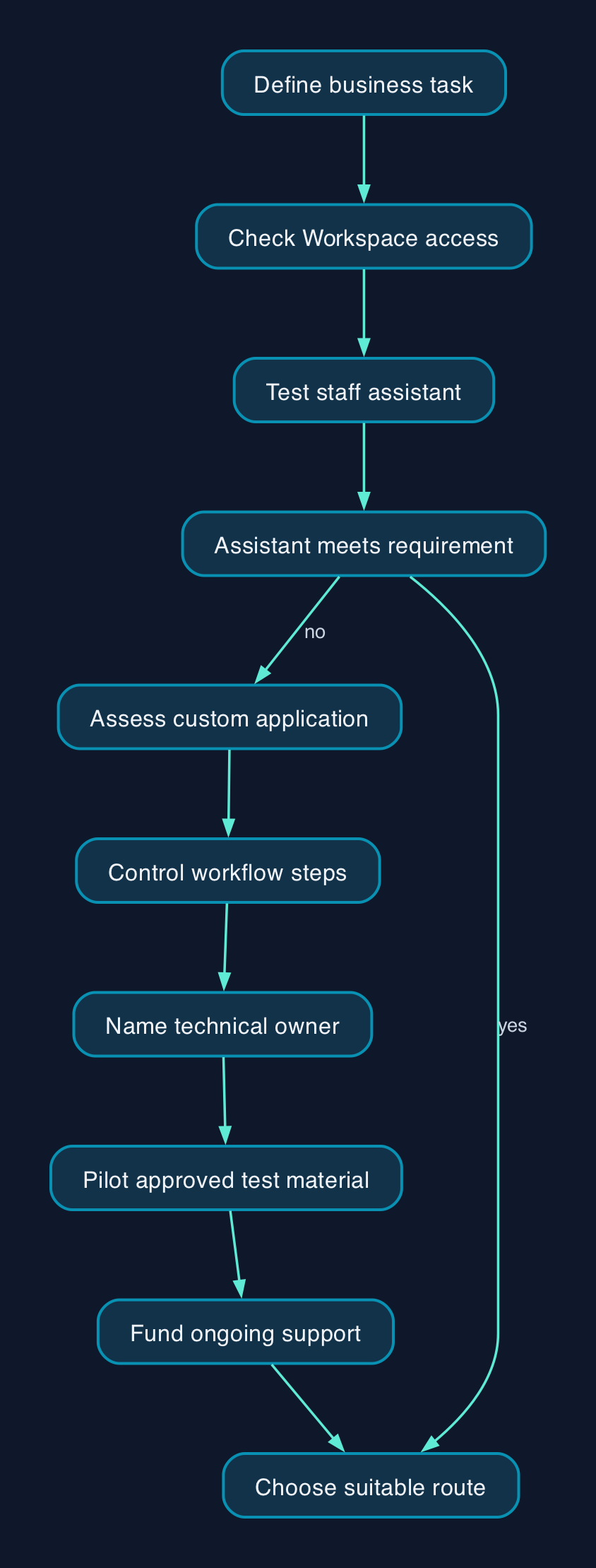
Pilot and rollout checklist
- [ ] Define the business task and record the current manual process, including where errors cause rework.
- [ ] Check the actual Workspace edition and Gemini Apps protection level against Google’s work-account guidance.
- [ ] Test whether the staff-facing application can meet the requirement before approving custom development.
- [ ] Name the business owner, technical maintainer and incident contact, including any partner’s support hours.
- [ ] Select the model and deployment route, then verify availability, location requirements, commercial terms and lifecycle.
- [ ] Build a pilot using approved test material, with a documented permission boundary and no unapproved production writes.
- [ ] Test representative successful tasks, incorrect inputs, restricted records and unavailable dependencies.
- [ ] Measure accepted outputs, human correction effort, response times and actual pilot charges against agreed acceptance criteria.
- [ ] Before changing a live workflow, back up affected configuration and data, train users and test the manual fallback.
- [ ] Retain the test set, configuration history and handover material so a model or supplier change can be evaluated.
Lifecycle checks deserve an explicit owner. Google’s supplied release notes identify Vertex AI Extensions as deprecated, with shutdown after 26 November 2026. If an implementation proposal includes Extensions, require its migration approach before accepting it.
Compare the routes against your operating capacity
The table below gives CTC’s suitability assessment. Product capabilities are linked to Google’s documentation; the recommendations are editorial judgements rather than measured rankings.
| Route | Best fit | Skills and support to budget for | Main constraint and exit question |
|---|---|---|---|
| Gemini Apps through the appropriate Workspace edition | Staff can complete the task within the available assistant features | Administration, user training and output review | Confirm edition-specific features and limits through the Workspace access table; check how working material will be retained or exported |
| Custom application using managed model access | Your software must control requests, responses and workflow steps | Application development, integration, testing and ongoing maintenance | Managed model APIs do not remove ownership of your application; retain code and replacement tests |
| Application using a separately deployed model | A specific model or serving requirement justifies additional infrastructure work | Model deployment, container configuration and operational support | Google’s endpoint deployment route adds infrastructure responsibilities; define how models and configurations transfer |
| Application using Gemma on your chosen hardware or hosting | You have a concrete reason to control the hosting environment | Hardware or hosting management, model operation and evaluation | Google describes Gemma deployment on hardware and hosted services; assess licence terms and operating costs separately |
Do not commission custom infrastructure merely because it offers more choices. Choose it when a tested requirement rules out the simpler routes and the organisation can support the additional work.
Editorial analysis
For a small business, the strongest reason to choose the developer platform is a workflow that cannot be delivered adequately inside the staff-facing application.
The weakest reason is an assumption that a platform automatically produces better answers. The supplied evidence contains no controlled comparison establishing that claim.
Require a pilot to demonstrate a specific improvement, such as fewer manual transfers, usable structured responses or reliable approval routing. Include the cost of maintaining that improvement. If the app meets the requirement, retaining it is a valid buying decision.
Sources
The supplied research was handed over on 28 September 2026. Publication or update dates are included below only where stated within the source text.
- Google Cloud, Vertex AI release notes and platform transition notice.
- Google, Use Gemini Apps with a work or school Google Account.
- Google, Gemini Apps limits and upgrades for Google AI subscribers.
- Google Cloud, Generate content with the Gemini API.
- Google Cloud, Overview of models on Agent Platform, updated 25 September 2026.
- Google Cloud, Deploy generative AI models.
- Google Cloud, Gemini Enterprise Agent Platform pricing.
- Google Cloud, Use Gemma open models.