

A UK organisation should add vector search when staff describe problems differently from the documents containing the answers. That does not automatically justify a separate vector database. Existing search platforms can combine keyword and vector retrieval, as Azure AI Search demonstrates. Start by testing your existing search against real questions, then choose a separate database only where measured improvements justify its integration, operating costs and support responsibilities.
Separate the retrieval problem from the database purchase
The useful distinction is between a search capability and the infrastructure providing it.
Keyword search matches words and terms. Vector search uses numerical representations, called embeddings, to find conceptual similarity. Hybrid search combines the two. Enterprise search and vector retrieval therefore overlap: Azure AI Search supports text and vector fields within the same index.
Consider a hypothetical British engineering distributor. A service adviser asks, “What should we check when the pump keeps getting too hot?” The relevant maintenance document might discuss “repeated thermal shutdown”. That is a sensible question for testing conceptual retrieval.
The same adviser might also need the instructions for an exact part code. A result about a similar component could be dangerous or simply waste time. Microsoft specifically identifies product codes and specialised terminology as cases where keyword matching can perform better.
For a small IT team, the first decision should be whether retrieval needs improving. Buying another database comes later.
When keeping existing search is sensible
Keep or improve your current search when testing shows that it reliably finds the correct, current documents for staff questions.
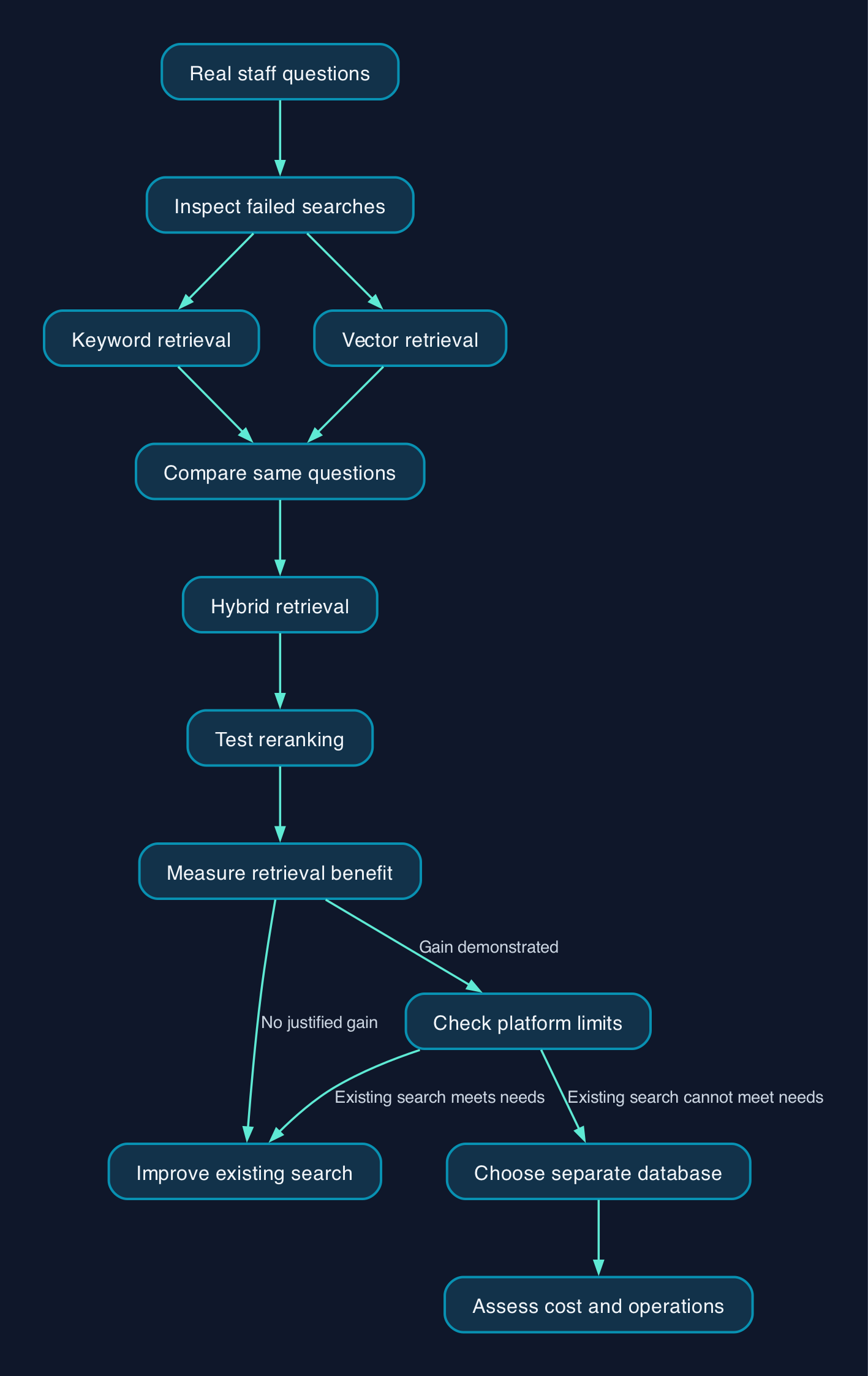
Before adding embeddings, inspect failed searches. Was the document missing? Was its title misleading? Did ingestion omit a table? Was an obsolete version ranked above the approved one? Treat these as content and retrieval defects to investigate, rather than assuming a new database will resolve them.
Retaining an existing service is especially attractive when its connectors, access controls and support arrangements already meet your needs. Verify those capabilities in your own installation; the evidence supplied here does not establish what your current enterprise search includes.
When vector retrieval earns its place
Trial vector retrieval when users routinely paraphrase documents, describe symptoms rather than formal terms, or ask questions whose relevant passages use different vocabulary. That follows the distinction between conceptual matching and exact matching in Microsoft’s retrieval documentation.
Compare keyword, vector and hybrid results against the same questions. Add reranking as a further experiment, not an assumed improvement. Microsoft’s implementation guidance recommends tuning incrementally.
A dedicated vector database becomes a credible choice when that trial establishes a retrieval benefit and your existing platform cannot meet the required integration, capacity, response time or operating requirements at an acceptable cost. These are procurement criteria, not a universal document-count threshold.
How the assistant should connect to company knowledge
Retrieval-augmented generation, usually shortened to RAG, gives a language model retrieved material to use when answering. Microsoft describes Azure AI Search as supporting applications built around this pattern.
The following is an illustrative responsibility model, not a claim that any named product supplies every component automatically.
| Stage | Proposed responsibility | Evidence required before acceptance |
|---|---|---|
| Source documents | Business owners approve content and identify authoritative versions | Named owners and a process for replacing obsolete material |
| Ingestion | The implementation team imports text, source references and access information | Checks that changes and removals reach the index |
| Retrieval | The search service finds relevant passages using the selected methods | Results tested against real questions and user permissions |
| Answer generation | The application supplies authorised passages to the model | Answers cite the correct sources and handle missing evidence |
| Operations | Internal IT or a contracted provider maintains the service | Monitoring, escalation, restoration and exit responsibilities |
Make permission handling an acceptance condition. Test whether restricted passages are excluded before they reach the answer-generating model, including after a user changes role.
Database access controls are only part of this design. For example, Weaviate documents role-based access control for its deployment, but that alone does not establish that an implementation preserves every permission from your document systems.
For UK procurement, request the locations of document storage, embedding generation, answer generation, logs and backups separately. The supplied evidence does not establish UK-region availability or contractual residency commitments across these options.
Costs beyond the vector index
Use the following as a cost model based on the evidence supplied for 28 September 2026. It is not a set of comparable UK quotations.
| Option | Documented charging basis | What a UK buyer should establish |
|---|---|---|
| Pinecone | Read units, write units, storage and data leaving the service, alongside applicable plan commitments | Expected usage, billing currency, tax treatment and any separate model costs |
| Amazon OpenSearch Service | Managed cluster instance hours, storage and transfer, or Serverless compute and storage | Selected region, deployment configuration, capacity and commitment terms |
| Azure AI Search semantic ranking | Usage-billed premium feature, with a limited free allowance | Base search costs plus the expected ranking and model charges |
| Self-managed Weaviate | Infrastructure requirements depend on the workload and index | Hosting, administration, monitoring, recovery, support and maintenance costs |
Sources for the charging bases are Pinecone’s cost guide, AWS pricing, Microsoft’s semantic ranking overview and Weaviate resource planning.
Pinecone illustrates why the smallest advertised figure needs context. Its documentation lists Starter at US$0 per month, Builder at US$20 per month, Standard at US$50 per month and Enterprise at US$500 per month. Builder is a flat fee covering included usage, with excess usage blocked. Standard and Enterprise charge for usage above their respective minimum commitments; the minimum is not added again on top of that usage. Pinecone explains the billing treatment.
These dollar figures are not GBP quotations or estimates of the full system. Pinecone’s supplied extract does not establish VAT treatment. AWS states that its published prices exclude applicable taxes, including VAT, unless otherwise noted. AWS pricing terms.
Ask suppliers to price the same operating period and workload. Include document preparation, connector development, embedding generation, index updates, model usage, permission testing, training, support and eventual export. Treat unpriced staff work as an unresolved cost, not a saving.
Self-hosting also needs a restoration budget. Weaviate’s production guide calls for monitoring, tested upgrades and disaster recovery procedures. Its resource guidance explains why memory and CPU requirements depend on the chosen index and workload.
Compare deployment routes against the same questions
The evidence supports several routes, but not a performance league table.
| Route | Documented basis | Circumstances worth testing | Main procurement question |
|---|---|---|---|
| Retain existing enterprise search | Establish its actual capabilities through your own configuration and contract | Current retrieval is accurate and the main gaps concern content or integration | Can it supply authorised, current passages to the assistant? |
| Azure AI Search | Combined keyword and vector retrieval, with optional semantic ranking | A team wants both retrieval methods within one search service | Does the additional ranking improve this organisation’s results? |
| Pinecone | Usage-based search infrastructure with documented full-text, vector and hybrid cost treatment | A team is evaluating a separately managed retrieval service | What will real reads, writes, storage and transfer cost? |
| Amazon OpenSearch Service | Managed cluster and Serverless commercial models | A team is assessing AWS-operated search infrastructure | Which exact configuration meets retrieval needs, and what capacity must be funded? |
| Self-managed Weaviate | Documented Kubernetes deployment and resource-management requirements | A team has the skills and a reason to operate the infrastructure | Who owns upgrades, incidents, capacity and restoration? |
The product evidence comes from Azure hybrid search documentation, Pinecone’s cost documentation, Amazon OpenSearch Service pricing and Weaviate’s production guide. The suitability assessments are editorial judgement.
The AWS extract establishes commercial deployment choices, not the detailed retrieval capabilities of a selected configuration. Confirm those before shortlisting. Equally, do not choose self-management solely to avoid a managed-service bill if nobody can take responsibility when the service fails.
Where a partner builds the assistant, require a handover covering source connectors, retrieval settings, permission mapping, evaluation questions, monitoring and export procedures. Ask whether ongoing support covers the complete application or only the database.
Editorial analysis
CTC’s position is that a vector database should solve a demonstrated retrieval or operating problem.
Build an evaluation set from actual staff questions, with document owners identifying acceptable supporting passages. Include paraphrases, exact identifiers, outdated documents, restricted material and questions the collection cannot answer. Keep a separate set of questions for checking the final configuration after tuning.
Measure retrieval and answer quality separately. First ask whether the right authorised passage was returned. Then assess whether the assistant used it accurately and cited it correctly. Record response time, operating effort and cost alongside quality.
This evidence pack contains supplier documentation, rather than an independent comparison across these products. It supports explaining the mechanisms and commercial choices, but not naming a universal winner. The strongest purchase case is your own reproducible improvement on questions that matter to the business.
Sources
The supplied extracts were used for this article on 28 September 2026. Publisher update dates were not independently established.
- Microsoft Learn — Hybrid search using vectors and full-text search in Azure AI Search
- Microsoft Learn — Semantic ranking in Azure AI Search
- Microsoft Learn — Add semantic ranking to queries in Azure AI Search
- Microsoft Learn — Create a hybrid query in Azure AI Search
- Microsoft Learn — Azure MCP Server tools for Azure AI Search
- Pinecone — Understanding Pinecone cost
- AWS — Amazon OpenSearch Service pricing
- Weaviate — Kubernetes getting to production
- Weaviate — Resource planning