

ChatGPT Enterprise UK data residency covers where in-scope customer content is stored at rest for supported features. It does not promise that every processing step, system record or connected service stays in the UK. OpenAI has introduced UK data residency for ChatGPT Enterprise, but buyers should assess storage, model processing and external integrations separately. The purchasing decision turns on which activities your organisation needs to keep within a UK boundary.
Start with the UK boundary your business needs
A UK business choosing ChatGPT Enterprise should first distinguish two requirements. One might be that covered content must be stored in the UK. Another might be that content must remain in the UK throughout storage, model processing and every connected workflow.
Those requirements lead to different purchasing decisions. OpenAI’s published boundary supports the narrower interpretation of data residency. It expressly warns against treating the selected region as a boundary around every processing step, system record or external integration.
For a small or mid-sized business, the practical task is to turn a broad instruction such as “keep our data in the UK” into requirements a supplier can answer. Identify the information covered, the activities covered and whether the restriction comes from your own policy or a customer contract.
Consider a hypothetical consultancy whose client requires project documents to be stored in the UK. Its assessment would differ from one whose client also restricts all processing and third-party access to the UK. The consultancy should obtain written confirmation against the actual requirement before approving that client’s documents for use.
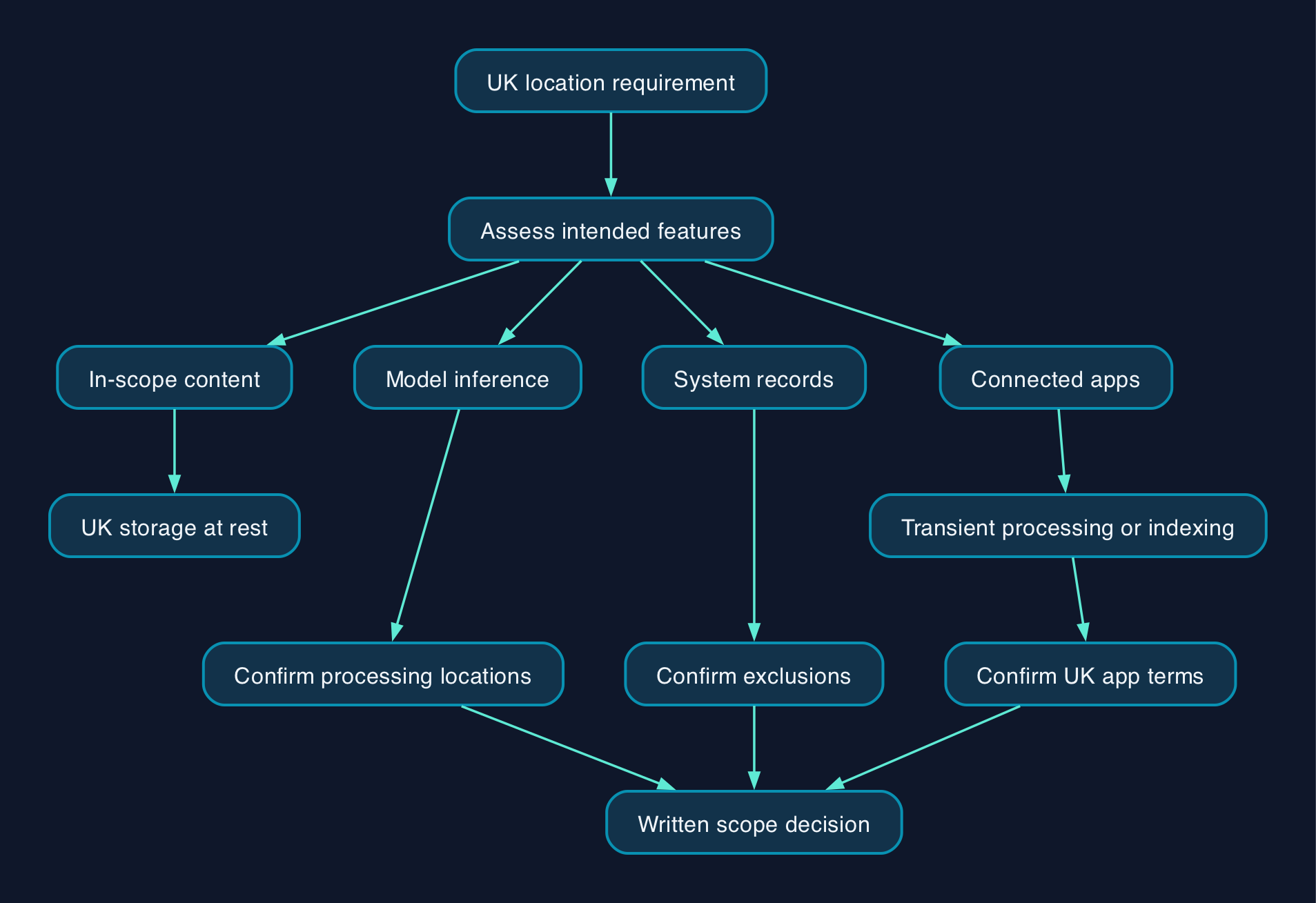
Storage and inference are separate questions
Storage at rest concerns content held by the service. Inference means the model processing a request to generate a response.
OpenAI distinguishes these concepts explicitly in its ChatGPT Business storage guidance. That page says a selected storage region does not determine where requests are processed and responses generated. This explains the distinction, but Business documentation should not be substituted for Enterprise terms.
For Enterprise, OpenAI separately lists data residency and inference residency among deployment controls. Buyers therefore need confirmation of both, rather than assuming the first includes the second.
The available source extracts do not establish the complete Enterprise content inventory, whether UK inference residency is available for the intended deployment, or an exhaustive list of processing countries and exceptions. Those points need written confirmation before accepting a requirement that all processing must stay in the UK.
Which activities may fall outside the UK commitment
The useful distinction is between an activity being covered by a UK commitment and an activity actually occurring abroad. An exclusion or missing assurance does not prove that a particular request went overseas.
OpenAI’s scope statement identifies processing steps, system records, external integrations and third-party apps as areas that a regional storage commitment does not necessarily contain. Treat these as separate lines in the supplier assessment.
| Activity or data category | What the evidence establishes | What the buyer should obtain |
|---|---|---|
| Covered content stored at rest | Residency applies to in-scope content for supported features. | The Enterprise content categories and features covered by the UK selection. |
| Model inference | OpenAI treats data residency and inference residency as separate controls. | Confirmation of processing locations for the models and features staff will use. |
| System records | The residency statement does not put every system record inside the selected region. | A description of excluded records, their contents and applicable location commitments. |
| Apps and external integrations | The storage commitment does not automatically contain external integrations or third-party apps. | The data flow, recipient and location terms for each approved connection. |
| Synced app content | OpenAI describes indexing for sync and gives an all-apps support statement for US and European residency workspaces. | UK-specific support and index-location confirmation for the selected app. |
| ChatGPT Sites | OpenAI states that Sites lacks data and inference residency support at launch. | Current feature terms before approving Sites for information subject to a UK location restriction. |
This assessment should follow the features employees will actually use. Approval for a basic chat workflow should not automatically approve a connected application or a hosted Site with a different residency position.
How connected workflows change the assessment
An illustrative workflow has three stages. An employee brings information into ChatGPT, the service processes the request, and a connected feature may retrieve or handle additional information. Each stage creates a separate question about content, processing and responsibility.
OpenAI’s app documentation distinguishes transient processing for chat and deep research from indexing for apps with sync. Indexing creates a separate location question because the buyer needs to understand where that indexed content falls within the agreed residency scope.
Assign the workspace administrator responsibility for the approved feature list. Give the business owner of each connected system responsibility for identifying the information involved. Procurement should then obtain terms covering the complete workflow.
For a business with limited IT staff, begin with the smallest feature set that meets the use case. Adding an app later should trigger a review of its data flow and residency terms before staff use it with restricted information.
Cost the required controls before signing
The supplied evidence contains no verified ChatGPT Enterprise GBP price or residency surcharge. A numeric price comparison would therefore be misleading.
Request a quotation for the configuration that meets your requirements. Ask it to identify the licence commitment, any applicable usage charges, included controls, support and the commercial treatment of any residency requirement.
Alongside the supplier quotation, budget for internal work. Relevant tasks include reviewing contractual scope, configuring the workspace, assessing connected apps, training staff and checking whether later feature changes affect the approved workflow. These are planning considerations, not claims that OpenAI charges separately for each task.
If the supplier cannot confirm a decisive location requirement, a lower licence price does not resolve that gap.
Editorial analysis
The right purchasing question is whether the agreed service scope matches the information and workflows your organisation intends to approve.
UK storage residency can address a defined storage requirement. An all-processing requirement needs additional evidence, particularly for inference, system records and connected features. The strongest buying position is a written schedule that pairs each intended feature with its covered content, location commitments and exclusions.
For smaller organisations, a narrow initial deployment makes that schedule easier to manage. Approve the use cases you can substantiate, assign someone to own changes, and expand when the evidence supports the next workflow.
Sources
- OpenAI — The next chapter for UK sovereign AI
- OpenAI Help Center — Admin controls, security, and compliance for plugins and apps
- OpenAI Help Center — Admin controls, security, and compliance in apps for Enterprise, Edu, and Business
- OpenAI Help Center — Managing ChatGPT Sites for your workspace
- OpenAI Help Center — Where your ChatGPT Business content is stored
- OpenAI Help Center — ChatGPT Enterprise admin quickstart