


A UK AI readiness assessment should establish which business problem is worth tackling, whether the necessary data and permissions are usable, who will operate the system, and how success will be measured before spending starts. For a small or mid-sized business, the useful output is a costed decision with named owners and clear conditions for a pilot. Keep buying licences, building agents and improving the existing process as separate options.
Start with a business decision
For a UK small business, CTC recommends commissioning the assessment around a named workflow and a spending decision. “Should we fund a pilot that drafts responses to delivery enquiries?” gives the assessor something testable. “How can we become AI-ready?” leaves the scope open.
Record the current workload, handling time, error rate and escalation process using the company’s own evidence. Agree what would count as an improvement and who can verify it. Do not present a supplier’s projected time saving as an established benefit.
Keep the existing process in the comparison. A clearer form, better search, a software configuration change or conventional automation should remain eligible outcomes.
Consider a hypothetical UK wholesaler receiving delivery enquiries by email. The assessment should examine whether staff can reliably find order status, whether customer records are accessible to the right people and whether the proposed tool would draft an answer or actually change an order. Those are different projects with different acceptance conditions.
What the assessment should deliver
The following is CTC’s recommended acceptance specification. It translates the skills, data and infrastructure checks in the adoption planning guidance into documents a buyer can inspect.
| Assessment area | Evidence to request | Decision it should support |
|---|---|---|
| Business case | Workflow description, measured baseline, intended benefit and accountable sponsor | Whether the problem justifies investment |
| Existing tools and processes | Current subscriptions, configurations, manual work and alternative fixes | Whether another purchase is necessary |
| Data readiness | Sample records, source owners, quality problems, update frequency and access restrictions | Whether the proposed output can be dependable |
| Technical fit | Required connections, identity arrangements, infrastructure and unresolved dependencies | Whether to buy, configure, build or defer |
| People and operations | Available skills, training needs, support owner and escalation arrangements | Whether the company can run the result |
| Security and authority | Permitted data, permitted actions, approval points and access-revocation procedure | How much authority a pilot should receive |
| Commercial scope | Assessment deliverables, implementation assumptions, recurring costs and exit work | What the business would actually commit to |
| Evaluation | Representative tasks, failure cases, acceptance thresholds and stop conditions | Whether a pilot earns further funding |
Each finding should identify its evidence, owner and next action. “Data quality is amber” is insufficient without explaining which records are unreliable, which proposed use case depends on them and what remediation would cost.
A scorecard can help organise the findings. CTC’s recommendation is to treat unresolved permissions or missing operational ownership as explicit blockers rather than letting a favourable average score obscure them.
Map the workflow and its responsibilities
An assistant that drafts text for review and an agent authorised to update business records need different assessments. The distinction follows from the delegated authority described in agent governance guidance.
For the hypothetical wholesaler, a proposed pilot could retrieve order information and prepare a reply for a staff member to approve. Changing delivery instructions or issuing refunds would remain outside that pilot’s authority.
The assessment should describe that boundary in operational terms.
| Part of the proposed workflow | Suggested owner | Evidence required before a pilot |
|---|---|---|
| Receiving the enquiry | Customer service lead | Defined enquiry types and exceptions |
| Retrieving order information | Data owner and IT administrator | Approved sources and tested access restrictions |
| Producing a draft | Technical owner and process owner | Representative examples and agreed quality checks |
| Approving an external response | Customer service supervisor | Review responsibility and escalation rules |
| Monitoring failures and costs | Service owner | Logs, spending controls and incident procedure |
| Suspending access | IT administrator | Tested way to disable the connection and resume manual work |
These roles are proposed responsibilities, not a requirement to create separate jobs. A small company may assign several to one person, provided the person has the authority and time to fulfil them.
Ask the assessor to document where information travels, which account each connection uses and what happens when a dependency fails. Require a distinction between something demonstrated in a test and something merely proposed.
Check UK contracts and data handling
For a UK buyer, the assessment brief should request GBP quotations, explicit VAT treatment, support hours stated in UK time and clear responsibility for subcontracted work. Any requirement concerning storage location, overseas access or customer confidentiality should become a documented selection criterion.
Where a proposed use case involves employee records, customer information or consequential decisions about people, commission an appropriate review of the actual data flow and intended use. A supplier’s generic assurance statement should not close an unresolved question in the assessment.
The supplied evidence does not establish the legal requirements for a particular deployment. This is not legal advice; consult your legal counsel.
Separate the assessment fee from the implementation budget
Request separate estimates for diagnosis, remediation, a pilot and ongoing operation. Otherwise, a relatively small assessment fee can become the starting point for an undefined implementation commitment.
One published example illustrates the difference between stages. The AI Consultancy’s pricing page, supplied in the evidence retrieved on 28 September 2026, lists a Readiness Sprint from £3,500, Discovery and Pilot from £15,000, and Build and Embed from £40,000, all excluding VAT. These are that supplier’s starting fees for different scopes, not market averages, equivalent alternatives or a complete project total.
The readiness package describes a two-week engagement with a report and workshop. It explicitly excludes writing code and conducting procurement on the client’s behalf. Payment terms and stage gates are agreed before work begins.
For the subsequent business case, CTC recommends a cost model covering the following items.
| Cost component | What to establish |
|---|---|
| Assessment | Departments, interviews, sample review, workshops and final deliverables included |
| Preparation | Data correction, permissions work and process documentation |
| Software and usage | Required editions, seats, consumption charges, commitments and limits |
| Implementation | Configuration, connections, testing and migration work |
| People | Staff participation, training, supervision and continuing administration |
| Operations | Monitoring, support, maintenance and incident handling |
| Exit | Data export, access removal, documentation and supplier handover |
State the evaluation period and separate one-off costs from recurring charges. Treat any unpriced component as unresolved, rather than assuming it costs nothing.
Compare assessment routes before choosing a supplier
The available evidence supports a comparison of assessment approaches. It does not support a current feature or price ranking of Google, AWS, Microsoft, other application suppliers or open-source deployment options. Those choices should follow the workflow requirements and receive their own product-specific checks.
The following examples have different scopes and commercial bases.
| Route and example | What the supplied source establishes | What the buyer still needs to establish |
|---|---|---|
| Vendor questionnaire through Microsoft Assessments | A structured readiness questionnaire with personalised guidance | Who will validate answers against actual systems and consider alternatives outside the vendor’s ecosystem |
| Focused consultation from HeyBRB | Its page advertises an assessment at £499 and describes workflow interviews and recommendations | VAT treatment, technical inspection depth and whether the scope covers the proposed agent’s permissions |
| Fixed-scope Readiness Sprint described above | A report, data audit, stakeholder walkthrough and prioritised use cases, with implementation excluded | Whether the stakeholder coverage and evidence review are sufficient for the business |
| Broader consultancy through Sopra Steria’s Digital Marketplace listing | Stakeholder consultation, process and architecture review, risk assessment and a roadmap; the listing displays £530 a unit a day | The meaning of the billing unit, staffing, duration, VAT, contractual scope and applicable procurement route |
The marketplace listing identifies G-Cloud 14. Its displayed rate should not be treated as a complete assessment price or a quotation available on identical terms to a private business.
For any assessor, request a sample deliverable with confidential information removed. Ask how recommendations are separated from subsequent implementation sales, whether referral arrangements exist and whether the report can support procurement from another supplier. Those are due-diligence questions, not allegations about the providers listed here.
Editorial analysis
CTC’s position is that readiness should be judged at workflow level. A business may be prepared to test an internal drafting assistant while lacking the permissions, supervision or recovery arrangements needed for an agent that changes customer records.
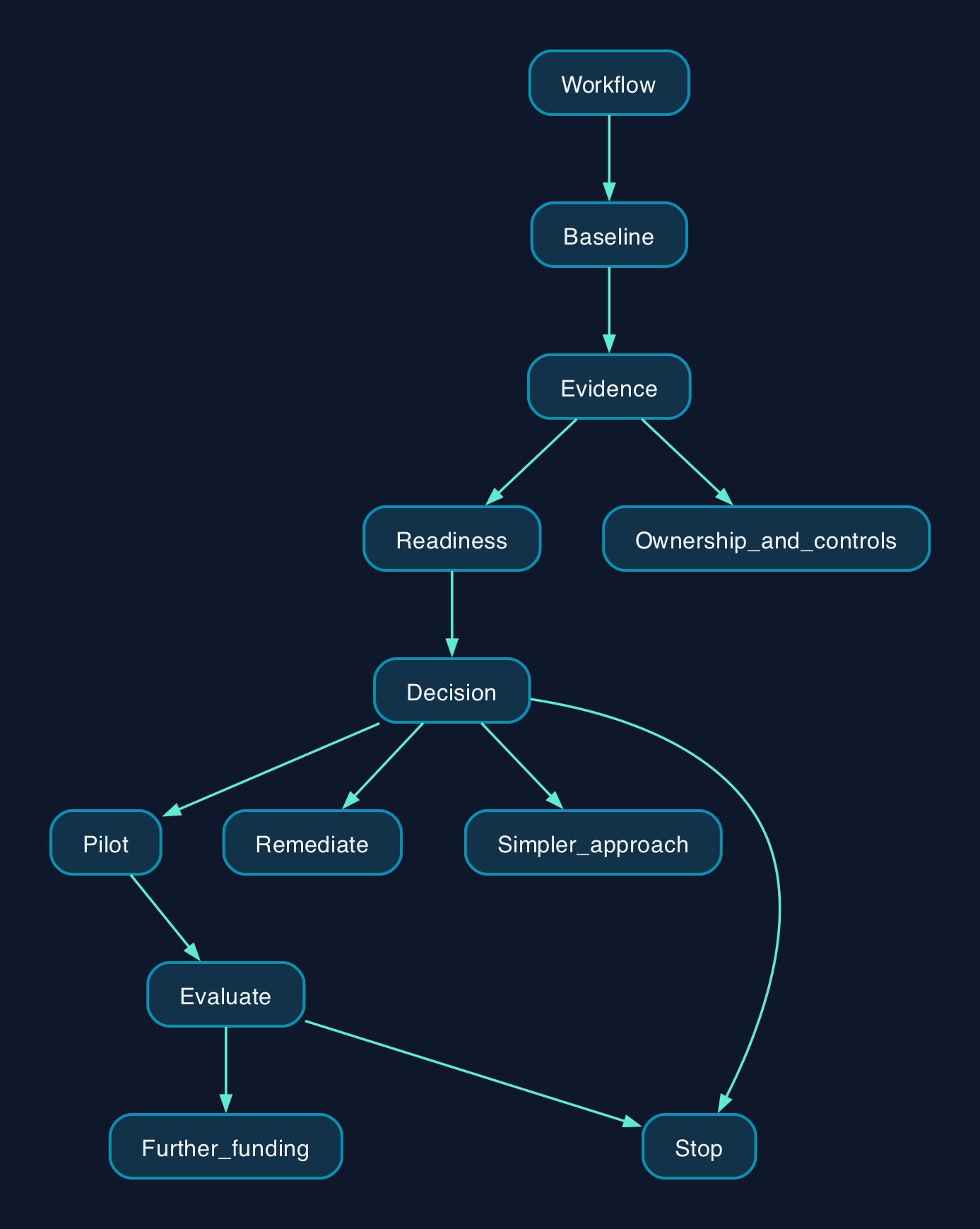
The strongest assessment therefore ends with a decision for each proposed use case. Proceed to a bounded pilot, repair a named dependency, select a simpler approach or stop. Each decision should have an owner, supporting evidence and a spending implication.
Before buying licences in volume, require a written pilot brief stating the approved users, data, actions, budget and acceptance conditions. Before increasing an agent’s authority, require evidence that its controls and recovery procedure work. A favourable presentation alone should not release the next budget.
Sources
The article uses the supplied source extracts retrieved on 28 September 2026. Prices and service descriptions should be reconfirmed before purchase; publication dates are not established for every page.
- Microsoft Learn — AI Readiness Assessment
- Microsoft Learn — Plan for AI adoption
- Microsoft Learn — Govern and secure AI agents
- Microsoft Learn — AI governance and security maturity
- Microsoft Learn — Organisation and culture maturity
- The AI Consultancy — AI Consultancy Pricing
- HeyBRB — AI Consulting UK costs and deliverables
- Digital Marketplace — Sopra Steria AI Readiness Assessment