
Yes, a growing UK online retailer should run independent uptime monitoring before Black Friday, Cyber Monday and Christmas, because a storefront outage during peak trading costs sales in real time. UptimeRobot is the cheapest and fastest for basic up-or-down checks; Better Stack adds unlimited phone call alerts and scripted checkout testing on top of a paid seat; Pingdom is the only one with checkout-flow testing built into its price with no script to write, at a higher cost per check.
Key pointers
- A storefront outage during Black Friday or the Christmas run-up costs live sales every minute it lasts, and the three tools differ sharply on how fast they catch one and how they alert you.
- UptimeRobot's cheapest paid tier, Solo, starts at €13 a month (about £11.14 at the reference rate used below) or €12 a month billed annually, for 10 monitors on a 60-second check.
- Better Stack's free tier covers 10 monitors and one status page for $0, but its fastest interval (30 seconds) needs the paid Responder seat at $34 a month (about £25.67), or $29 a month billed annually.
- Pingdom prices per check on a slider rather than in named plans; the entry step (10 uptime checks, 1 transaction check, 50 SMS credits) showed £14 a month, or £12.16 a month billed annually, when fetched directly for this article, though the figure appears to vary by the visitor's detected region, so treat it as indicative and get a quote for your own account.
- Neither of the two free tiers is really built for a live storefront, and Pingdom offers a free trial rather than a free plan: UptimeRobot pitches its free plan at "hobby and non-profit" use, and Better Stack calls its free tier "free for personal projects".
- Pingdom's basic uptime checks run no faster than 60 seconds even on its priciest step, slower than UptimeRobot's 15-second Scale tier and Better Stack's 30-second Responder plan.
- Ask any supplier how an alert reaches an out-of-hours phone before you commit. Better Stack bundles unlimited phone call alerts into its paid Responder seat; UptimeRobot sells SMS and voice credits in one-off blocks; Pingdom has no phone call alert option at all, only email, SMS credits, push and webhook or Slack integrations.
- Online spending values in Great Britain rose 2.5% month-on-month to August 2026, a rebound from a change of -4.2% in July, so the busiest trading weeks are also the ones where a slow free-tier check interval matters most.
What Storefront Uptime Monitoring Actually Buys You
Uptime monitoring is a third-party service that pings your website from outside your own hosting, on a fixed interval, and tells you the moment it stops responding. That is a different job from the analytics, error tracking or full observability stacks aimed at engineering teams running complex infrastructure. A growing retailer with its own website, whether on Shopify, WooCommerce or a custom platform, usually does not need log aggregation or distributed tracing. It needs to know within seconds, not minutes, when the storefront, the checkout or the payment redirect stops working, and it needs that alert to reach a real person who can act.
The decision matters more around peak trading because the cost of a slow detection compounds. A five-minute gap between checks on a quiet Tuesday might mean a handful of missed visits. The same five-minute gap during a Black Friday sale, with paid traffic running and a fixed promotional window, can mean a meaningful chunk of the day's revenue before anyone notices. None of the three services here can prevent an outage. What they buy you is faster, more reliable notice, and in Pingdom's case, notice that the checkout itself, not just the homepage, is the thing that broke.
How Each Service Watches Your Storefront
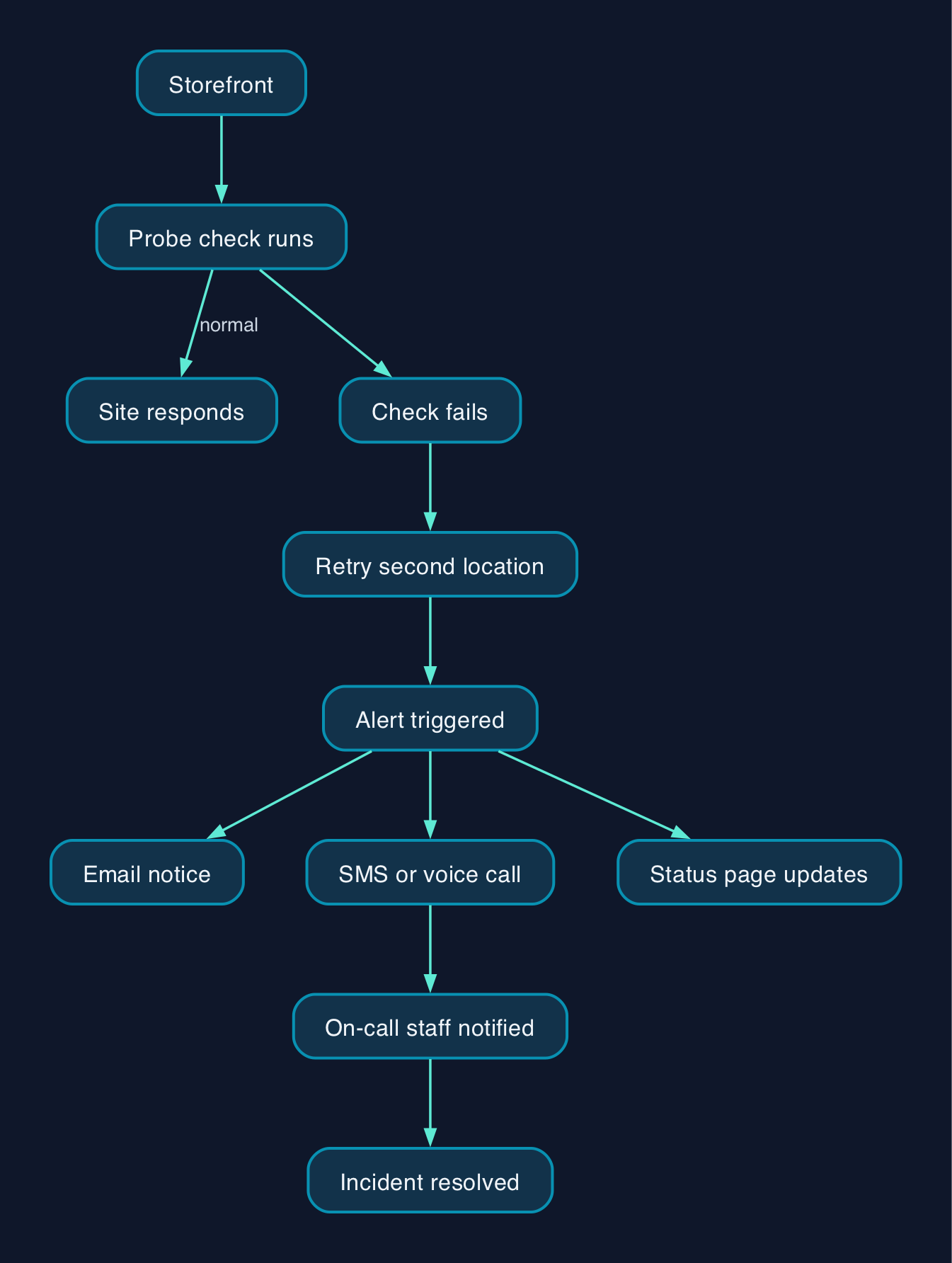
All three work on the same basic mechanism: a probe outside your infrastructure requests your site on a fixed interval, and if that request fails or times out, the service confirms the failure (often from a second location, to rule out a local network blip) before it fires an alert. The alert can go by email, SMS, voice call, Slack, Teams or a webhook into your own tools, depending on the plan, and a public status page can update automatically so customers and support staff see the same information.
UptimeRobot and Better Stack both price around monitor count and check speed: how many endpoints you watch and how often. UptimeRobot's tiers step up together, monitor count and interval both increasing as you pay more, and it has no transaction-testing feature at any tier. Better Stack bundles a fast interval into its paid Responder seat regardless of monitor count, then lets you add extra monitor packs on top. Pingdom works differently again. Its calculator sells uptime checks, transaction checks and SMS credits as one bundle on a single slider.
Two of the three can also drive a browser through a real user journey, such as login, search or a shopping cart checkout, rather than just requesting a single URL, but they do it differently. Pingdom's transaction checks are configured through its own interface and included in the calculator price. Better Stack's equivalent runs a Playwright browser-automation script that you write yourself, or generate with Playwright's code recorder or an AI assistant, and it is billed separately from the Responder seat at $1 per 100 Playwright minutes of execution.
Pricing and Cost Model
Prices below are as fetched directly from each vendor's own pricing page for this article. UptimeRobot showed euros to a UK browser on 29 September 2026, and Better Stack lists only in US dollars. Pingdom's calculator returned pounds sterling on every check made for this article, but its underlying pricing script showed no currency-selection logic of its own, and a separate check of the same page found a different figure in US dollars, so Pingdom's price most likely varies by the visitor's detected region rather than being one fixed global number. Confirm your own quote and billing currency at checkout rather than relying on any figure here. The GBP-equivalent column for UptimeRobot and Better Stack is a reference estimate only, calculated at the EUR-to-GBP rate of 0.85718 and the USD-to-GBP rate of 0.75489 published by the European Central Bank via Frankfurter's currency API on 29 September 2026, not either supplier's actual UK price; your card issuer's own exchange rate and any FX fee will differ.
| Vendor | Entry paid step | Monthly price | Annual price (per month) | GBP equivalent (monthly, reference rate) | Monitors or checks included | Fastest interval |
|---|---|---|---|---|---|---|
| UptimeRobot | Solo | €13 | €12 | about £11.14 | 10 monitors | 60 seconds (Solo); 15 seconds on Scale |
| Better Stack | Responder | $34 | $29 | about £25.67 | 10 monitors carried over from the free tier, plus paid add-on packs | 30 seconds |
| Pingdom | Synthetic Monitoring entry step | £14 (as served to this fetch) | £12.16 (as served to this fetch) | not applicable; price appears region-dependent | 10 uptime checks, 1 transaction check, 50 SMS credits | 60 seconds (all steps) |
VAT treatment is not stated on any of the three pricing pages, but the billing entity behind each one is on the record. UptimeRobot is billed by UptimeRobot s.r.o., an EU-registered company in Bratislava, Slovak Republic, with its own EU VAT number, so a UK business should expect this to be treated as an EU B2B supply. Better Stack is billed by Better Stack, Inc., a Delaware (US) corporation whose own terms state that payments are "exclusive of any taxes, duties, tariffs, levies and withholdings", which the customer is responsible for. Pingdom operates as a SolarWinds brand. Confirm the actual VAT and invoicing treatment with each supplier before budgeting, rather than assuming reverse charge applies uniformly.
For a retailer running roughly 10 to 20 endpoints (storefront, checkout, key API routes, a status page), the practical entry costs are UptimeRobot Solo at €13 a month (about £11.14), Better Stack's free tier plus one Responder seat at $34 a month (about £25.67) if you want phone alerts and faster checks, or Pingdom's entry step, which showed £14 a month when fetched for this article but should be quoted for your own account, if checkout-flow testing is worth paying for on top of basic uptime checks.
Vendor and Option Comparison
| Criterion | UptimeRobot | Better Stack | Pingdom |
|---|---|---|---|
| Fastest available interval | 15 seconds (Scale tier) | 30 seconds (Responder) | 60 seconds (every tier, per its own setup guide) |
| Checkout or transaction testing | Not offered at any tier | Playwright browser scripts, self-written, metered at $1 per 100 minutes | Configured in the interface, bundled into the calculator price |
| Free tier suitability for a live store | 50 monitors, but positioned for "hobby and non-profit" use, 5-minute checks | 10 monitors, positioned as "free for personal projects", 3-minute checks | None; sign-up is trial-based |
| Phone and SMS alerting | SMS and voice credits bought separately, one-off | Unlimited phone call alerts bundled into the Responder seat | SMS credits bundled per pricing step; no phone call alert option |
| Status pages | Included from Solo, white-label from Team | Included from the free tier | Listed as a feature at every step, without a stated page limit |
| Currency on its own pricing page | Euros, as shown to a UK visitor | US dollars | Pounds sterling, on the check made for this article |
| Best fit | A retailer that mainly wants fast, cheap alerts across many endpoints | A retailer that also wants incident tooling and guaranteed phone escalation bundled in | A retailer that needs to know the checkout itself still works, not just that a page loads |
No option here is a universal winner. A retailer running a simple storefront with a handful of pages is unlikely to need transaction checks at all and would be overpaying for them. A retailer whose checkout has broken silently before, where a page loads but payment fails partway through, needs one of the two that test the actual journey: Pingdom if a configured-not-coded check fits the team better, or Better Stack if someone is comfortable writing or generating a short Playwright script and paying for it by the minute. UptimeRobot does not currently offer this capability on any plan.
Getting Ready Before Peak Trading
- Map every URL that has to work for a sale to complete: homepage, product pages, cart, checkout, payment redirect and order confirmation, not just the homepage.
- Set your check interval to match how much revenue a short outage would cost. A five-minute interval on a quiet month may be fine; consider a faster paid tier for the promotional weeks themselves.
- Decide who is actually on call for an alert at 2am on Black Friday, and confirm the alert channel, phone, SMS or Slack, reaches that person's device, not just an inbox nobody checks after hours.
- Set up a public status page before you need one. Customers searching "is [retailer] down" during an outage should find your own status page, not a social media thread.
- Test the alert path once, deliberately, before peak trading starts. Trigger a failure on a test URL and confirm the notification actually arrives and escalates as configured.
- If your checkout has a multi-step flow, weigh whether basic uptime checks are enough or whether transaction monitoring that walks through login, search and checkout would have caught a past failure sooner.
Editorial Analysis
Price per monitor is not the number that matters most here. A retailer that picks the cheapest plan and gets a useful alert 90 seconds after checkout breaks is better off than one on a pricier plan that never tests the checkout at all. The real trade-off is between speed (how fast a check runs and how reliably the alert reaches a person) and depth (whether the tool tests just a URL or an actual user journey). UptimeRobot and Better Stack are the stronger choice on speed and cost for a retailer that mainly needs to know the site is up. Pingdom is the stronger choice for a retailer whose past failures have been in the payment or checkout flow rather than the homepage. Buying both a fast basic monitor and, closer to peak trading, a short-term transaction-monitoring add-on is a reasonable middle path for a retailer that cannot yet justify the depth of Pingdom's plans year-round.