

For a UK enterprise paying Oracle Database Enterprise Edition support every year, managed PostgreSQL could reduce recurring costs. In this worked example, AWS compute and storage cost £32,792 annually against £78,389 for Oracle's first-year support at list prices, although equivalent workload capacity has not been demonstrated. The decision turns on your actual Oracle renewal quote, the target configuration and how much Oracle-specific code needs conversion, testing or rewriting before the migration saving starts.
Key pointers
- Oracle Database Enterprise Edition costs $47,500 per Processor licence plus $10,450 for the first year of Software Update Licence & Support, list price (Oracle Technology Global Price List, 15 September 2026).
- Current AMD EPYC and Intel Xeon chips carry Oracle's 0.5 core factor, so licensing all 16 physical cores in the example requires 8 Processor licences (Oracle Processor Core Factor Table).
- PostgreSQL itself has no licence fee, but managed services can charge for compute, storage, data transfer, provisioned IOPS, additional throughput, monitoring and extended-version support.
- Migration costs depend on the constructs in your codebase and the target service, because tools automate some PL/SQL conversion while other objects need manual changes.
- Ask any commercial Postgres or hyperscaler supplier three things: what percentage of your schema converts automatically, what their Oracle-compatibility features cover, and what a Multi-AZ or zone-redundant configuration actually costs per year.
- EDB Postgres Advanced Server's Oracle-compatibility features can reduce rewriting, but require an EPAS deployment with its own commercial subscription.
- Staying on Oracle but moving it into Oracle Cloud Infrastructure, on consumption-based ECPU pricing or Bring-Your-Own-Licence terms, is a real middle option if a full migration is not worth the risk this year.
- Get your own core count and option list priced against the vendor's own price list, and obtain your actual renewal quote for an existing deployment, before you trust anyone else's TCO model, including this one.
Why UK Enterprises Are Reconsidering Oracle Licensing
Oracle Database Enterprise Edition is licensed by Processor or by Named User Plus. This example uses the Processor metric and assumes the whole server is within the licensing scope. For AMD EPYC and current Intel Xeon chips, the core factor is 0.5, so a two-socket server with eight cores per socket (16 physical cores) needs 8 Processor licences. At $47,500 per Processor for Enterprise Edition, that is $380,000 in perpetual licence fees before a single option is added, plus $83,600 for the first year of Software Update License & Support (Oracle's own name for this line item) at the published 22% rate.
Options add to the Enterprise Edition price where the deployment requires them. Partitioning costs $11,500 per Processor plus $2,530 first-year support. Real Application Clusters costs $23,000 per Processor, and Active Data Guard costs $11,500 per Processor. Each option repeats the licence-plus-22%-first-year-support arithmetic on top of the base Enterprise Edition fee in Oracle's published price list.
Lower utilisation alone does not reduce licensing requirements, but the licensable core count depends on the deployment and applicable terms. PostgreSQL itself carries no licence fee. Managed PostgreSQL services still charge for infrastructure and applicable extras: AWS lists charges including data transfer, provisioned IOPS, additional throughput, monitoring and extended-version support alongside compute and storage (AWS pricing). That difference in cost structure is a reason to compare the full recurring bills before a renewal.
What Oracle Costs You Today
Using Oracle's own published price list, a UK enterprise purchasing Oracle Database Enterprise Edition with the Partitioning option for a single two-socket, 16-core server would incur the following licence and first-year support costs, in US dollars at Oracle's global list price, before any negotiated discount:
Assumptions: all 16 physical cores are within the licensing scope, AMD EPYC or a current Intel Xeon (0.5 core factor), licensable Processors = 16 × 0.5 = 8. GBP figures use the European Central Bank's 29 September 2026 reference cross-rate of 1 USD = £0.7549 (ECB reference rates); this is an exchange-rate estimate, not a UK quoted price, and moves with the market and with any discount Oracle offers. GBP values are rounded to the nearest pound after conversion.
| Component | Formula | USD | Indicative GBP |
|---|---|---|---|
| Enterprise Edition licence (one-off) | 8 × $47,500 | $380,000 | £286,862 |
| Partitioning licence (one-off) | 8 × $11,500 | $92,000 | £69,451 |
| Enterprise Edition support (first year) | 8 × $10,450 | $83,600 | £63,110 |
| Partitioning support (first year) | 8 × $2,530 | $20,240 | £15,279 |
| Total first-year support | $103,840 | £78,389 |
That £78,389 represents first-year support on top of a fresh £356,313 licence purchase at these list prices and the stated exchange rate. Page 15 of Oracle's price list specifies that published support prices apply to the first year only; renewals use the previous year's support fees plus Oracle's Inflationary Adjustment Rate, subject to applicable contractual caps. An existing deployment requires its actual renewal quote. These figures do not include the server hardware or DBA time.
What Managed PostgreSQL Costs Instead
PostgreSQL itself has no licence fee. The following examples use AWS's and Microsoft's published UK-region rates, but they are different configurations and do not establish equivalent workload capacity to each other or to the Oracle server.
Annual costs assume 8,760 hours of operation. The AWS storage calculation treats 2 TB as 2,000 billed GB and uses the Multi-AZ rate of $0.266 per GB-month, giving 2,000 × $0.266 × 12 = $6,384. Figures exclude applicable VAT and service charges beyond the components shown.
| Option | Spec | Deployment | Annual cost (USD) | Indicative GBP |
|---|---|---|---|---|
| AWS RDS for PostgreSQL, eu-west-2 (London) | db.r6g.4xlarge, 16 vCPU, 128 GiB | Multi-AZ with one standby (compute only) | $37,054.80 | £27,973 |
| AWS RDS for PostgreSQL storage, 2 TB gp3 | eu-west-2 (London), 2,000 billed GB | Multi-AZ with one standby | $6,384 | £4,819 |
| AWS RDS total (compute + 2 TB storage) | Multi-AZ with one standby | $43,438.80 | £32,792 | |
| Azure Database for PostgreSQL Flexible Server, UK South | Standard_D16ds_v5, 16 vCore, 64 GiB, General Purpose | Single instance (non zone-redundant), compute only | $14,436.48 | £10,898 |
Source: AWS RDS for PostgreSQL pricing and Azure Database for PostgreSQL Flexible Server pricing, with rates checked on 29 September 2026.
That AWS Multi-AZ figure, £32,792 a year for compute and 2 TB of storage, is approximately 41.8% of the example's £78,389 first-year Oracle support cost, before counting Oracle's one-off licence purchase. It is a comparison of selected cost components, not evidence that the configurations deliver equivalent performance or that an existing deployment's renewal would cost £78,389.
The Azure figure covers a single instance with half the AWS instance's RAM and excludes storage. Adding zone-redundant high availability doubles Azure compute to $28,872.96 annually before storage, compared with $37,054.80 for AWS compute alone. Multi-AZ and zone redundancy therefore need their own cost calculations; they are not free additions to the single-instance price. PostgreSQL table partitioning carries no extra database licence fee.
These examples do not include a separate commercial PostgreSQL support subscription. EnterpriseDB's own documentation for its EDB Postgres AI Cloud Service shows estimated management-infrastructure costs of $400-700 a month for Azure, $400-600 for AWS and $600-800 for Google Cloud at list price. These are infrastructure estimates, not support-subscription quotes; EDB's service pricing is based on provisioned vCPUs, while infrastructure in a customer's own cloud account is billed by that cloud provider (EDB pricing and billing). Community PostgreSQL with no paid support contract is also a legitimate choice for teams confident in their own DBA skills, since the licence itself is free either way.
What the Migration Adds to the Cost
The licensing saving is straightforward to calculate. The migration project is not, because it depends on how much Oracle-specific code your applications rely on.
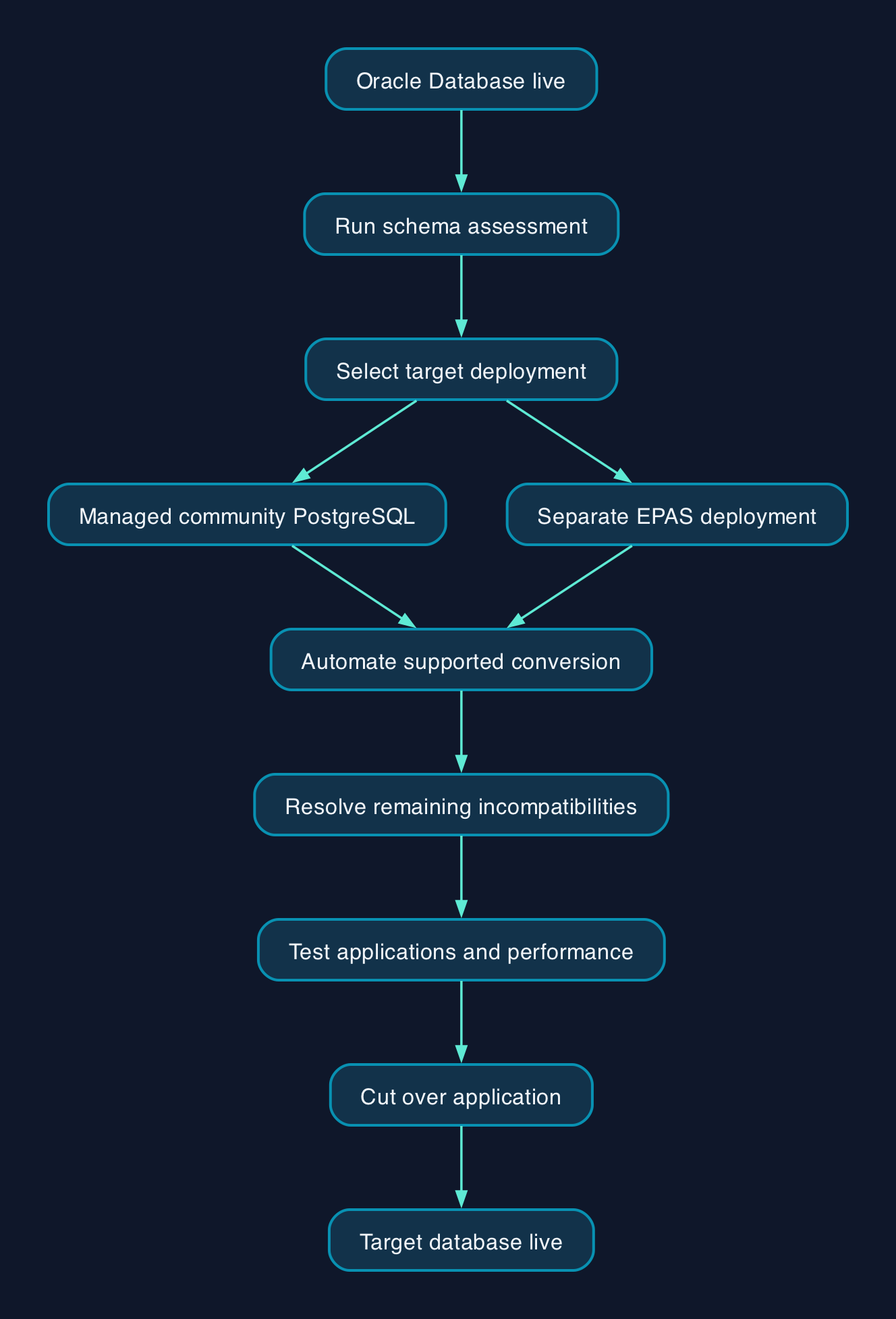
Schema conversion tools automate part of the work. AWS's Schema Conversion Tool (SCT) connects to the source Oracle database, converts the schema and produces an assessment report showing which objects converted cleanly and which need manual attention (AWS SCT documentation). Ora2Pg is a free, open-source tool that scans an Oracle database, extracts its structure or data and generates SQL scripts for PostgreSQL; it also automates some PL/SQL conversion, including autonomous-transaction wrappers using dblink or pg_background (Ora2Pg project documentation). One licensing consultancy puts typical automatic conversion rates at 75-92% of schema objects, a figure it presents as its own benchmark rather than a number either Oracle or AWS publishes (Oracle Licensing Experts).
PL/SQL can concentrate the remaining effort. Packages, autonomous transactions, Oracle-specific built-in procedures such as DBMS_OUTPUT and DBMS_LOB, and some cursor-handling patterns require assessment against the conversion tool and target service. They do not universally require manual rewriting. The same consultancy estimates 6-9 person-months of manual conversion work for a 200,000-line PL/SQL codebase; that is its worked estimate, not a vendor-published figure or a quote for your estate.
EDB Postgres Advanced Server can narrow the compatibility gap, at a cost. EDB's Oracle-compatible features include a PL/SQL-compatible stored procedural language, Oracle-style data-dictionary views, and dblink_ora, an OCI-based database link that lets EDB Postgres Advanced Server query a live Oracle system directly, useful for a phased cutover (EDB compatibility documentation). EPAS is a separate database distribution requiring its own deployment and commercial subscription, not an extension you can add to RDS or Aurora PostgreSQL. Its effect on conversion effort needs testing against your codebase.
Oracle-specific architecture also needs assessment. Real Application Clusters' shared-storage active-active clustering, Exadata-specific hardware optimisations and some advanced spatial 3D functions do not map cleanly onto PostgreSQL or its managed-service equivalents in the consultancy's comparison. If your workload leans heavily on any of these, migration risk rises accordingly and a like-for-like comparison stops being simple.
Options Compared
| Option | Licence cost | Where it runs | Best fit | Weakest point |
|---|---|---|---|---|
| Stay on Oracle Database EE (on-premises or lift-and-shift) | $47,500/Processor plus 22% first-year support, list price; existing deployments need their actual renewal quote | Existing data centre or IaaS | Heavy RAC, Exadata or PL/SQL estates where rewrite risk outweighs the saving | Recurring support and infrastructure costs remain |
| Oracle Base Database Service (OCI) | Consumption (ECPU-hour), with software and support included or BYOL | Oracle Cloud Infrastructure | Staying on Oracle's engine while moving off owned hardware | Requires pricing the selected service and applicable licence terms |
| AWS RDS or Aurora for PostgreSQL | No PostgreSQL licence fee; AWS service charges apply | AWS, UK region available (eu-west-2 London) | Teams already on AWS wanting a fully managed database | Conversion work depends on the codebase; EPAS compatibility requires a separate EPAS deployment |
| Azure Database for PostgreSQL Flexible Server | No PostgreSQL licence fee; Azure service charges apply | Azure, UK region available (UK South) | Teams already on Microsoft Azure | Zone redundancy doubles the compute cost shown here |
| EDB Postgres Advanced Server / EDB Postgres AI | PostgreSQL free; EDB subscription on top | EPAS deployment or EDB's cloud service using AWS, Azure or Google Cloud | Large PL/SQL estates that need Oracle-compatible features to reduce rewriting | Adds a commercial subscription that must be included in the comparison |
| Self-managed community PostgreSQL | None | Own servers or any cloud VM | Teams with strong in-house PostgreSQL DBA skills wanting full control | You own patching, backup, HA and on-call unless you buy support |
No option here is universally right. A UK enterprise with a modest PL/SQL footprint and a mature AWS or Azure estate has a straightforward case for assessing RDS or Flexible Server. A UK enterprise with a large, RAC-dependent, deeply PL/SQL estate may find EDB Postgres Advanced Server, or simply staying on Oracle in OCI under BYOL terms, the lower-risk route this year, even though it defers the licensing saving.
Questions to Put to Any Supplier Before You Commit
- What percentage of our actual schema converts automatically with your tooling, based on a real assessment report against our database, not a generic industry figure?
- What specifically in our PL/SQL codebase will need manual rewriting, and can you quantify it in person-days rather than a percentage?
- What does Multi-AZ, or zone-redundant, configuration cost for the instance size we actually need, including storage, IOPS, throughput, data transfer, monitoring and extended-version support?
- If we choose EDB Postgres Advanced Server or another commercial Postgres distribution, what does the support subscription cost per year, and what happens if we later want to move off it?
- What is the realistic cutover window, and what does a rollback plan look like if application testing finds a blocking incompatibility?
- If we stay with Oracle, what does a Base Database Service or BYOL arrangement in OCI actually cost against our current on-premises licence, actual support renewal quote and infrastructure?
Editorial Analysis
The economics can favour leaving Oracle for a UK enterprise whose annual support bill is large relative to the cost of converting and testing its applications. In this worked example, £78,389 in first-year Oracle support at list prices compares with £32,792 annually for the selected AWS Multi-AZ compute and storage configuration, or 41.8% of the first-year support figure. That gap justifies an assessment, but does not establish equivalent capacity or a full migration business case; an existing deployment must use its actual renewal quote to assess recurring savings. Migration risk sits in application behaviour as well as schema conversion, including PL/SQL packages, triggers and autonomous transactions. A UK enterprise should size the remaining conversion work and validate target performance with its own assessment and application tests before setting a migration date against a licence renewal.
Sources
- Oracle Technology Global Price List - Oracle Corporation, 15 September 2026
- Oracle Processor Core Factor Table - Oracle Corporation
- Oracle Base Database Service Pricing) - Oracle Corporation
- Amazon RDS for PostgreSQL Pricing - Amazon Web Services
- AWS Schema Conversion Tool documentation - Amazon Web Services
- Azure Database for PostgreSQL Flexible Server Pricing - Microsoft
- EDB Postgres Advanced Server enhanced compatibility features - EnterpriseDB
- EDB Postgres AI Cloud Service pricing and billing - EnterpriseDB
- Ora2Pg - Ora2Pg project
- PostgreSQL License - The PostgreSQL Global Development Group
- Euro foreign exchange reference rates - European Central Bank, 29 September 2026
- Oracle to PostgreSQL Migration on AWS - Devopsity
- Oracle Database vs PostgreSQL licensing, support and TCO comparison - Oracle Licensing Experts