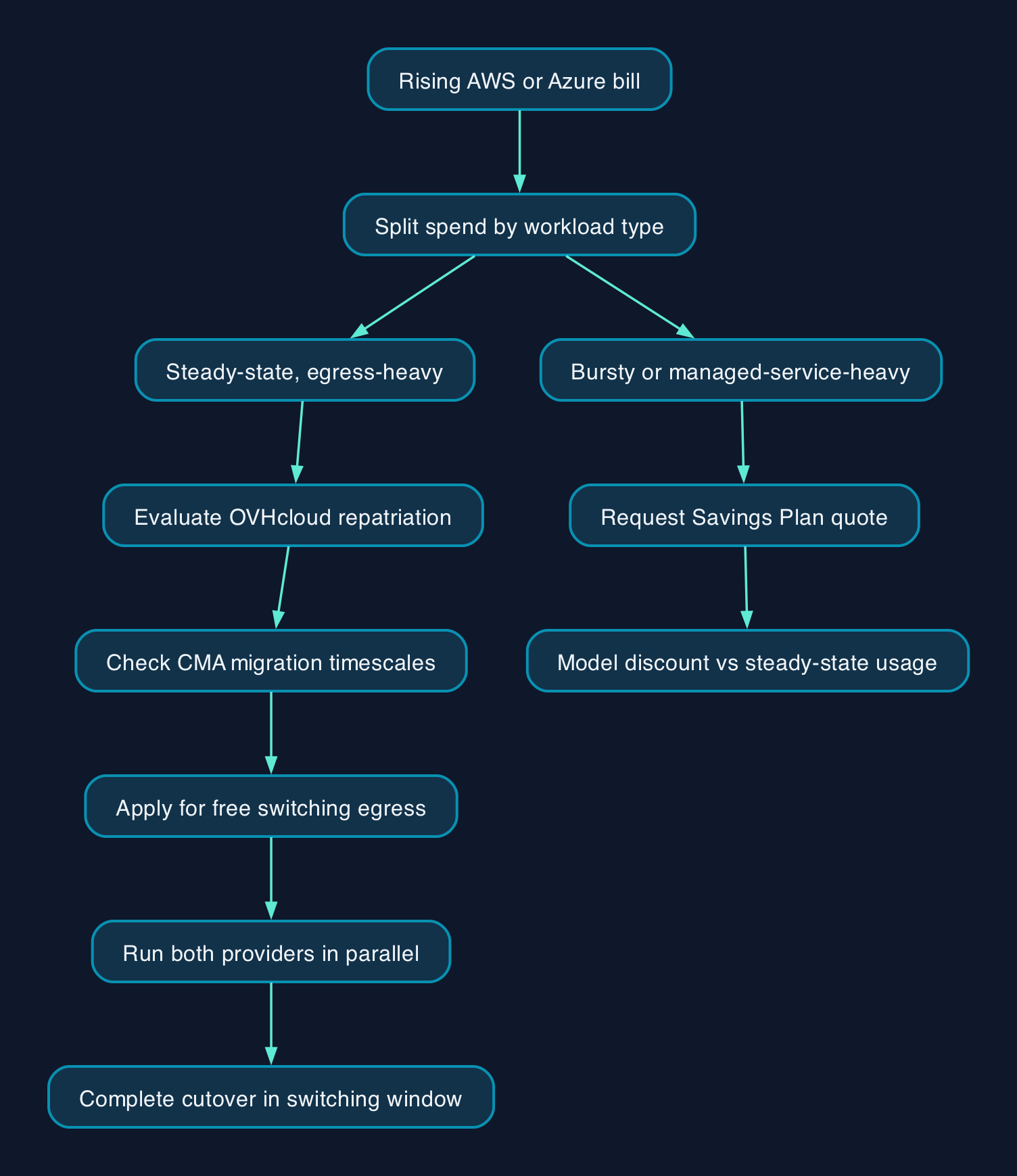
Full repatriation from AWS to OVHcloud pays off fastest for steady-state, egress-heavy workloads, where OVHcloud's bundled bandwidth and roughly 46% lower on-demand compute price outweigh a migration that typically takes months. For bursty or managed-service-heavy estates, renegotiating first, using AWS or Azure Savings Plans (up to 66-72% and 65% off) plus their free switching-egress credits as leverage, usually recovers more value for far less operational risk.
Key pointers
- OVHcloud's b3-16 instance (4 vCPU, 16GB RAM) lists at £0.088 an hour on its UK storefront, against £0.1634 an hour for a comparable Azure Standard_D4s_v5 in UK South, a difference of roughly 46%; AWS's equivalent m5.xlarge lists at $0.2220 an hour, with no standing GBP price published.
- OVHcloud includes outbound traffic free and unmetered in its European and UK regions, with no monthly cap; AWS and Azure both start charging per GB after a 100GB monthly allowance.
- Ask AWS or Azure for a committed-spend discount before assuming you need to move: AWS Savings Plans go up to 66% (Compute) or 72% (EC2 Instance), and Azure's savings plan for compute goes up to 65%.
- AWS offers a free 90-day egress window for a full-account or single-service switch, widened from 60 days in a September 2025 update; Microsoft's equivalent is a 60-day window that excludes partial moves, and both require pre-approval before you start.
- The EU Data Act forces a full removal of cloud switching charges from 12 January 2027, a point the UK's Competition and Markets Authority has already examined in its cloud market investigation.
- Real switching timescales gathered by the CMA range from over a month for the simplest workloads to over a year for the most complex, so budget migration time, not just migration cost.
- OVHcloud's Public Cloud prices change from 1 October 2026: local storage and a public IPv4 address unbundle from the base compute rate, adding up to 21.9% to some instance types.
- 37signals' well-documented move off AWS cut its cloud bill from a $3.2 million to a $1.3 million annual run rate by 2024, with the remaining spend all tied up in a four-year S3 contract that did not expire until summer 2025, and with its own operations engineers running the replacement hardware.
Why the Repatriate-or-Negotiate Question Keeps Coming Up
A cloud platform lead watching an AWS bill climb faces two very different projects. One is commercial: go back to AWS or Azure with a committed-spend proposal and negotiate a discount. The other is operational: move workloads to a provider like OVHcloud that prices compute and storage as a flat rate with bandwidth bundled in, and accept a migration.
The clearest public account of what that second path actually costs and saves comes from 37signals, the maker of Basecamp and HEY. Its co-founder David Heinemeier Hansson has published detailed figures on the company's move off AWS onto hardware it owns in colocation racks. The cloud bill fell from a $3.2 million annual run rate to $1.3 million in 2024, the first full year after the compute and database move, and the roughly $700,000 spent on new Dell servers was recouped within a year of savings. That remaining $1.3 million was entirely AWS S3 storage, locked into a four-year contract that did not expire until summer 2025; when it did, 37signals used AWS's free 60-day switching-egress window to move close to 10 petabytes of customer data out at no transfer cost, on its way to a projected total saving of more than $10 million over five years. It is worth being precise about what this case does and does not show. 37signals moved to hardware it owns and operates itself with dedicated engineers, not to a managed provider such as OVHcloud, and it is a single company at a specific scale with unusually steady, well-understood traffic. It demonstrates that the underlying economics of leaving a hyperscaler for predictable, high-volume workloads can be real and large, not that every enterprise gets the same result.
A migration consultancy that sells OVHcloud migration services, Gart Solutions, makes a similar argument from the vendor side: it says it watched data-egress fees consume 22% of one media client's AWS spend before a storage-tier migration to OVHcloud removed that cost entirely. Vendor-adjacent claims like this are directionally consistent with AWS's and Azure's own published tiered egress pricing, but they come from a firm paid to run these migrations, so treat the specific savings percentages as sales material rather than an independent benchmark.
How a Partial Move or a Hybrid Estate Actually Works
Very few UK enterprises repatriate everything at once, and the economics rarely reward trying to. The workloads worth moving to OVHcloud are the ones with predictable, always-on capacity and heavy outbound data transfer: internal applications, batch processing, steady-state databases and bulk object storage, where OVHcloud's flat compute rate and unmetered outbound bandwidth in its European and UK regions work in the buyer's favour every month, not just during a burst.
Workloads that stay on AWS or Azure tend to be the opposite: bursty or seasonal capacity that benefits from elastic scaling, and anything built on a proprietary managed service, such as a specific database engine, AI platform or serverless product, that OVHcloud does not replicate feature-for-feature. Rebuilding those integrations is usually the single biggest source of migration risk and cost, more than the compute or storage price difference itself.
During a transition, most enterprises run both providers in parallel for a period while they cut workloads over. The EU Data Act's Article 34(2) provision, which the CMA's cloud market investigation examined in detail, caps egress charges for this kind of "in parallel use" multi-cloud running at the provider's own cost, from 12 September 2025. That matters because AWS's and Google's free-switching programmes explicitly do not cover temporary multi-cloud egress during the switch window under their standard terms, according to the CMA's analysis, which predates AWS's September 2025 extension of its own window from 60 to 90 days, so the in-parallel-use cap is the main protection against paying twice for the same data while the cutover is in progress.
The Real Cost Drivers for Compute, Egress and Switching
A like-for-like instance comparison
Azure and OVHcloud both publish standing GBP list prices for their UK-serving regions; AWS's public on-demand pricing page lists USD only, and a UK enterprise's actual AWS invoice currency and VAT treatment depend on its specific billing agreement with AWS. For a general-purpose 4 vCPU, 16GB RAM instance, published on-demand list prices in UK-serving regions, checked live on 29 September 2026, are:
| Provider | Instance | On-demand price | Approx. monthly (730 hrs) | What is included |
|---|---|---|---|---|
| AWS | m5.xlarge, EU (London) | $0.2220/hr (USD, no standing GBP list price) | ~$162.06 | Compute only; EBS storage and data transfer billed separately |
| Microsoft Azure | Standard_D4s_v5, UK South | £0.1634/hr | ~£119.28 | Compute only; managed disk and bandwidth billed separately |
| OVHcloud | b3-16, UK1 and other European regions | £0.088/hr | ~£64.24 | 100GB NVMe local storage included and outbound bandwidth fully unmetered, until local storage and the public IPv4 address unbundle on 1 October 2026 |
Prices from AWS EC2 On-Demand Pricing, the Azure Retail Prices API queried in GBP for UK South, and OVHcloud's UK storefront, all checked live on 29 September 2026.
OVHcloud's published GBP price for this instance is roughly 46% lower than Azure's published GBP price for the equivalent VM, and until 1 October 2026 that OVHcloud price already includes local storage and outbound bandwidth that Azure bills separately. AWS does not publish a standing GBP price, but its dollar-denominated rate for the equivalent m5.xlarge instance is numerically almost identical to Azure's dollar-denominated rate for the same specification, so a comparable gap against OVHcloud is likely once a UK invoice is converted; confirm the exact figure with your AWS account team. From 1 October 2026, OVHcloud's compute rate is unchanged, but a comparable b3-16 instance's local storage and public IPv4 address move to metered line items on OVHcloud's euro-denominated price list, adding roughly EUR 12 a month at that size (EUR 0.11/GB/month for the 100GB of local storage, plus roughly EUR 1.97/month for the IPv4 address), narrowing but not closing the gap.
Why egress compounds so fast
Assumptions. The figures below use each provider's own published per-GB tiers, rounded to whole tiers of 1,000GB per TB for simplicity, and reflect list prices before any negotiated discount.
At 50,000GB (roughly 50TB) of internet egress in a single month, after the shared 100GB free allowance, AWS's standard rate works out at roughly $4,292 and Azure's European rate at roughly $4,182. OVHcloud does not meter outbound traffic at all on Public Cloud instances in its European or UK regions, so the same 50TB of egress adds nothing to the bill beyond the instance's flat hourly rate; the 1TB-a-month included-then-billed model that appears in some OVHcloud documentation applies only inside its Asia-Pacific regions (Singapore and Sydney), not to a UK or European workload.
This is also where the free-switching programmes matter. AWS's own website confirms it will credit the egress cost of moving data out entirely for customers who get pre-approval and complete the move within 90 days, widened from 60 days in a September 2025 update, covering a full-account move or a single-service switch without requiring the account itself to close. Microsoft's equivalent gives customers 60 days but only for a full switch, excluding partial moves. The CMA found Microsoft's version does not cover partial switches at all, which it flagged as a meaningful gap given Microsoft's roughly 30-40% share of the UK market at the time of its investigation. Any enterprise planning a phased move should check current eligibility and timing with its account team before it starts moving data, not after.
Negotiating instead of moving
The alternative to any of this is asking AWS or Azure for a better deal on the workloads that stay. AWS's Compute Savings Plans cut on-demand compute pricing by up to 66% for a 1- or 3-year commitment, and its narrower EC2 Instance Savings Plans go up to 72% for customers willing to commit to a specific instance family in a Region. Azure's savings plan for compute goes up to 65% on a comparable basis. None of this requires moving a single workload, and unlike a migration it is fully reversible at renewal.
The chart below sets the two negotiating levers side by side with the cost of standing still on list pricing.
Vendor and Option Comparison
| Criterion | AWS (renegotiate) | Microsoft Azure (renegotiate) | OVHcloud (repatriate) |
|---|---|---|---|
| 4 vCPU/16GB on-demand price | $0.2220/hr, no standing GBP list price (~$162/mo) | £0.1634/hr (~£119/mo) | £0.088/hr (~£64/mo), storage and IPv4 unbundling from Oct 2026 |
| Included outbound bandwidth | 100GB/month free, then tiered per-GB | 100GB/month free, then tiered per-GB | Fully unmetered in UK/European regions; 1TB/month allowance applies only in OVHcloud's Asia-Pacific regions |
| Maximum published committed-spend discount | Up to 66-72% (Savings Plans) | Up to 65% (savings plan for compute) | Flat list pricing; savings plans apply only to compute, not storage or IPv4 from Oct 2026 |
| Free switching-egress support | Yes, for a full account or single-service switch, 90-day window (widened from 60 in Sept 2025), pre-approval required | Yes, full switch only, not partial, 60-day window, pre-approval required | Not applicable; OVHcloud is the destination in this scenario |
| UK data region | Yes, EU (London) | Yes, UK South | Yes, London (Erith), live since 2017 |
| Suits best | Bursty, elastic or managed-service-heavy workloads; enterprises not ready for a migration project | Same as AWS, plus organisations already committed to Microsoft's wider licensing estate | Steady-state, egress-heavy, general-purpose compute and storage with a realistic multi-month migration window |
No option is a universal winner. An enterprise with a genuinely bursty estate and heavy reliance on managed AI or database services will usually get more value, faster, from a renegotiated Savings Plan than from a migration project. An enterprise whose bill is dominated by steady, predictable compute and storage, especially with high egress, has the strongest case for moving some or all of that estate to OVHcloud, provided it can absorb the migration timeline and the operational cost of running infrastructure with less hand-holding than a hyperscaler's managed services provide.
Editorial analysis
Negotiate first. A committed-spend discount is reversible, does not require touching a single workload, and can typically be agreed inside a normal renewal cycle, while the CMA's own evidence from real UK and international switches shows migrations taking anywhere from a month for the simplest workloads to a year or more for complex, interconnected estates, with one financial institution estimating 12 months and around 1,000 staff involved. That asymmetry, fast and reversible against slow and largely one-way, is the main reason "keep negotiating" should usually be the default answer, not "repatriate."
Where repatriation earns its place is when the AWS or Azure bill is dominated by workloads that do not need elastic scaling, when egress already makes up a disproportionate share of spend, and when the enterprise has, or is willing to build, the operational capability to run its own infrastructure well. 37signals is the clearest evidence that the economics can work at that point, but its own numbers show the saving took roughly two years to fully materialise after the initial decision, and depended on dedicated engineering staff and a hardware refresh cycle the company was already equipped to manage. A UK enterprise considering the same move should model its own steady-state share of spend, its egress volume against OVHcloud's included allowance and the post-October-2026 unbundled pricing, and the realistic migration timeline from the CMA's evidence, before treating repatriation as the cheaper option by default.
Sources
- EC2 On-Demand Instance Pricing - Amazon Web Services
- Compute Savings Plans - Amazon Web Services
- Free data transfer out to internet when moving out of AWS - Amazon Web Services
- Cloud Cost Savings - Savings Plans - Amazon Web Services
- Prices - OVHcloud Public Cloud - OVHcloud
- Public Cloud prices (UK storefront) - OVHcloud
- Public Cloud: our prices are changing on 1 October 2026 - OVHcloud
- OVHcloud Regions - OVHcloud
- Pricing - Bandwidth | Microsoft Azure - Microsoft
- Azure Savings Plans - Microsoft
- Azure Retail Prices API - Microsoft
- Appendix N: Egress fees - free switching programmes - UK Competition and Markets Authority, Cloud Services Market Investigation
- Our cloud-exit savings will now top ten million over five years - David Heinemeier Hansson, 37signals
- OVH vs AWS: The Enterprise Decision That Defines Your Next Two Years - Gart Solutions
- OVHcloud Migration: The Complete Enterprise Guide for 2026 - Gart Solutions