
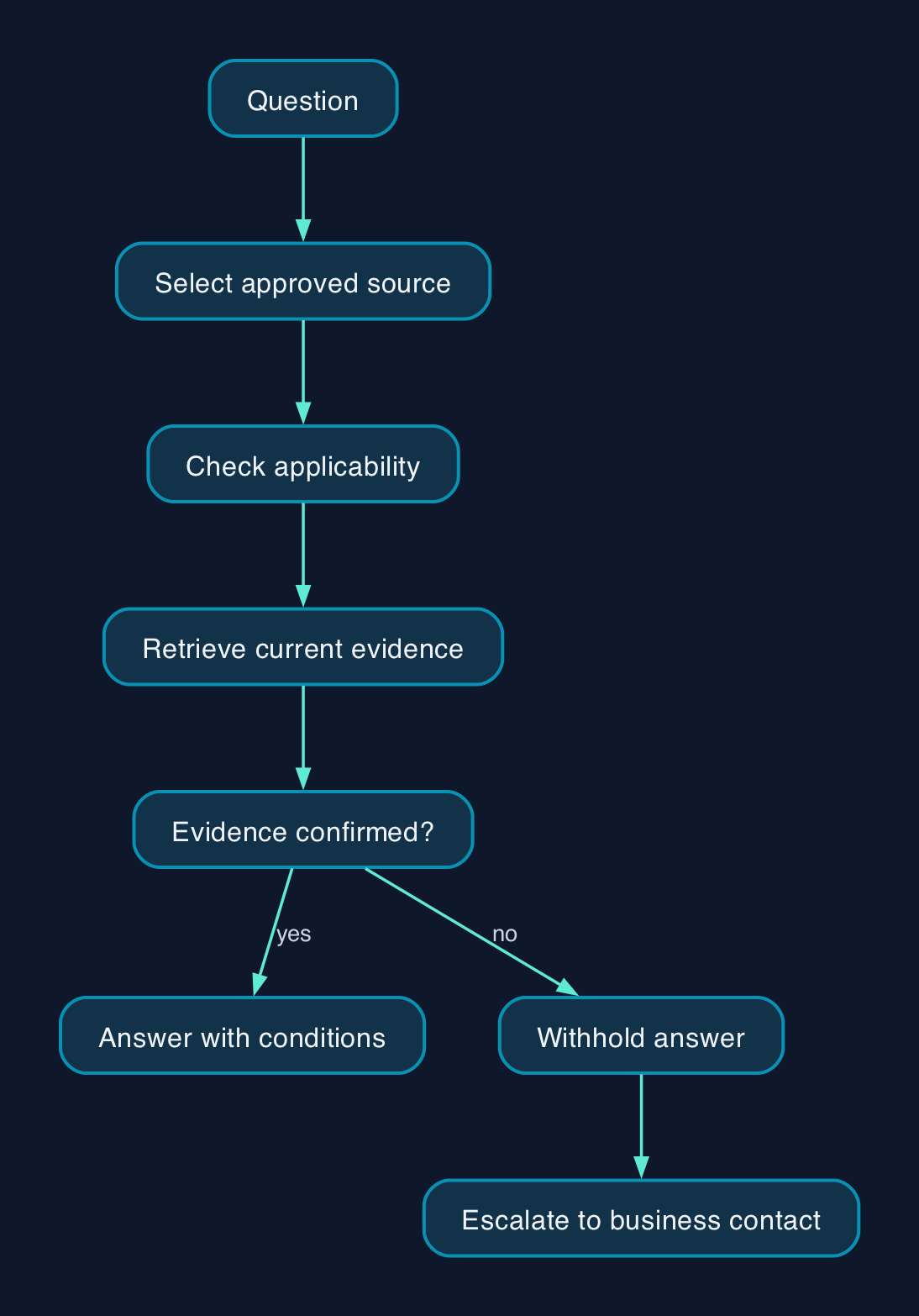
Give your assistant an approved source for each subject, a tested way to receive changes, and a rule to withhold answers when current information cannot be confirmed. For UK small and mid-sized businesses, start with the policies, prices and product details where a wrong answer would cause harm. Treat source ownership, update verification and escalation as operating responsibilities, with named people accountable for each.
Start with the answer that went wrong
Capture a real failure before changing the assistant. Record the question, answer, cited source, user account and conversation time. Ask the relevant business owner to identify the correct answer and the document or system that authorises it.
Then trace where the outdated information entered the response. Use the following as a diagnostic checklist, rather than assuming every platform exposes the same controls.
| What you find | What to investigate | Evidence needed before closing the fault |
|---|---|---|
| The authoritative source is itself wrong | Approval and publishing ownership | The business owner approves the corrected source |
| The source is correct but the retrieved passage is old | Uploaded copies, indexing, synchronisation and caches | The assistant retrieves the approved revision |
| Both old and current versions are retrieved | Archive scope, duplicate files and version filtering | Current questions exclude superseded material |
| The wrong regional or customer record is returned | Market, account, product and effective-date selection | The response uses the applicable record |
| The passage is correct but the answer is wrong | Instructions, interpretation and conversation context | The answer preserves the source’s conditions |
| No supporting source is returned | Fallback behaviour and escalation | The assistant withholds an unsupported answer |
For a hypothetical UK distributor, the approved trade price and a public catalogue price may both be current. The error is choosing the wrong price for the customer. Define “current” as approved, effective and applicable to this question.
Give each subject an owner and an authoritative source
Create a small source register before adding more documents. For each subject, record its owner, authoritative location, approval status, effective date, review date and permitted audience.
Keep the approval date separate from the effective date. A policy approved today might take effect later. Likewise, a recently edited product document might describe a discontinued model.
For UK price answers, require the source record to identify GBP or another currency, VAT treatment, charging unit, customer eligibility and any commitment period. Instruct the assistant to request missing context before presenting a price as applicable.
Do not delete historic policies or price lists simply to clean up search. Preserve records under your existing retention arrangements, but exclude superseded material from routine current-answer retrieval. If staff need historical answers, give that use case an explicit date-based route.
Separate policy retrieval from current price lookups
Use document retrieval for approved explanatory material. For frequently changing prices, availability or account-specific terms, prefer a controlled lookup against the system the business uses to authorise that information, where a supported interface exists.
This is a proposed design, not a claim that every assistant has the necessary connector. Microsoft’s documentation illustrates the distinction between knowledge sources and tools connected to external systems.
| Responsibility | Recommended owner | Required behaviour |
|---|---|---|
| Approve policies and product guidance | HR, operations or product owner | Publish an approved version with its scope and effective date |
| Authorise prices | Finance or commercial owner | Identify the applicable customer, currency, VAT treatment and validity |
| Configure retrieval and connections | IT administrator or implementation partner | Document where information comes from and how changes reach answers |
| Enforce access | System owner and IT | Test that users receive only information they may access |
| Handle uncertainty | Named business contact | Resolve conflicts or unavailable information without asking the assistant to guess |
| Accept changes | Business owner with IT | Sign off answers tested through the staff-facing assistant |
Start price integrations with read-only access. An assistant answering a price question should not need permission to change the price.
Prove that updates reach the answer
Set an acceptable delay for each information type with its owner. A product manual and an expiring quotation may need different controls. Do not promise a refresh interval that the configured source cannot demonstrate.
Run a controlled change test in a test environment or isolated pilot source.
- Save the original configuration and approved content.
- Ask a representative question and record the cited version.
- Publish an authorised test change with an identifiable revision.
- Check any available ingestion or indexing status.
- Ask again through the actual interface staff use.
- Repeat in a fresh conversation and an existing conversation.
- Confirm that the answer uses the changed value and preserves its conditions.
- Restore or approve the test content, then repeat the acceptance check.
For Copilot Studio using SharePoint, allow for the documented dependency on search indexing completing. The supplied documentation does not establish a guaranteed end-to-end refresh time.
Test removal separately. Withdraw a pilot document, remove a test user’s access and check what the assistant can still retrieve. Record unresolved delays and keep the affected answer route disabled until the required behaviour is demonstrated.
Make missing or conflicting evidence stop the answer
Define the assistant’s response when its source is unavailable, out of date or contradictory. A useful fallback identifies what could not be confirmed and names the next step.
For example, a proposed price fallback is “I cannot confirm the current price for this account. Please use the approved quotation process or contact the commercial team.”
Put critical controls in the retrieval or lookup workflow where possible. Require a successful lookup and the necessary validity fields before displaying a price. Treat instructions such as “always use the latest information” as an additional control to test.
Check every answering route. In Copilot Studio, topic-level sources can override agent-level sources, so correcting the global configuration alone may leave a conflicting topic configuration in place.
Budget for maintaining accurate answers
Ask for separate costs for source cleanup, integration, testing and ongoing operation. Include staff time for approving content, investigating failures and maintaining connections.
For outsourced work, put update monitoring, failure escalation, access reviews and handover into the service scope. Request the configuration, source register and acceptance tests as deliverables. Agree who responds when an update fails outside the provider’s support hours.
The supplied UK pricing extract lists Microsoft 365 Copilot at £23.10 per user per month, paid yearly, excluding VAT, with a qualifying Microsoft 365 business or enterprise plan required. It also describes standalone Copilot Studio prepaid and usage-based routes requiring an Azure subscription, but does not provide their unit rates. This is a pricing snapshot supplied on 28 September 2026, not a complete implementation cost. Microsoft’s UK pricing page
Measure pilot usage before committing to capacity. Keep licences, consumption, integration maintenance, content ownership, support and exit work visible as separate cost components.
Rollout checklist
Before changing production sources or permissions, preserve the configuration and agree how staff will obtain approved answers during an interruption.
- [ ] Assign a business owner and approved location to each pilot subject.
- [ ] Record the correct answer and source for each known failure.
- [ ] Identify uploaded copies, archives and overlapping source configurations.
- [ ] Record approval, effective-date, market and audience rules.
- [ ] Set an acceptable update delay and an escalation owner.
- [ ] Configure read-only access for informational system lookups.
- [ ] Test updates, withdrawals and revoked access with ordinary user accounts.
- [ ] Test missing records, conflicting versions and unavailable connections.
- [ ] Verify citations and applicability in fresh and continuing conversations.
- [ ] Train pilot users to report a wrong answer with its source and context.
- [ ] Obtain business-owner acceptance through the staff-facing interface.
- [ ] Document rollback and the manual route to authoritative information.
If the pilot fails, disable the affected answer route. Revert configuration only when doing so restores a verified safe service. Reintroducing an old configuration that serves obsolete content is not a successful rollback.
Compare suppliers using the same failure tests
The available evidence supports specific Microsoft behaviours, but does not establish equivalent capabilities, prices or UK delivery terms for other suppliers. The following is a procurement comparison framework, not a verified feature ranking.
| Route to assess | Demonstration to require | Responsibility to settle |
|---|---|---|
| Google-based proposal | A source change, withdrawal and access revocation reaching the proposed assistant | Who monitors the selected connection and resolves failed updates |
| AWS-based proposal | Current-record selection, retrieval evidence and behaviour during a lookup failure | Who operates each component and manages ongoing usage |
| Microsoft Copilot Studio | The exact source route, topic overrides, indexing behaviour and staff permissions | Who maintains agent settings and source ownership |
| Open-source or self-hosted build | Version filtering, deletion handling, permission enforcement and recovery | Who maintains the stack and supports incidents |
| UK managed-service provider | The same tests on its named platform and proposed configuration | Contracted support hours, escalation, exclusions and exit deliverables |
Compare each proposal against the same content and failure cases. An existing platform that passes those tests remains a credible option; require a replacement proposal to explain the specific gap it resolves.
Source capacity is a separate criterion. Microsoft documents 4 SharePoint URLs per generative answers topic node in classic mode, compared with 25 SharePoint URLs in generative mode. These are configuration limits, not refresh intervals or accuracy scores. Supported knowledge sources
Editorial analysis
CTC’s recommendation is to repair the source and update process before buying a replacement assistant. Make a supplier demonstrate that an approved change appears, a withdrawn source disappears and an unavailable lookup produces a safe response.
For a small business, begin with a narrowly scoped assistant whose sources have named owners. Expand only when the people maintaining those sources can support the additional work. An unanswered question with a useful escalation route is preferable to an unsupported policy or price presented as authoritative.
Sources
This guide uses supplied source extracts reviewed on 28 September 2026. The original pages were not independently reopened.
- Microsoft Learn — FAQ for generative answers
- Microsoft Learn — Unstructured data as a knowledge source
- Microsoft Learn — Use generative answers in a topic
- Microsoft Learn — Knowledge sources summary
- Microsoft Learn — Orchestrate agent behaviour with generative AI
- Microsoft Copilot Agents Labs — Build Intelligent Agents with Knowledge Sources, Tools, and Topics
- Microsoft — UK Copilot Studio pricing