
A small UK conveyancing firm choosing between Redbrick Solutions, Osprey Approach and Access Legal Proclaim is choosing a charging shape as much as a supplier. Redbrick charges per active matter, usually passed on to the client as a disbursement, or a fixed per-user fee. Osprey publishes a per-licence monthly price with a 36-month term. Proclaim publishes no price at all, so every firm has to ask.
Key pointers
- Get Redbrick's current transaction fee and its alternative per-user rate in writing. Neither figure is published.
- Get Proclaim's quotation in writing too. Access Legal's own product page carries no prices, plans or figures.
- If you pick Osprey, budget for its standard 36-month agreement and the 5% price rise on each go-live anniversary.
- Weigh your quietest month's matter count against your busiest. A per-matter fee moves with volume; a per-licence fee does not.
- Check whether legal accounting is built in (Osprey) or needs a separate integration (Redbrick, via Klyant).
- Confirm which Land Registry AP1 route each system actually uses. Redbrick states its own digital AP1; Osprey's runs through its InfoTrack integration.
- Budget for Law Society Conveyancing Quality Scheme (CQS) accreditation separately. It costs from £170 a year and has nothing to do with your software bill.
- Ask each vendor for two reference firms of a similar size before signing anything.
What Conveyancing Case Management Charging Actually Decides
A small firm's partner or office manager is not just buying software features here. They are picking which cost moves with the business and which one does not. A per-matter fee, like Redbrick's, rises and falls with completions. A per-licence fee, like Osprey's, is billed every month at the same rate whether a fee earner has ten live files or two. Proclaim sits outside both comparisons until a firm actually gets a quote, because Access Legal does not publish a charging structure to compare against.
This matters most for firms with seasonal or lumpy transaction volumes, which describes much of the UK conveyancing market: a slow winter, a stamp duty deadline rush, a fee earner on leave. A transactional model absorbs some of that swing automatically. A per-licence model does not, though it gives a firm a fixed number to put in next year's budget.
How Each System Fits a Conveyancing Transaction
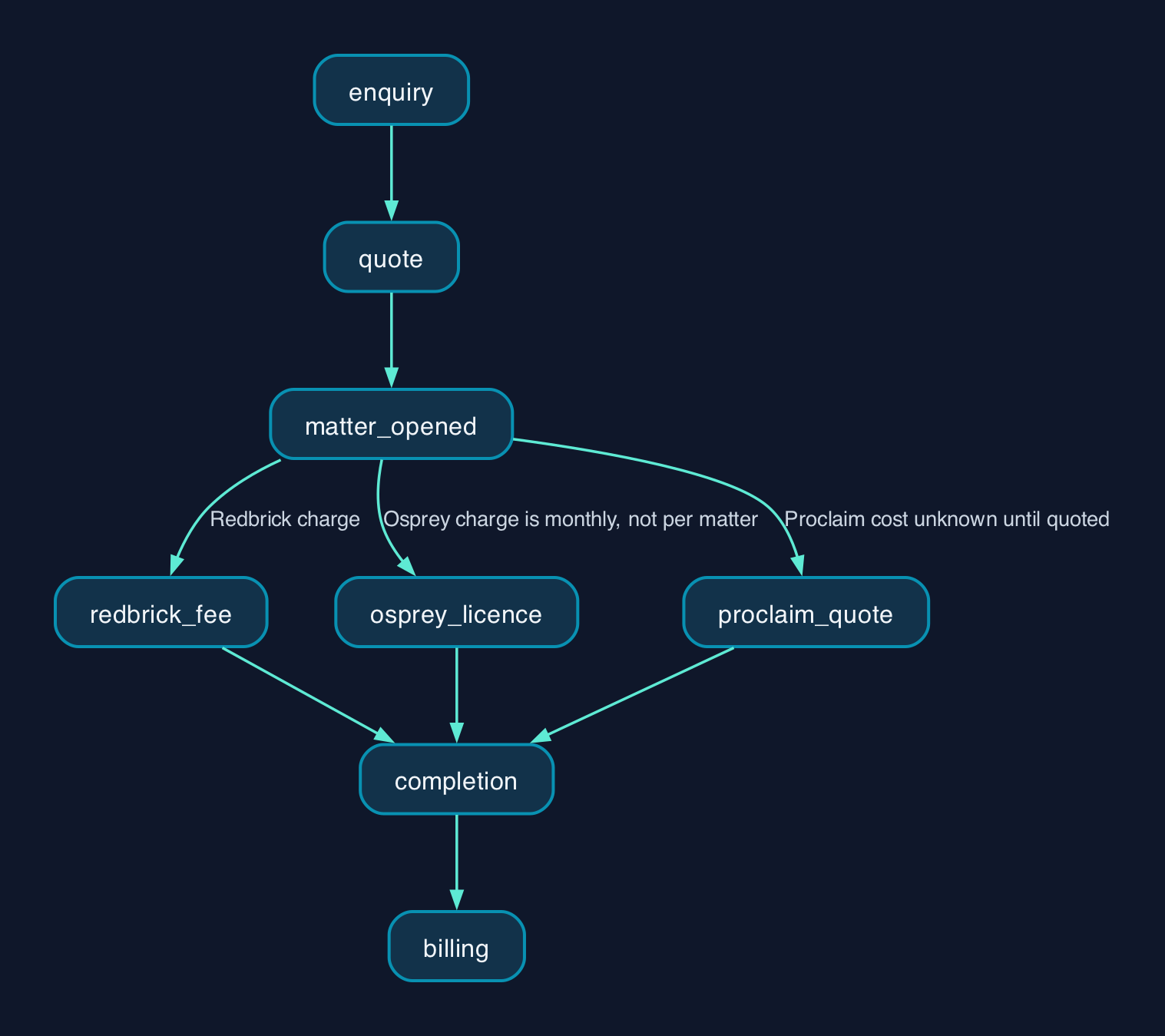
All three products follow roughly the same shape: an enquiry or quote, a matter opened on instruction, milestone documents and searches through to exchange and completion, then billing and file closure. Where the systems differ is where the cost is triggered.
On Redbrick, the transaction fee is triggered when a matter becomes active, not at the quote stage, so a firm is not charged for enquiries that never convert to instructions (Redbrick Solutions). On Osprey and, presumably, on Proclaim once a firm has a quotation, the licence cost is triggered by the number of paying users set up on the system each month, regardless of how many matters those users are actually working. A fee earner on Osprey costs the same in a quiet month as a busy one.
Redbrick handles legal accounting through a named integration with Klyant rather than a built-in ledger, while Osprey bundles a full law office accounting suite, VAT submissions and client account billing into every published tier (Redbrick Solutions; Osprey Approach). That is a genuine operational difference for a small firm that does not want to run and reconcile two systems.
Pricing and Cost Model
None of the three vendors publishes a complete price a firm can budget against without contacting them, but the type of number each one withholds, or discloses, differs.
| Vendor | Charging basis | Published price | Commitment | What it covers |
|---|---|---|---|---|
| Redbrick Solutions | Per active matter (transaction fee), or fixed per-user, per-month alternative | Not published; quoted per firm | Not stated on the vendor's site | Case management, e-signing, Land Registry digital AP1, biometric AML, unlimited training, free upgrades and support |
| Osprey Approach | Per paying licence, per month (Advanced or Premium), or Enterprise on application | Advanced £110/licence/month; Premium £140/licence/month | Minimum 3 licences; standard 36-month term; 5% price rise each go-live anniversary | Case, practice and accounts management; client portal (add-on on Advanced, included on Premium); telephone-first support |
| Proclaim (Access Legal) | Subscription, terms set per firm | Not published | Not stated on the vendor's site | General legal case management across conveyancing and other practice areas, document and file management, time recording, accounting |
Assumptions: the Osprey figures are the tiered, published monthly per-licence prices shown on its own pricing page, checked live on 29 September 2026, at the site's stated minimum order of three licences. Redbrick's and Proclaim's rows are what each vendor's own pages state about the charging basis; neither publishes a number.
To see what that means in cash terms, take a small firm buying Osprey at its stated minimum of three licences. Advanced comes to £330 a month (3 x £110), and Premium comes to £420 a month (3 x £140), both before any add-ons such as the £10-per-licence client portal on Advanced. Those are the only two numbers in this article a firm can put straight into a spreadsheet without first calling a vendor.
The chart below shows those two published Osprey figures side by side. Redbrick and Proclaim are not on it because neither vendor discloses a comparable number; a firm has to request one directly, which is itself a useful signal about how negotiable each price might be.
Vendor and Option Comparison
| Factor | Redbrick Solutions | Osprey Approach | Proclaim (Access Legal) |
|---|---|---|---|
| Best fit | Conveyancing-only firms wanting a specialist, transactional system | Firms wanting case management, practice management and accounts in one product | Firms wanting one system across conveyancing and other practice areas |
| Charging risk | Low fixed risk in quiet months; cost scales with completions | Fixed monthly cost regardless of matter volume, for the length of a 36-month term | Unknown until quoted; cannot be compared on price alone |
| Legal accounting | Via Klyant integration | Built in to every published tier | Included, per the vendor's own feature list |
| Land Registry AP1 | Direct integration with Land Registry e-DRS for digital AP1 | Via InfoTrack integration | Not detailed on the vendor's public page |
| Training and support | Unlimited training and free support and maintenance stated by the vendor | Unlimited online training and telephone-first support on every tier | Not detailed on the vendor's public page |
| Who should not choose it | A firm that wants one fixed number to put in a budget every month | A firm with very low or seasonal matter volumes locked into a 36-month term | A firm that needs to compare a hard price before it will even take a meeting |
None of these three is a universal winner. A high-volume conveyancing specialist with predictable staffing may prefer Osprey's flat, bundled cost. A firm with a volatile caseload, or one already using a separate accounting package, may prefer Redbrick's transactional model. A firm running conveyancing alongside several other practice areas has a reason to look at Proclaim's broader workflow coverage, but should not assume its pricing will land anywhere close to the other two until a quote is in hand.
Editorial Analysis
None of the three vendors' own pages give a directly comparable like-for-like price, so a firm cannot shortlist on cost alone from public information. The more useful exercise is matching the charging shape to the firm's actual transaction pattern before asking for quotes: a firm whose matter count swings by more than a third between its slowest and busiest months has a real financial reason to ask Redbrick for numbers first, because a per-matter fee is designed to move with that swing. A firm with stable, predictable headcount and caseload has less to lose from Osprey's flat per-licence structure, and gains a single published starting point to negotiate from. Proclaim's broader workflow scope across practice areas is a genuine differentiator for a firm that is not conveyancing-only, but it is not, on the evidence available, a reason on its own to pick it over a conveyancing specialist for a firm that only does conveyancing.