
For a UK SaaS startup with a handful of hosts and a small engineering team, Grafana Cloud is usually the cheapest to start on, because its $19 monthly Pro platform fee already covers 10,000 metric series and 50GB of logs. Datadog charges $15 to $23 per host for infrastructure plus a separate $31 per host if you add distributed tracing. New Relic gives 100GB of data free, but its cost tracks engineer headcount, not server count, once you add a second full-access seat.
Key pointers
- Start with Grafana Cloud's free tier (10,000 metric series, 50GB of logs, 14 day retention) if you run fewer than around 10 hosts and modest log volume.
- Ask what "per host" means before you sign: Datadog charges $15 to $23 per host for infrastructure monitoring, then another $31 to $35 per host if you add Application Performance Monitoring (APM) tracing.
- Count engineers, not servers, before choosing New Relic. Its Standard edition costs $10 for the first full platform user and $99 for each of up to four more.
- Watch your Datadog host count during launches and load tests. Datadog bills the whole month at the high-water mark of the lower 99 percent of your hourly host count, so a five day spike can set your bill.
- None of the three vendors publish a GBP price list. You pay in US dollars and, if you are VAT registered, self-account for UK VAT under the reverse charge rather than seeing it added to the invoice.
- Two of the three now host in the UK. Grafana Cloud has a UK region (AWS eu-west-2 or GCP europe-west2) and Datadog launched a UK availability zone on AWS London in July 2026. New Relic offers an EU data centre option, not a UK-specific one.
- Check retention as well as price per gigabyte. Grafana Cloud's Pro tier keeps 30 days of logs and 13 months of metrics; New Relic's ingest price covers metrics, logs and traces combined.
- All three accept OpenTelemetry data, so your instrumentation code survives a future switch even if the billing does not.
What each platform actually charges you for
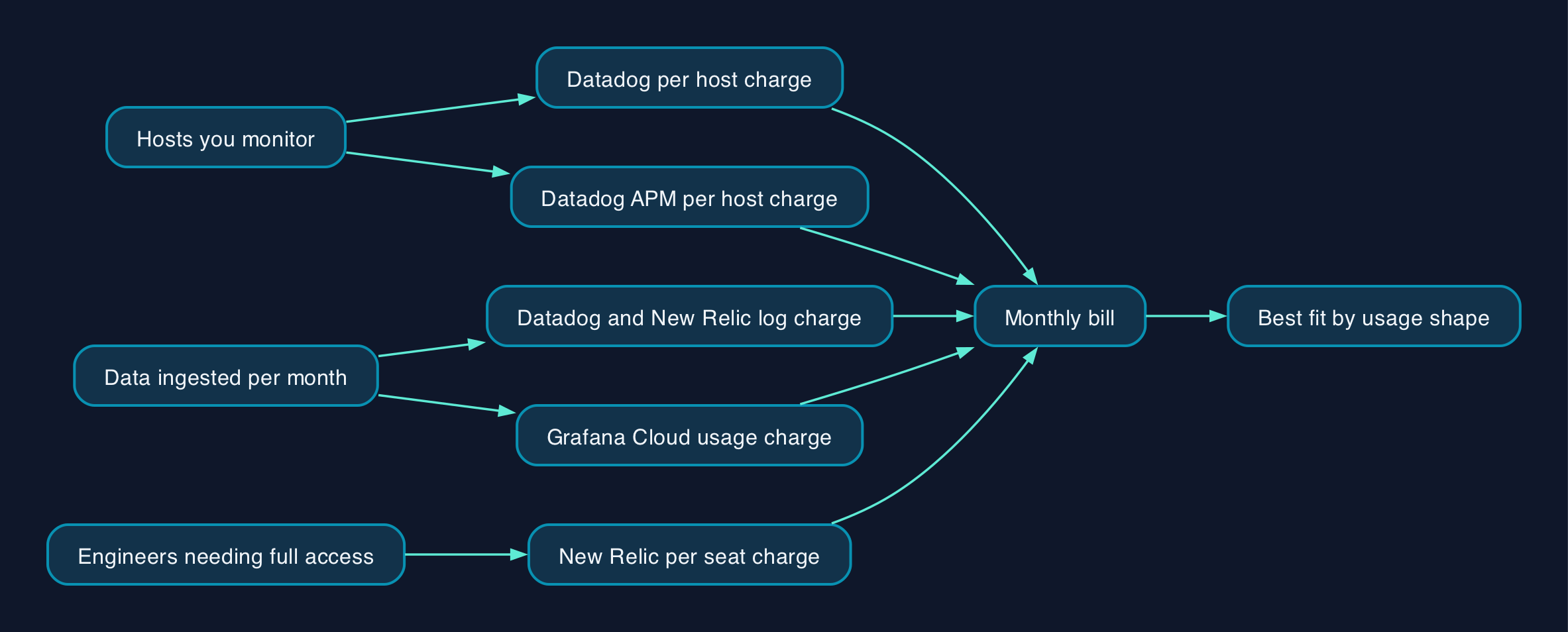
The three platforms meter completely different things, which is why a straight price comparison misleads unless you know your own usage shape first. Datadog's pricing page charges per monitored host for infrastructure, then a second, separate per-host charge for APM if you want distributed tracing across your services. A host is any VM, container node, or serverless instance Datadog agents report on, so a Kubernetes cluster can generate more billable hosts than you expect if nodes scale up during a deploy.
New Relic charges almost the opposite way. Data ingest, covering metrics, logs, traces and events together, is free up to 100GB a month, and the meaningful cost driver is how many engineers need full platform access rather than how much infrastructure you run. A three-person founding engineering team pays for three seats regardless of whether you monitor five hosts or fifty.
Grafana Cloud bundles a flat monthly platform fee with usage-based pricing per signal type. The Pro tier's $19 fee already includes an allowance of 10,000 active metric series and 50GB of logs; a small startup often never crosses either threshold, making the effective monthly cost just the platform fee. All three products accept telemetry over OpenTelemetry's OTLP protocol, an open, vendor-agnostic framework maintained by the Cloud Native Computing Foundation, so instrumenting your application against the open standard rather than a proprietary SDK keeps the option to move platforms later without rewriting your code.
Pricing and cost model
All three vendors quote list prices in US dollars; none publishes a GBP price list. Using HMRC's official September 2026 period rate of USD 1.3554 to GBP 1 (published 19 August 2026 for customs and VAT calculations, not a live card rate), $19 converts to roughly £14.02 and $15 to roughly £11.07. Treat any GBP figure in this article as an accounting estimate: your actual card or bank statement will show whatever rate your payment provider applies on the day it bills you, which will differ. Because the suppliers are based outside the UK, a VAT-registered UK business does not see VAT added to the invoice either way. Instead you self-account for it under the reverse charge set out in HMRC's VAT Notice 741A: you declare the notional 20 percent output tax and reclaim the same amount as input tax on the same VAT return, which nets to no cash cost if your business makes fully taxable supplies.
| Cost driver | Grafana Cloud | Datadog | New Relic |
|---|---|---|---|
| Entry price | Free; Pro from $19/month platform fee (about £14.02) | Free up to 5 hosts; Pro from $15/host/month (about £11.07) | Free (100GB data plus 1 user) |
| Infrastructure/metrics unit | $6.50 per 1,000 series beyond the included 10,000 | $15 to $23 per host per month | Bundled into the per-user seat, not billed per host |
| Logs | $0.05 to $0.40 per GB beyond the included 50GB | $0.10 per GB ingested | $0.40 to $0.60 per GB beyond the free 100GB |
| Tracing (APM) | Same usage-based model as logs and metrics | Separate charge, $31 to $35 per host per month | Included in the full platform user seat |
| Named users | Grafana Visualization: 3 active users included, then $8/active user/month ($55 with Enterprise plugins) | Unlimited, not billed per seat | $10 first user, $99 per additional user (Standard, up to 5); $349/user (Pro) |
| Entry-level commitment | None below Enterprise | None below Enterprise, but annual billing sets the lower per-host rate | None below Enterprise |
| Highest tier | Enterprise from a $25,000/year spend commit | Enterprise, custom pricing | Enterprise, contact sales |
A worked example for a small monitoring stack
Assumptions: a UK SaaS startup runs 10 monitored hosts (a mix of application servers and containers), has three founding engineers who each need full platform access, and generates around 50GB of logs a month. No distributed tracing is switched on in the base case.
On Grafana Cloud, 10 hosts running typical infrastructure and application dashboards is unlikely to push active metric series past the 10,000 included in the Pro tier, and 50GB of logs sits at the edge of the included allowance. Three engineers logging in to Grafana also sits exactly at the 3 active users included free under Grafana Visualization, so no seat charge applies yet. The monthly bill is the $19 platform fee, roughly £14.02 at HMRC's September 2026 accounting rate of USD 1.3554 to GBP 1.
On Datadog, Infrastructure Pro across 10 hosts costs 10 times $15, or $150 a month (about £110.67). Log ingestion for 50GB adds 50 times $0.10, or $5 a month. With no APM switched on, the total is $155 a month, about £114.36. Adding APM tracing across the same 10 hosts adds 10 times $31, or $310 a month, taking the total to $465 a month, about £343.07.
On New Relic, 50GB of data ingest is comfortably inside the free 100GB allowance, so data costs nothing. Three full platform users on the Standard edition cost $10 for the first user plus $99 for each of the next two, totalling $208 a month (about £153.46), with tracing included in that seat price.
<!--chart:chart-1-->
None of these figures include support-plan upgrades, custom metric overages, or the Enterprise tiers that larger teams eventually need. As data volume or host count grows, the ranking can change: Grafana Cloud's per-series and per-GB rates rise past the included allowance, and Datadog's per-host charge is comparatively predictable at scale because it does not depend on log volume alone.
Vendor and option comparison
Grafana Cloud suits a small team that wants one flat platform fee covering metrics and logs, and that is comfortable running an open-source-based stack (Grafana dashboards, Prometheus-compatible metrics via Mimir, Loki for logs, Tempo for traces). Dashboard access itself is billed separately as Grafana Visualization, with 3 active users included free and $8 per active user per month beyond that, so a founding team of three or fewer pays nothing extra for seats; a bigger team should add that line to its sums. Grafana Cloud is not the natural choice for a team that wants a single vendor to also own security monitoring or a fully managed on-call and incident workflow out of the box, since its own feature set is narrower there than Datadog's.
Datadog suits a team that expects to add APM, security monitoring, real user monitoring and synthetic testing under one roof and wants unlimited named users while they scale headcount. It is a weaker fit for a cost-sensitive early-stage startup because the per-host charge for infrastructure and the separate per-host charge for APM compound quickly, and the high-water mark billing model documented in Datadog's own billing reference means a host count spike that lasts more than a few hours during a product launch, longer than the top 1 percent of the month that Datadog excludes, can set the whole month's bill.
New Relic suits a startup with few hosts but several engineers who each want full query and dashboard access, since the free 100GB data allowance absorbs most early-stage telemetry at no cost. It is a weaker fit once the engineering team grows past five or six people needing full access, because the per-user charge on the Standard edition, and the $349 per user Pro rate for larger or unlimited-user teams, can outpace a per-host model for a team that is engineer-heavy relative to its server count.
<!--chart:chart-2-->
None of these three should be chosen purely because a competitor uses it. Ask each supplier for a sample invoice based on your actual host count, data volume and team size before committing, since list prices on the public pages rarely match the bill you actually receive once retention settings, custom metrics and indexed log volumes are added.
Questions to ask before you commit
- What does our actual host count, data volume and team size translate to on a sample invoice, not the list price?
- Which retention period is included at our tier, and what does extending it cost per GB or per month?
- Does the vendor bill on a high-water mark, an average, or a hard usage cap, and what happens automatically if we exceed it?
- Can we start on the free or entry tier and upgrade without a forced migration of dashboards and alerts?
- Is UK or EU data residency available at our tier, and does it carry an extra per-GB charge (as it does with New Relic's EU option)?
- How much of our stack can we instrument through OpenTelemetry rather than a proprietary agent, to keep switching costs low later?
Editorial analysis
For a UK SaaS startup at the point of choosing its first observability platform, the decision usually comes down to which resource you expect to run out of first: hosts, data, or engineers. A small team running few hosts but wanting several people to dig into dashboards is a natural fit for New Relic's free tier. A lean team happy to lean on open-source-compatible tooling and a single predictable platform fee is a natural fit for Grafana Cloud. A team that expects to need a fuller platform, including security monitoring and synthetic testing, as it scales, and that will keep adding engineers faster than hosts, may find Datadog's unlimited-user model worth the higher per-host and per-APM-host price once volume discounts on longer contracts apply. None of the three is a universal winner, and all three let you start free and prove the fit before committing spend.
Sources
- Pricing | Datadog
- Billing | Datadog Docs
- Pricing | New Relic
- Grafana Pricing | Free, Pro, Enterprise
- Grafana Cloud availability by region
- Now Live: Datadog's New Availability Zone in the United Kingdom
- Place of supply of services (VAT Notice 741A)
- September 2026 HMRC currency exchange monthly rates
- What is OpenTelemetry?
- Monitoring & Observability Providers | Compare the Cloud