For most mid-market businesses running two or more racks, colocation with a specialist such as Equinix, Telehouse or VIRTUS Data Centres usually beats patching an ageing server room, once redundant power, cooling and fire suppression are priced in. The trade-off is a new monthly bill instead of occasional capital spend, and none of the three UK operators publish list prices, so the real answer depends on quotes for your rack count and power draw.
Key pointers
- Ask every operator for pricing broken down by space, power (per kW) and connectivity; a bundled "full cabinet" quote hides which line item actually moves your bill as you grow.
- Full-cabinet colocation in London runs roughly £1,100 to £3,800 a month depending on zone, so get quotes from more than one operator and more than one site before you compare.
- A UK server room drawing 3 to 6kW typically needs 5 to 9kW of cooling and a 6 to 10kVA UPS once you add redundancy, so a "cheap" retrofit rarely stays cheap.
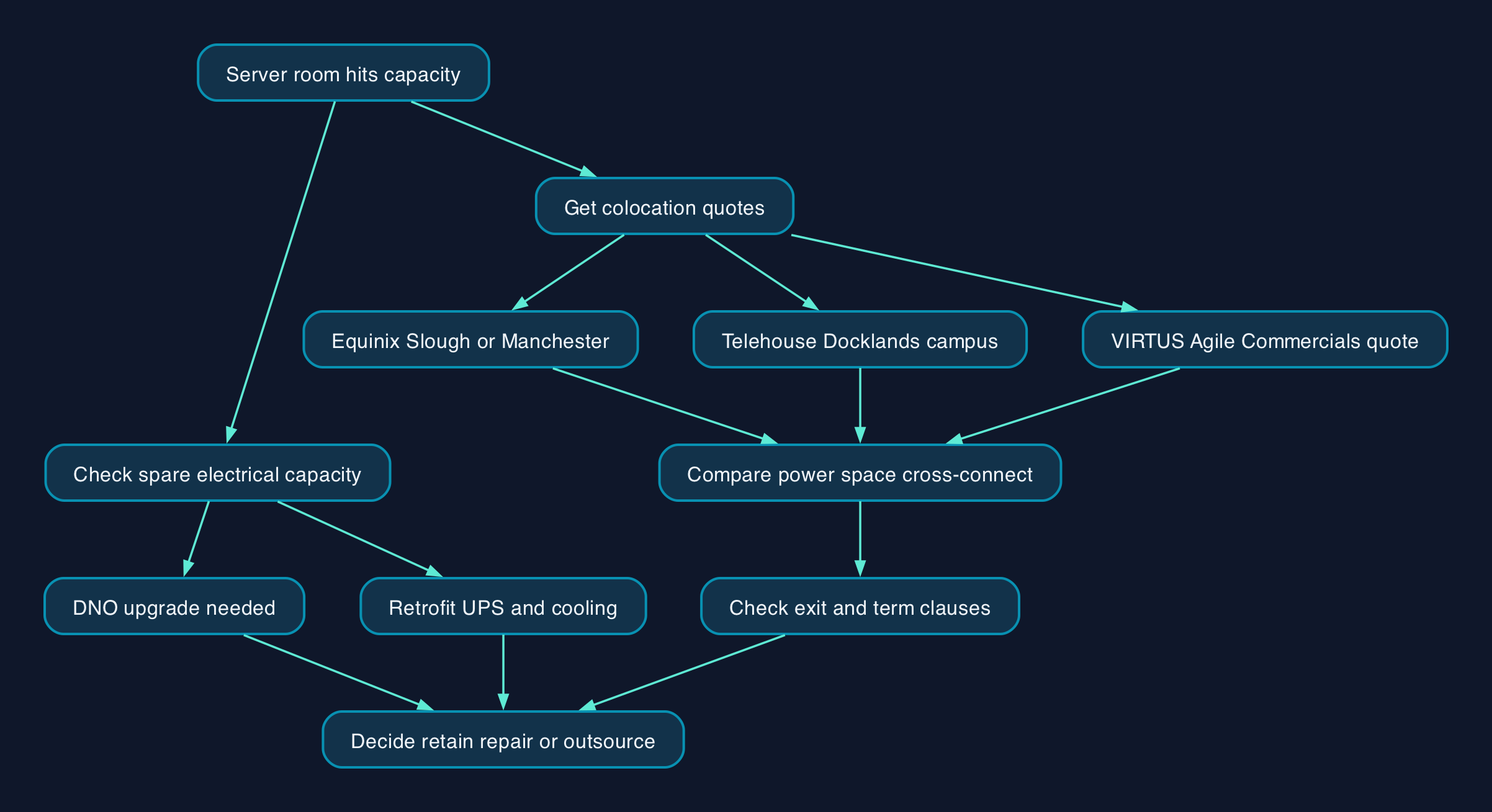
- Check the building's spare electrical capacity before committing to either path; a distribution network operator (DNO) supply upgrade can take months to arrange in an older building.
- VIRTUS quotes through an "Agile Commercials" framework built around power, space and term rather than a fixed price list, so ask what happens contractually if your power draw grows mid-term.
- Confirm whether cross-connect and remote-hands charges are included or billed separately, since these recur every month regardless of how many racks you take.
- Get the exit terms in writing before you sign anything: minimum term, decommissioning cost and who is responsible for wiping and removing hardware.
Why this question comes up now
A server room that worked for ten employees rarely works for fifty. The signs are familiar to most IT infrastructure managers: the air conditioning runs flat out in summer, a fourth rack will not fit without an electrical upgrade, and the UPS only has enough runtime for a handful of minutes. At that point the decision is not really about buying new kit, it is about whether to keep investing in a space that was never designed to be a data centre, or move critical infrastructure to somewhere that was.
Colocation providers such as Equinix, Telehouse and VIRTUS Data Centres sell exactly that: rack space, power, cooling, physical security and network connectivity in a purpose-built facility, billed monthly instead of financed as a one-off capital project. The business case usually turns on three things: how much redundant power and cooling your current setup is missing, how much floor space and electrical capacity you actually have left to expand into, and how much you value moving that risk off your own premises.
How Equinix, Telehouse and VIRTUS differ
None of the three names in this decision publish a retail price list for colocation, so the differences that matter are about location, power density and commercial model rather than a headline rate.
Equinix concentrates its largest UK campus at Slough, on Buckingham Avenue, where LD4, LD5, LD6, LD7 and LD10 operate as a cross-connected campus. Not every Equinix London facility sits there: LD8 is in Docklands at Harbour Exchange, close to Telehouse, and LD9 is at Park Royal in west London, roughly 35 minutes from Heathrow. Equinix also runs a Manchester campus. Its positioning is around interconnection: Equinix Fabric lets tenants connect virtually to cloud providers and other Equinix customers worldwide. Slough offers cheaper power and larger floor plates than central London, and suits businesses that need low latency to European and transatlantic routes rather than proximity to the City.
Telehouse operates five interconnected buildings on its Docklands campus in East London, home to the London Internet Exchange (LINX). Power availability per rack varies sharply by building, from 0.5kW at the older Telehouse North and East through to 3kW and above at Telehouse North Two and the newer Telehouse South, so the specific building you are quoted for matters as much as the Telehouse name. Docklands suits businesses that need dense carrier and internet exchange connectivity, or that already peer at LINX.
VIRTUS Data Centres runs several campuses around the M25, including Stockley Park, Slough, Saunderton, Hayes and Enfield, and sells through what it calls an "Agile Commercials" framework rather than a fixed catalogue: options include short-term Colo-on-Demand capacity, a Flex model that lets power usage vary within an agreed band, and bespoke Enterprise agreements for larger, multi-site deployments. Standard racks sit in the low-to-mid kilowatt range, with high-density footprints available up to 40kW or more per rack for GPU or compute-heavy workloads, according to an independent review of the operator.
Pricing and cost model
Colocation is priced on a mix of space, power and connectivity, and how those are bundled varies by operator and site. Ask every provider to itemise all three before comparing quotes.
| Cost component | Typical UK range (excl. VAT) | Billing basis | What to check |
|---|---|---|---|
| Full cabinet, Slough financial corridor | £1,800–£3,800/month | Packaged monthly rate | Whether a power allowance is included or metered separately |
| Full cabinet, Docklands | £1,600–£3,400/month | Packaged monthly rate | Which Telehouse building, since per-rack power varies from 0.5kW to 3kW+ |
| Full cabinet, Royal Docks or outer London | £1,100–£2,200/month | Packaged monthly rate | Lower cost but check connectivity and latency needs |
| Power | £185–£380/kW/month | Metered or contracted allowance | Whether this replaces or adds to a packaged cabinet rate |
| Cross-connect | £220–£480/month | Per connection, recurring | Add up every carrier and cloud on-ramp you will need |
| Fractional rack (per U) | £70–£90/U/month (50W included) | Reseller pricing inside Telehouse and Interxion | Useful if you need far less than a full cabinet |
These are indicative UK market rates from a data-centre marketplace, not vendor list prices, because Equinix, Telehouse and VIRTUS all quote individually. Treat the ranges as a sanity check on a quote, not a substitute for one.
The comparison to make is against what your current server room actually costs to keep running safely, not just what it cost to build originally. Redundant power protection for a growing UK server room typically means a 6kVA rack-mount UPS at £1,800 to £3,500, or a 10kVA unit at £3,500 to £6,000, plus managed power distribution units at £200 to £500 each. Cooling capacity needs to run at roughly 1.3 to 1.5 times your IT power load to cope with the room itself, not just the racks, which for a single full rack drawing 3 to 6kW typically means 5 to 9kW of cooling delivered by two redundant units rather than one. None of that includes the building work, and if your incoming electricity capacity is already tight, arranging a distribution network operator supply upgrade can take months in an older building, so check it early. A single poorly planned server room retrofit averages £8,500 to put right after the fact.
On raw electricity, UK non-domestic consumers in manufacturing paid an average of 16.8 pence per kWh in the final quarter of 2025, excluding the Climate Change Levy and VAT, according to official government data. That figure is a useful anchor for grid rates generally, but it is not directly comparable to a colocation provider's per-kW charge, which bundles the provider's own power procurement, UPS overhead and cooling into a single rate. The more useful comparison is efficiency: a typical in-house server room running standard air conditioning operates at a Power Usage Effectiveness of 1.4 to 1.6, meaning 40 to 60% more power is drawn for cooling and delivery than the servers themselves use, against 1.1 to 1.2 for a purpose-built facility. On a growing load, that gap compounds every month.
Retain and repair the server room instead
Staying put is a legitimate option, particularly if your growth is modest, your building has spare electrical capacity, and you are not planning to move offices in the next few years. A retrofit means sizing a proper UPS and redundant cooling for your actual load rather than the load you started with, adding environmental monitoring so a cooling failure is caught before it causes an outage, and confirming your incoming electrical supply has headroom before you order equipment. It keeps capital spend under your control and avoids handing operational risk to a third party, but it also means you continue to own every hour of maintenance, every failure, and every future upgrade.
Vendor and option comparison
| Option | Best suited to | Power and density | Commercial model | Watch out for |
|---|---|---|---|---|
| Retain and upgrade the server room | Modest, predictable growth; stable premises | Usually 3 to 12kW per room after retrofit | Capital spend plus ongoing maintenance | DNO upgrade lead times; no built-in redundancy unless you design it in |
| Equinix (Slough, Docklands, Park Royal or Manchester) | Businesses needing multicloud or global interconnection | Slough offers cheaper power and larger floor plates; scalable density | Individually quoted, contract term negotiable | Confirm which building; LD8 is Docklands and LD9 is Park Royal, not Slough |
| Telehouse (Docklands) | Businesses needing LINX peering or carrier density | 0.5kW to 3kW+ per rack depending on building | Individually quoted per building | Confirm which of the five Docklands buildings you are quoted for |
| VIRTUS Data Centres | Businesses wanting flexible power bands or high-density GPU racks | Standard racks up to 40kW+ available | "Agile Commercials": Colo-on-Demand, Flex or Enterprise terms | No published price list; requires in-house skills or a managed partner to run |
No single option suits every business here. A small deployment that just needs headroom for two more years might be cheaper to retrofit in place; a business already booking remote-hands calls every month, or planning disaster recovery across two sites, is usually better served by a colocation contract even before the pricing comparison.
Migration and rollout checklist
- Confirm your current and projected power draw in kW, not just rack unit count, before requesting quotes from any provider.
- Get written quotes from at least two of Equinix, Telehouse and VIRTUS (or another verified UK operator) covering space, power, cross-connects and remote hands as separate line items.
- Ask each shortlisted operator which specific building or hall you would be assigned to, since power density and redundancy vary by site within the same brand.
- Check the incoming electrical capacity at your current premises with your landlord or a qualified electrician if you are considering a retrofit instead.
- Plan a pilot migration of non-critical systems first, and confirm rollback steps before moving anything customer-facing.
- Agree cabling, labelling and access-control standards with the receiving facility before the physical move date.
- Test failover and remote-hands response times during a controlled window, not for the first time during a real incident.
- Get the exit terms, minimum contract length and decommissioning costs in writing before signing.
- Warn every affected team of the cutover window in advance, and keep the old server room powered as a fallback until the new site has been running cleanly for at least one full billing cycle.
Editorial analysis
The strongest argument for colocation is not the headline price, it is what a £1,100 to £3,800 monthly cabinet already includes that most SME server rooms do not have: redundant power feeds, N+1 or 2N UPS configurations, fire suppression designed for electrical equipment, and staffed physical security around the clock. Pricing that against a DIY retrofit only looks fair if you cost the retrofit properly, including the UPS, the redundant cooling, and the electrical work, rather than comparing a colocation quote against the server room as it stands today, half-protected and already out of headroom. Where colocation looks weaker is flexibility for very small, stable deployments: a business that genuinely does not expect to grow for several years, and whose current room has spare capacity, may find the ongoing monthly cost harder to justify than a modest one-off upgrade.
Sources
- London Colocation, UK Data Centre Space
- UK Data Centers, Colocation & AI-Ready Infrastructure, Equinix
- Equinix LD4, Slough campus, Colo-X
- Equinix opens data center in Manchester, expanding existing sites in London, DCD
- Equinix LD9 London Data Center, Datacenters.com
- London Data Centres & Colocation, Telehouse
- UK Colocation Data Centres, VIRTUS Data Centres
- VIRTUS Data Centres Review 2026, WHTop
- London Colocation pricing, Faelix
- Quarterly Energy Prices: March 2026, Department for Energy Security and Net Zero
- Server Running Cost UK 2026, Servnet UK
- Server Room Setup for Your New Office, Cloudswitched
- Cooling for Expanding Server Rooms, Micro Climate
- Top Five Considerations for Migrating to Colocation, Compare the Cloud
- United Kingdom Existing & Upcoming Data Center Portfolio, ResearchAndMarkets