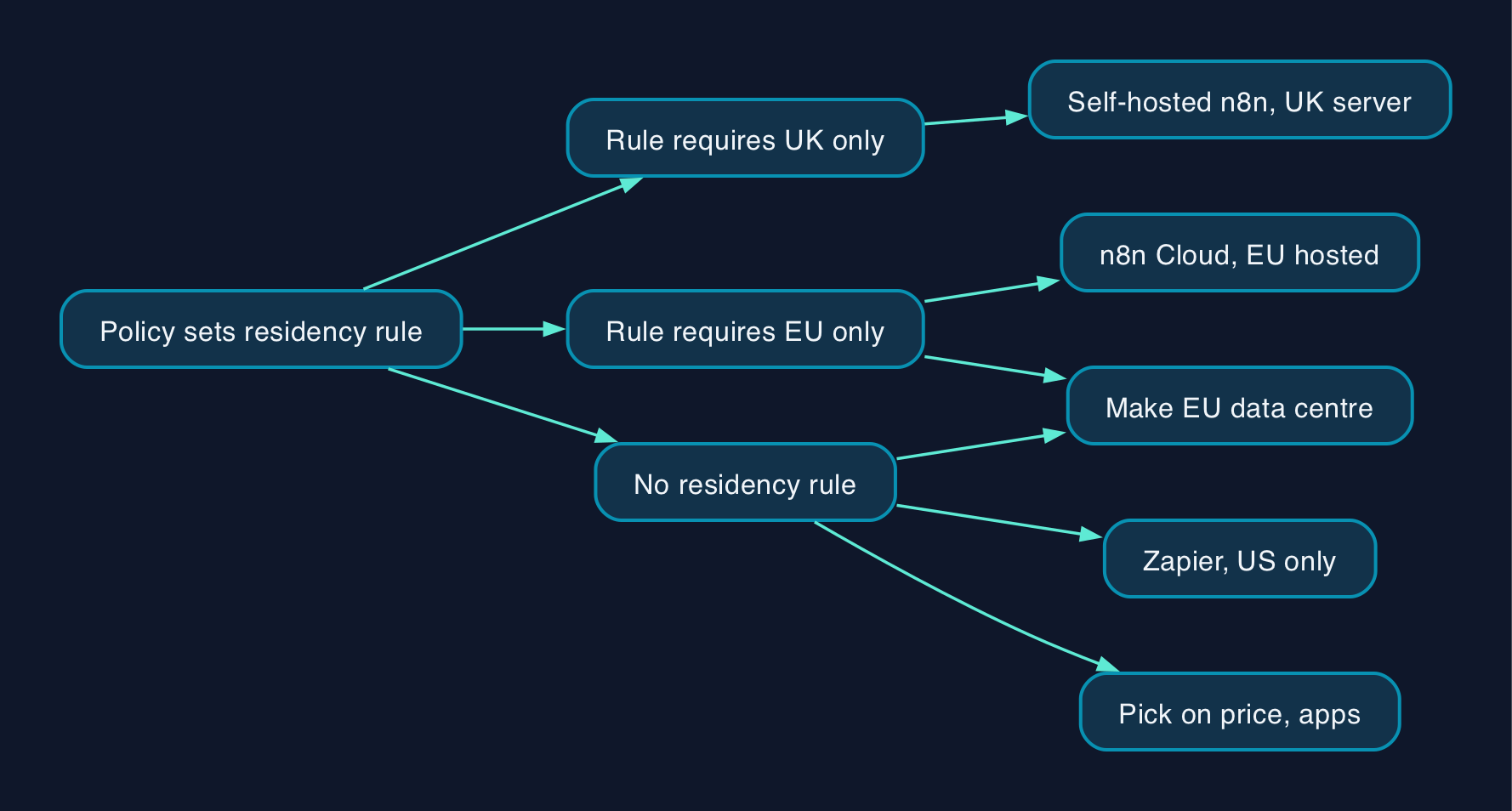
Zapier stores all customer data in the United States with no EU option, so it fails a strict UK or EU residency rule outright. Make lets you pick a US or EU data centre at signup, which satisfies an EU rule but not a UK-only one. Self-hosted n8n, free for internal business use under its Sustainable Use Licence, is the only route that guarantees UK-only storage, provided the business runs, patches and backs up the server itself.
Key pointers
- If the requirement is "no data outside the UK", only self-hosted n8n on UK infrastructure meets it. n8n Cloud and Make's EU option both put data in continental Europe, not the UK.
- If the requirement is "no data outside the EU", n8n Cloud (hosted on Azure in Frankfurt) and Make's EU data centre both qualify without self-hosting.
- Zapier has no EU-only or UK-only storage option at any plan, including Enterprise. Ask the supplier directly before assuming otherwise.
- Self-hosting removes the licence fee but not the work: patching, backups, encryption at rest and answering data subject requests all move to your IT team.
- Get the billing unit straight before comparing prices: Zapier charges per task, Make per credit, n8n Cloud per workflow execution. The same workflow can cost very different amounts on each.
- A small UK-region VPS runs from around $4 a month for the hardware alone (DigitalOcean's published entry price); budget separately for a person's time to run it.
What the decision means for a UK mid-market business
A workflow automation tool moves data between systems that already hold personal information: a CRM, an accounting package, a support inbox, an HR system. Every one of those workflows is a live copy of a data flow, and where the automation platform stores that data becomes a genuine GDPR question the moment customer or employee records pass through it.
The three platforms in this comparison handle that question in different ways. n8n is workflow automation software that a business can either run on n8n's own servers (n8n Cloud) or install and operate on its own infrastructure (self-hosted). Zapier and Make are always run by their vendor; the customer never controls the physical location of the server, only, in Make's case, which region it sits in.
For a mid-market IT or operations lead, the practical question is rarely "is US hosting illegal". Personal data can lawfully move from the UK to the US using Standard Contractual Clauses and the UK extension to the EU-US Data Privacy Framework, which Zapier has certified against. The real trigger is usually narrower and comes from somewhere else: a client contract that specifies UK or EU-only processing, a public-sector or NHS framework condition, a cyber insurance policy, or an internal policy set after a previous audit finding. When that clause exists, it rules out whichever platform cannot meet it, regardless of the general legal position.
Smaller businesses with no such clause do not need to rule out Zapier or Make on residency grounds alone; the decision then comes down to cost, the app library and how much in-house technical time is available, covered below.
UK GDPR and data residency
This section explains general UK GDPR mechanics; it is not a compliance verdict for any one business or contract. This is not legal advice; consult your legal counsel.
Under UK GDPR, sending personal data to a "separate organisation" outside the UK is a restricted transfer, and every restricted transfer must be covered by one of three routes: UK adequacy regulations for the destination country, an appropriate safeguard such as the International Data Transfer Agreement or Addendum together with a transfer risk assessment, or a specific, necessary exception.
This applies to Zapier's US hosting and, if the EU option is not selected, to Make's hosting too. It does not automatically make either platform unusable. Zapier has certified against the UK extension to the EU-US Data Privacy Framework and offers Standard Contractual Clauses in its DPA, which is one recognised safeguard route. What UK GDPR does not offer is a shortcut: a business still has to identify that a restricted transfer is happening, choose and document a lawful transfer mechanism, and be able to show that work if asked, whichever platform it picks.
A contractual clause that says "no data outside the UK" or "no data outside the EU" is a different, stricter bar than UK GDPR's own minimum. UK GDPR permits transfers to the US under the frameworks above; a client contract can still forbid it. Check the actual wording of the clause before ruling out a platform, since "residency" and "no restricted transfers" are not the same requirement.
How the three platforms actually differ
All three platforms connect apps and automate multi-step processes without custom-coding every integration. The differences that matter for a UK mid-market buyer are less about what each tool can build and more about who operates it, where the data sits, and what a workflow costs to run at volume.
Zapier is a fully hosted SaaS product with no self-hosting option at any tier. Zapier operates the servers, applies security patches, and is contractually the data processor. In exchange, the customer has no control over where the underlying data physically sits; it stays in the US.
Make is also fully hosted, but the customer picks the data centre region, US or EU, once, when the organisation is created. That single choice cannot be changed afterwards, so a business expecting to add EU clients later should set it up correctly from day one rather than assuming it can be moved.
n8n offers both models. n8n Cloud is fully hosted, currently on Azure infrastructure in the EU, and is operated day-to-day the same way as Zapier or Make, just with fewer connector integrations pre-built (n8n relies more on generic HTTP and webhook nodes for niche apps). Self-hosted n8n hands the business the entire stack: the server, the database, the TLS certificate, the backups and the encryption key. Nothing about the software forces it to stay in any particular country; a UK mid-market business can put the instance on a server in London, Manchester or anywhere else it controls, which is the only way any of the three platforms can guarantee UK-only storage today.
Pricing and cost model
Each platform bills on a different unit, which changes which one looks cheap at a given workload. The prices below are those each vendor's pricing page displayed to a UK visitor on 29 September 2026: Zapier and Make quote in US dollars, while n8n shows UK visitors its own sterling price points (visitors elsewhere in Europe see euros). Zapier's pricing page has a currency toggle, including GBP, but it converts the USD list price at the live exchange rate rather than publishing a fixed GBP figure, so this piece quotes the USD list price it actually displays by default; n8n's GBP prices, by contrast, are set figures shown on its pricing page. This piece does not otherwise convert between currencies without a stated, dated exchange rate, so treat prices shown in different currencies as not directly comparable.
- Zapier charges per task. Each action step in a workflow that runs successfully consumes one task; some AI steps use more than one.
- Make charges per credit. Each module that processes data in a scenario consumes at least one credit, and heavier modules use more.
- n8n (Cloud or self-hosted) charges per workflow execution, or nothing at all for self-hosted software. A full multi-step workflow run counts as one execution regardless of how many steps it contains, so complex workflows do not multiply the cost the way they can on Zapier or Make.
| Platform | Entry paid plan | Price | What it buys | Governance-ready tier | Price |
|---|---|---|---|---|---|
| Zapier | Professional | $19.99/mo, billed annually | Multi-step Zaps, unlimited premium apps, webhooks | Team (25 users, SAML SSO) | $69/mo |
| Make | Core | $9/mo for 10,000 credits, billed annually | Unlimited active scenarios, scheduled runs, API access | Teams (roles, shared templates) | $29/mo for 10,000 credits |
| n8n Cloud | Starter | £20/mo, billed annually | 5 concurrent executions, unlimited users and workflows | Business (self-hosted, SSO/SAML/LDAP, Git version control) | £571/mo billed annually, £686/mo billed monthly |
| n8n self-hosted | Community Edition | Free software; infrastructure from about $4/mo | Unlimited executions, all integrations, no licence fee, internal use only | Enterprise self-hosted (SSO, log streaming, SLA) | Contact n8n |
The gap in the last column is the most important number here. n8n's Business plan, at £571 a month billed annually (£686 a month billed monthly), is n8n's entry point for SSO, SAML and audit-grade governance features, and it requires self-hosting; n8n's Enterprise plan carries the same controls further and can run on n8n Cloud instead, at a price n8n only quotes on request. Zapier and Make reach broadly comparable team-level controls at $69 and $29 a month respectively, in a different currency, because those platforms fold the infrastructure cost into the subscription. A business that needs SSO and governance but not UK-only storage may find Zapier or Make's team tier considerably cheaper than n8n's paid self-hosted route; a business that specifically needs UK-only storage does not have that option from Zapier or Make at any price.
Running n8n's free Community Edition yourself removes the £571 to £686 Business plan cost entirely, but shifts the SSO, audit logging and access-control work onto whoever administers the server, using open-source or self-built tooling (a reverse proxy with its own authentication, for example) rather than a vendor feature.
Self-hosting infrastructure. Virtua.Cloud, a European VPS provider, estimates a light self-hosted n8n instance (under 20 workflows) at 12 to 17 EUR a month for the server, database and backups combined, rising to 24 to 29 EUR a month for a small team running 50 to 100 workflows, plus one to two hours a month of maintenance time. A UK-region equivalent from DigitalOcean's London data centre starts from around $4 a month for the smallest bundled plan; a business running more than a handful of workflows should budget for a larger instance than the entry tier. None of these figures include the staff time to patch, monitor and back up the server, which is the real ongoing cost of the self-hosted route.
Vendor and option comparison
| Criterion | Zapier | Make | n8n Cloud | n8n self-hosted |
|---|---|---|---|---|
| Who operates the server | Zapier | Make (Celonis) | n8n GmbH | Your business |
| Data location control | None; always US | Choose US or EU at signup, fixed | EU (Azure Frankfurt) | Anywhere you host it, including the UK |
| Meets a "UK only" clause | No | No | No | Yes, if hosted in the UK |
| Meets an "EU only" clause | No | Yes, if EU region chosen at signup | Yes | Yes, if hosted in the EU |
| Billing unit | Task | Credit | Execution | Free software; infrastructure cost only |
| Entry price | $19.99/mo | $9/mo, 10k credits | £20/mo | From about $4/mo infra, plus staff time |
| Who patches and secures the platform | Vendor | Vendor | Vendor | Your IT team |
| Licence for commercial reselling | N/A, SaaS subscription | N/A, SaaS subscription | N/A, SaaS subscription | Needs a separate commercial agreement with n8n |
| Best fit | No residency requirement, wide app library needed, no in-house server admin | EU-only requirement, no need for UK-specific hosting | EU-only requirement without running your own server | Strict UK-only requirement, or in-house DevOps capacity to justify the saving |
No option here is a universal winner. A business with no residency clause and limited technical staff is usually better served by Zapier's larger app library or Make's cheaper entry tier than by taking on server administration for no compliance benefit. A business that has been told, in writing, that data must not leave the UK has effectively one workable route among these three: self-hosted n8n on UK-based infrastructure. A business with an EU-only requirement, rather than a UK-only one, has two workable routes without touching a server: Make's EU data centre or n8n Cloud.
Editorial analysis
The framing "self-host for data residency versus the convenience of a SaaS tool" undersells how narrow the actual gap is. Make already offers an EU data centre choice at signup, at a lower entry price than n8n Cloud, which covers the most common version of this requirement (EU, not specifically UK) without anyone touching a server. Self-hosting only earns its keep when the requirement is genuinely UK-only, when a client or regulator has said so in writing, or when a business already has the in-house capacity to run a Linux server and would rather pay for compute than for a vendor's SSO tier. Buying n8n's £571-to-£686-a-month self-hosted Business plan purely for convenience, without a real UK-only requirement, gets a business the worst of both options: it still has to self-host, and it pays several times Zapier's or Make's governance-tier price for the privilege. The decision should start with reading the actual clause that triggered it, not with a general preference for open, self-hosted tools.
Sources
- n8n Pricing - n8n.io
- Choose how to use n8n - n8n Docs
- n8n Community licence - n8n Docs
- n8n Security - n8n.io
- Zapier Plans and Pricing - Zapier
- Zapier Data Privacy Overview - Zapier
- Make Pricing and Subscription Packages - Make (Celonis)
- Make Organizations help article - Make Help Center
- ICO, a brief guide to international transfers - Information Commissioner's Office
- DigitalOcean Regional Availability - DigitalOcean
- DigitalOcean Droplet Pricing - DigitalOcean
- n8n vs Zapier vs Make, cost, privacy and GDPR compared - Virtua.Cloud