

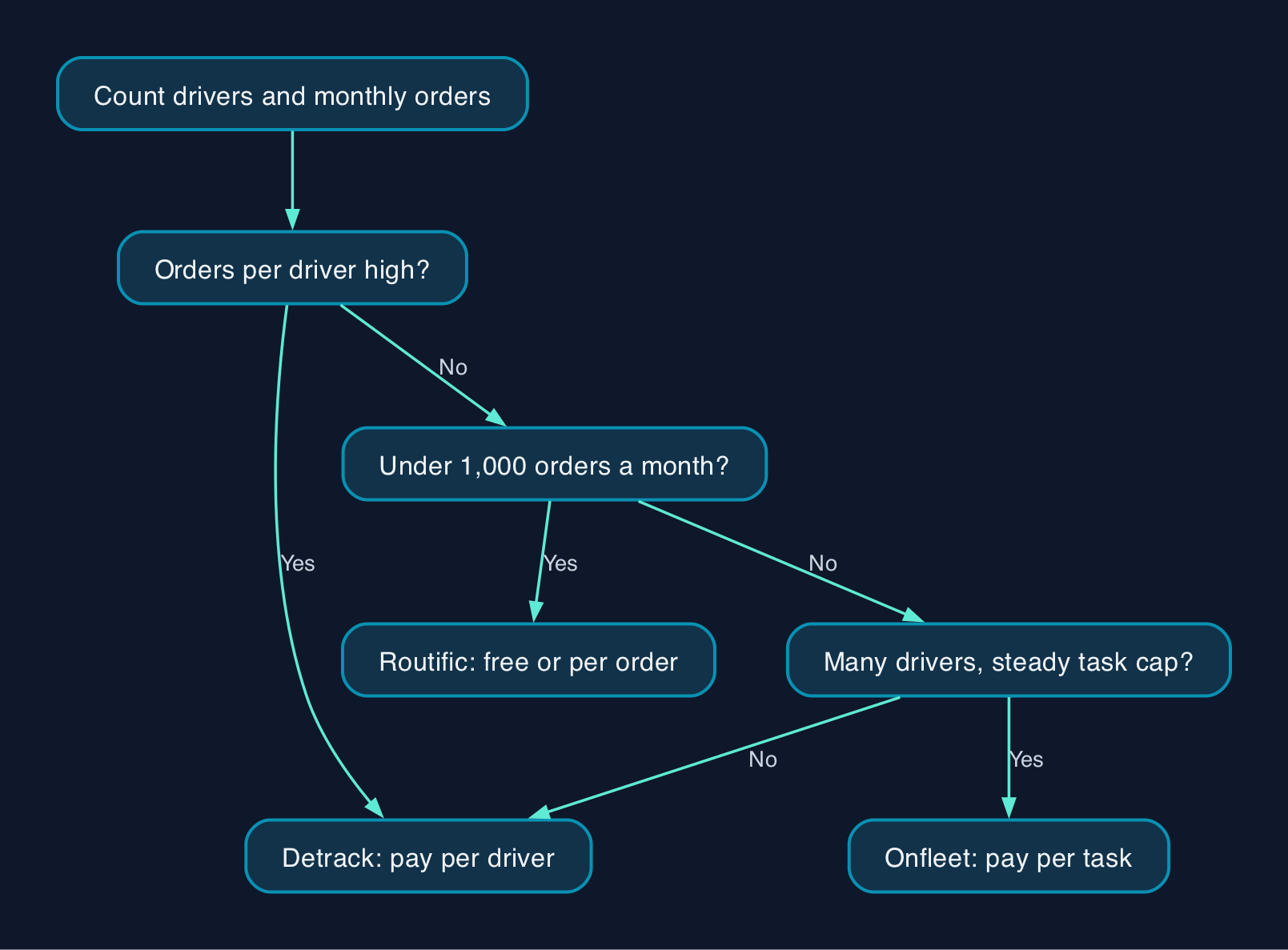
For a UK courier or last-mile operator with under 20 drivers, the honest answer is that no single platform is cheapest at every volume. Detrack charges a flat $29 to $39 per driver a month regardless of order count, which favours a small, stable team with a high number of stops per driver. Onfleet and Routific charge by completed order or task instead, which can favour a larger or more variable driver roster with lighter individual loads. Work out your typical drivers and monthly orders before comparing headline prices.
Key pointers
- Detrack bills per driver ($29 Pro or $39 Advanced a month), not per order, so a driver doing many stops costs the same as one doing few.
- Onfleet bills per completed task ($619 Launch for 2,500 tasks, $1,349 Scale for 5,000, $3,099 Enterprise for 10,000+), with users unlimited on every plan.
- Routific dropped its old per-vehicle model in mid-2024 and now charges per order, free up to 100 orders a month, then a flat $150 up to 1,000, then a sliding per-order rate.
- Route optimisation sits on Detrack's $39 Advanced tier, not the $29 Pro tier, and on Onfleet's Scale tier for the advanced version (Launch only gets basic optimisation).
- Onfleet does not publish its per-task overage rate; ask for it, and any breakpoints, in writing before you sign.
- All three list prices in US dollars, so a UK buyer's actual sterling cost moves with the exchange rate, not just the vendor's list price.
- A UK business buying from any of these overseas suppliers typically gets an invoice with no VAT shown and self-accounts for it under the reverse charge, rather than being charged VAT at checkout.
- Proof of delivery is closest between the three at the mid tier: Detrack's entry Pro plan already includes signature, up to 10 photos and 5-year retention, while Onfleet gates barcode scanning and age verification to its Scale plan.
What Route Planning and Proof of Delivery Software Actually Does
A small courier or last-mile operator uses this kind of software for two connected jobs: working out the best order to visit stops in, and capturing evidence that each delivery actually happened. Route optimisation turns a list of addresses into a sequenced run for each driver, accounting for stop count, time windows and vehicle capacity. Proof of delivery (POD) captures a signature, photo, barcode scan or timestamp at the point of handover, so a dispute over a missing parcel can be settled by pulling up the record rather than taking the driver's word for it.
All three platforms in this comparison do both jobs. Detrack and Routific put proof of delivery in every tier, including Routific's free plan. Route optimisation is universal on Routific but gated to Detrack's higher Advanced tier and to Onfleet's higher Scale tier for the fuller version (onfleet.com/pricing).
For a small UK operator, the practical question is not which platform has the most features on paper. It is which pricing model fits your actual mix of drivers and orders, and whether the proof-of-delivery depth matches what your customers or insurers expect.
How Detrack, Onfleet and Routific Price Their Plans
The three vendors use three different meters. Detrack meters drivers. Onfleet meters completed tasks in stepped monthly plans. Routific meters orders on a sliding scale. None of the three publish prices in pounds; all three list in US dollars, so the sterling figures below are estimates, not the supplier's UK price, converted at £1 = $1.3251 as reported by FXStreet on 28 September 2026 (fxstreet.com).
| Platform | Entry tier | Mid tier | Top published tier | Unit charged |
|---|---|---|---|---|
| Detrack | Pro, $29/driver/month (about £22) | Advanced, $39/driver/month (about £29) | Enterprise, custom | Per driver, unlimited jobs |
| Onfleet | Launch, $619/month for 2,500 tasks (about £467) | Scale, $1,349/month for 5,000 tasks (about £1,018) | Enterprise, $3,099/month for 10,000+ tasks (about £2,339) | Per completed task |
| Routific | Free up to 100 orders/month | $150/month flat up to 1,000 orders (about £113), then 15c to 3c per extra order | Custom above 50,000 orders/month | Per order |
Sources: detrack.com/pricing, onfleet.com/pricing, routific.com/pricing.
Assumptions. The GBP figures above and in the worked examples below are calculator conversions at the stated rate, not published sterling prices. They exclude card processing fees (Onfleet charges 3.5% on card, Apple Pay and Google Pay payments), telephony add-ons, and any VAT treatment.
A UK business buying software from Detrack (Singapore-priced in USD), Onfleet (US) or Routific typically receives an invoice with no VAT charged, because the place of supply for B2B digital services is normally treated as the customer's country and the overseas supplier does not charge UK VAT. Instead, a VAT-registered UK buyer self-accounts for the notional VAT under the reverse charge: declaring it as both output and input tax on the same VAT return, which is usually cost-neutral if the purchase is for fully taxable business use (gov.uk VAT Notice 741A). This is not legal advice; consult your legal counsel or accountant on your specific VAT position. A courier that is not yet VAT-registered should still take note: HMRC's guidance states that the value of these overseas software purchases must be added to a business's own taxable turnover when testing whether it has crossed the £90,000 VAT registration threshold, even if the courier makes no VAT-registered sales of its own (gov.uk VAT Notice 741A).
Two Worked Examples
The query behind this comparison is whether Detrack's per-driver model beats Onfleet's per-task model when a small operator runs a high order count per driver. The answer depends on both numbers, so here are two scenarios using the published prices above.
Scenario A: 15 drivers, high volume. Each driver completes 50 stops a day, 22 working days a month, for 16,500 orders a month. Detrack's Advanced tier (needed for route optimisation) costs 15 x $39 = $585 a month, about £441. Routific's sliding scale works out to $150 for the first 1,000 orders, then $150, $130, $200 and $400 across the next four bands, then $325 for the remaining 6,500 orders in the 10,000-to-20,000 band, totalling $1,355 a month, about £1,023. Onfleet's published Enterprise tier starts at $3,099 a month for 10,000 tasks, about £2,339, and 16,500 tasks sits above that starting allowance, so the real Onfleet bill at this volume would be at least £2,339 and likely more, since Onfleet does not publish rates above the Enterprise starting point.
Scenario B: 20 drivers, low volume. Each driver completes 100 stops a month (5 a working day), for 2,000 orders a month across the full 20-driver roster this query asks about. Routific costs $150 for the first 1,000 orders plus $150 for the next 1,000 at 15c each, totalling $300 a month, about £226. Onfleet's Launch tier covers the volume comfortably within its 2,500-task allowance for a flat $619 a month, about £467. Detrack's Advanced tier costs 20 x $39 = $780 a month, about £589, the most expensive of the three at this driver count and order volume.
These two scenarios show the crossover directly: Detrack wins when order volume per driver is high relative to driver count, because its price does not move with order volume. Onfleet and Routific win when driver count is high relative to order volume, because their price does not move with headcount.
Proof of Delivery Depth Compared
| Feature | Detrack | Onfleet | Routific |
|---|---|---|---|
| Signature capture | Yes, all tiers | Yes, all tiers | Yes, all tiers including free |
| Photo capture | Up to 10 photos, all tiers | Yes, all tiers | Multiple photos, all tiers |
| Barcode scanning | Yes, via Scanner app | Scale tier and above | All tiers |
| Age or ID verification | Not standard | Scale tier and above | Not standard |
| POD data retention | Up to 5 years | Not published on the pricing page | 90 days for file downloads |
| Route optimisation included | Advanced tier only | Basic on Launch, advanced on Scale+ | All tiers, including free |
Sources: detrack.com/pricing, onfleet.com/proof-of-delivery, routific.com/customer-notifications.
Detrack's 5-year POD retention on its entry tier is the deepest audit trail of the three for a dispute that surfaces months after delivery. Barcode scanning is available on all three, but Onfleet's age or ID verification is the one capture type unique to it, and it sits on the $1,349 Scale tier rather than the $619 Launch tier, so an operator handling age-restricted goods needs the higher plan. Routific bundles barcode scanning into every tier, including the free one, but only retains POD files for 90 days.
Which Platform Suits Which Small UK Courier
A courier with a small, stable team of drivers doing a high number of stops each day, and no need for barcode or age verification, gets the lowest bill from Detrack's Advanced tier and keeps proof of delivery on every job without extra cost. A courier running a larger or more seasonal driver pool, where headcount swings more than order volume, is likely to pay less on Routific's free or $150 tier, or on Onfleet's Launch tier if barcode scanning or ID verification is a requirement from day one.
None of the three should be chosen on price alone. Detrack's Xero integration matters if invoice-to-delivery automation is the priority (detrack.com/integrations). Onfleet's Command Center and advanced route optimisation only appear from the Scale tier, so a Launch-tier buyer is running basic routing regardless of task volume. Routific's 90-day POD retention window is short if disputes commonly surface later than three months after delivery.
Before signing with any of them, ask the supplier three things in writing: the exact overage or step-up cost once you exceed your plan's allowance, whether SMS notifications are included or billed separately, and whether the contract is monthly or requires an annual upfront commitment.
Editorial Analysis
Editorial analysis. The case for Detrack in this comparison, that its per-driver pricing beats Onfleet's per-task pricing for a small operator with a high order count per driver, holds up against the published prices in Scenario A above. But it is not a universal rule. Scenario B shows the same logic reversing once driver count rises relative to order volume. A small UK courier deciding between these three platforms should build both a high-volume and a low-volume monthly estimate using its own driver count and order history, rather than relying on either vendor's headline positioning, because the crossover point sits well within the range a small operator with under 20 drivers could plausibly hit in either direction.
Sources
- Detrack Pricing — Detrack
- Onfleet Pricing — Onfleet
- Onfleet Billing (Support Center) — Onfleet
- Onfleet Proof of Delivery Software — Onfleet
- Routific Pricing — Routific
- Routific Customer Notifications — Routific
- Detrack Integrations — Detrack
- Register for VAT — GOV.UK / HMRC
- Place of supply of services (VAT Notice 741A) — GOV.UK / HMRC
- British Pound gains as several BoE members warn of upside inflation risks — exchange rate reference, 28 September 2026