

UK small and mid-sized businesses should compare the cost of running a tested workload, then decide whether to own or rent the infrastructure. Start with software compatibility, memory requirements, privacy controls and expected usage. Our recommendation is to pilot before purchasing, retain existing capacity where it meets the requirement, and consider ownership only when measured demand, operational skills and complete quotations justify it.
Define the private AI workload before choosing hardware
For this comparison, private AI means an organisation-controlled deployment with defined access, data handling and operational responsibilities. Treat those controls as purchasing requirements to demonstrate, rather than assuming that the word “private” settles them.
Separate the accelerator decision from the delivery decision. NVIDIA versus AMD concerns the hardware and supported software configuration. Ownership versus cloud rental concerns where the system runs, how capacity is purchased and who operates it.
Write a workload brief before seeking quotations. State whether the job is inference, meaning running an existing model, fine-tuning an existing model, or training a model. Include the exact model, acceptable output quality, document sizes, expected simultaneous users and maximum acceptable response time.
For a hypothetical UK engineering consultancy building an internal document assistant, the acceptance test should include employees’ document permissions and realistic question lengths. A demonstration using short public prompts would not establish suitability for that deployment.
Make UK requirements equally specific. Request the proposed processing location, backup location, support hours in UK time, escalation arrangements, billing currency and VAT treatment. If UK-only processing is a requirement, obtain evidence covering the whole service, including logs and support access.
The available evidence does not establish current UK-region capacity, provider privacy terms or comparable GBP tariffs. It therefore supports a hardware and procurement comparison, rather than a verified ranking of UK cloud GPU offers.
Architecture and operational responsibilities
An illustrative document assistant connects an authenticated application to permitted documents, retrieval services and a model-serving endpoint. Specify those access boundaries before placing the model on an owned server or rented infrastructure.
The following is a proposed responsibility map to agree with a supplier, not a description of any provider’s standard contract.
| Component | Responsibility to assign | Acceptance evidence to request |
|---|---|---|
| User access and document permissions | Internal application owner, with implementation support if needed | Tests showing that users cannot retrieve documents outside their permissions |
| Model and serving software | Named internal engineer or contracted operator | Recorded model, software versions, configuration and repeatable deployment |
| GPU infrastructure | Internal infrastructure team, hosting company or cloud provider, according to contract | Exact configuration, capacity commitment and hardware fault process |
| Patching and monitoring | Explicitly named operator | Patch schedule, alert recipients and escalation procedure |
| Data, logs and backups | Business data owner and service operator | Agreed locations, retention settings, access controls and a restore test |
| Exit and recovery | Internal service owner, supported by the supplier | Exported configuration, recoverable data and a tested redeployment procedure |
AMD’s compatibility documentation makes version alignment an explicit technical requirement. Put ownership of that alignment into the operating agreement, including responsibility for testing upgrades.
For owned infrastructure, obtain a facilities assessment against the exact server specification. The DGX H100/H200 guide specifies power, weight, temperature and airflow requirements. Those requirements should inform the hosting quotation before a hardware order is signed.
Pricing and the full cost model
As at 28 September 2026, this comparison has no verified supplier GBP price schedule with equivalent UK locations, commitments and service scope. Use the following table as a quotation template, not a price list.
Ask each bidder to quote the same workload and evaluation period. Require the edition, accelerator model, number of accelerators, location, minimum purchase, commitment, exclusions and VAT treatment alongside the headline charge.
| Cost component | Owned NVIDIA or AMD system | Cloud GPU service |
|---|---|---|
| Compute capacity | Complete server, warranty, financing and expected replacement costs | Full instance or GPU charging unit, minimum allocation and committed payments |
| Supporting infrastructure | Storage, networking, rack space, power and cooling | Included CPU and memory, storage, networking and separately billed services |
| Software | Licence and support terms, with bundled items identified | Image, operating system, model-serving and management charges |
| Deployment | Installation, integration, security configuration and acceptance testing | Environment setup, data transfer, integration and acceptance testing |
| Staffing and support | Administration, patching, hardware escalation, training and absence cover | Administration retained by the customer, managed support and escalation charges |
| Resilience | Backup, spare capacity and recovery arrangements | Backup, recovery capacity and any reservation needed to meet the service target |
| Exit | Data migration, equipment disposal and contract termination | Data export, transfer charges, configuration migration and termination obligations |
Use the same assumptions on both sides
Set an evaluation period and record expected demand, idle capacity, staffing effort, electricity tariff, support scope and recovery requirements. Leave unknown inputs visible.
For ownership, calculate acquisition, deployment, software, hosting, energy, staff, support and exit costs over that period. For cloud, calculate contracted and usage charges, storage, networking, deployment, staff, support and exit costs over the same period.
Divide each total by work completed at the required quality and response time. For a document assistant, that might be accepted requests completed within the agreed latency target. For a training job, compare runs reaching the same agreed result.
Keep capacity purchases separate from useful output. A low hourly rate is insufficient if the quoted configuration fails the workload test or requires more engineering time than the alternative.
Treat power specifications as planning inputs
NVIDIA specifies 10.2kW maximum system power for DGX H100/H200 and approximately 14.3kW for DGX B200. These figures help size electrical provision; they do not establish an electricity bill.
Request measured consumption during the proposed workload and identify whether the hosting charge already includes energy or cooling. Avoid counting either twice.
NVIDIA, AMD Instinct and cloud options compared
Compare memory without turning it into a performance ranking
The following capacities are published hardware specifications. They are useful for shortlisting, but do not establish application speed, usable model capacity or value for money.
| Accelerator | Published memory per GPU | Supporting specification |
|---|---|---|
| NVIDIA H100 SXM | 80GB | NVIDIA HGX components |
| NVIDIA H200 SXM | 141GB | NVIDIA HGX components |
| NVIDIA B200 SXM | 180GB | NVIDIA HGX components |
| AMD Instinct MI300X | 192GB | AMD MI300X acceptance guide |
| AMD Instinct MI350X | 288GB | AMD MI350X acceptance guide |
Measure memory use with the intended model, serving software and concurrency. Do not accept an aggregate memory figure across several accelerators as proof that the application can use it as required.
NVIDIA’s H200 benchmark descriptions illustrate why test conditions matter. Some comparisons change batch size between configurations. Require a test that matches your service requirement before translating a supplier’s performance claim into savings.
Choose the delivery approach separately
The suitability assessments below are editorial judgements and procurement conditions, not independently measured rankings.
| Option | Circumstances favouring consideration | Skills and administration to assess | Main commercial and exit questions |
|---|---|---|---|
| Owned NVIDIA system | An existing NVIDIA deployment already passes the workload test, or the proposed system does so with acceptable operating costs | Named support for the exact software stack, upgrades, hardware and facilities | Complete system quotation, software entitlements, warranty, replacement and migration |
| Owned AMD Instinct system | The application passes acceptance testing on the proposed AMD configuration and the complete cost is competitive | Supported ROCm configuration, application validation and continuing upgrade testing | Porting effort, server support, maintenance scope and cost of moving away |
| Rented GPU infrastructure | A bounded pilot or variable workload, provided capacity and data requirements can be demonstrated | Deployment, security, cost control and the operational work retained by the customer | Region, allocation size, availability, billing unit, commitment and export charges |
| Managed GPU service | The business needs an operator and can obtain a clear service scope | Internal service ownership and supplier oversight | Included operations, exclusions, response authority, escalation and handover |
| Retain the existing setup | Current capacity passes the agreed quality, latency and recovery tests | Evidence of bottlenecks and ongoing supportability | Renewal cost compared with the full cost of replacement |
For AMD, use the ROCm compatibility matrix to establish the supported configuration. The MI300X acceptance guide then provides a framework for validating system health and performance. Hardware support alone does not prove that a particular application meets its business requirements.
For NVIDIA, distinguish the accelerator from the complete system quotation. The DGX B200 specification includes defined hardware and software components. Do not assume an independently configured GPU server has identical inclusions.
Build a cloud shortlist without assuming UK availability
The supplied SiliconAnalysts cloud GPU tracker lists candidates including AWS, Google Cloud, Azure, CoreWeave, Lambda and RunPod. Use that as discovery evidence only; it does not establish equivalent UK offers or contractual suitability.
Send shortlisted providers the same request. Ask for the exact accelerator, region, available allocation, software image, networking arrangement, capacity guarantee and complete charging schedule. Add an AMD-based proposal where a provider can substantiate availability and support for the required configuration.
Require demonstrations of access restrictions, deletion, backup recovery and export. Decline to score an unverified capability as present merely because a sales description calls the service private or dedicated.
Editorial analysis
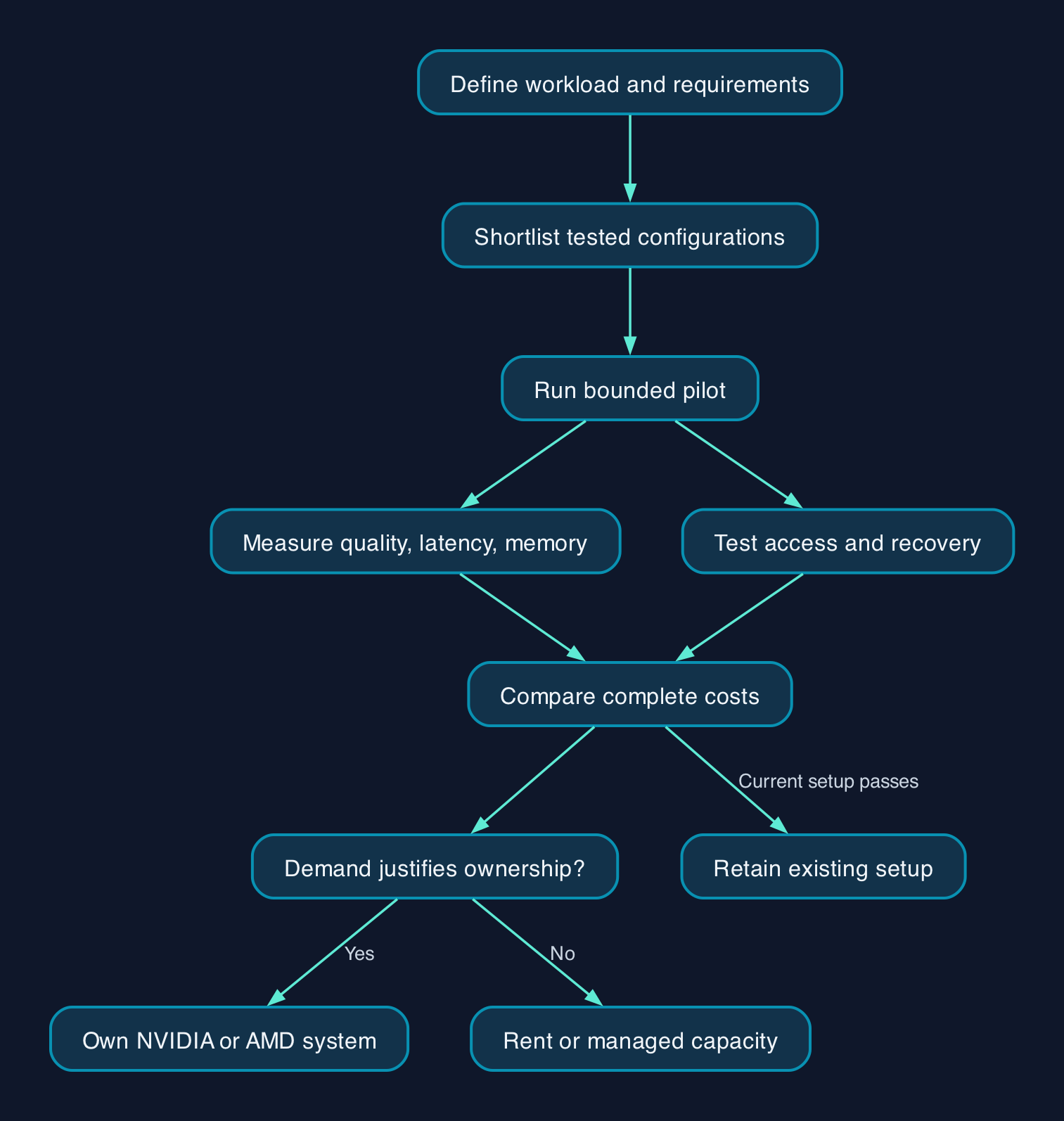
For a UK business without measured GPU demand, our recommendation is to buy evidence before buying long-term capacity. Commission a bounded pilot with explicit acceptance criteria and an agreed spending limit.
Use the same model, quality threshold, input lengths and concurrency on each candidate. Record response times, completed work, memory use, errors, staff effort and the full bill. Include recovery and access-control tests alongside performance measurements.
Choose NVIDIA where the tested configuration and available support justify its total cost. Choose AMD Instinct where the application passes validation and the complete commercial proposal remains attractive after migration and maintenance work. Choose rented or managed capacity where its verified availability, responsibilities and commitment fit the business.
Keep the existing setup when it passes those same tests. A replacement proposal should demonstrate a business improvement large enough to pay for migration, training and disruption.
Sources
- NVIDIA — HGX H100, H200 and B200 reference architecture components
- NVIDIA — Introduction to DGX H100/H200 systems
- NVIDIA — DGX B200 specifications and performance conditions
- NVIDIA — H200 specifications and benchmark conditions
- AMD — ROCm compatibility matrix
- AMD — Instinct MI300X customer acceptance guide
- AMD — Instinct MI350X customer acceptance guide
- SiliconAnalysts — Cloud GPU pricing tracker, used for supplier discovery only