


For a UK small or mid-sized business, start with the documents staff need to find and the work they must produce. Pilot Gemini first if work already centres on Google Workspace, where Google provides AI features within its business applications. Shortlist ChatGPT for research across connected sources and Claude for document analysis and file production. These are starting points for testing, not a ranking of accuracy or value.
Choose the document workflow before the assistant
“Working with long documents” covers different jobs. Reading a supplied report is different from finding the latest policy across shared folders. Producing an editable briefing from that evidence adds another requirement.
Separate the purchase into three tasks.
| Task | What the assistant must demonstrate | Evidence the buyer should inspect |
|---|---|---|
| Analyse supplied documents | Preserve qualifications, find exceptions and distinguish conflicting passages | Answers checked against the original documents |
| Research a question | Find relevant sources and connect each conclusion to supporting evidence | Source passages, publication dates and citation accuracy |
| Retrieve internal knowledge | Find the authoritative version within the user’s permitted sources | Correct version, document owner and access behaviour |
For a small business, the best starting point is usually the task that already consumes paid staff time. A consultancy might test proposal research. A manufacturer might test maintenance-document retrieval. These are suggested pilot scenarios, not customer results.
The supplied evidence does not establish a current, like-for-like ranking for long-document accuracy, context capacity or research quality. A context window describes how much material a model can consider at once; it does not, by itself, establish whether the model finds the clause that matters.
Where each option deserves a pilot
Claude for document analysis and producing files
Claude deserves a place on the shortlist when the required output is an editable document, spreadsheet or presentation. Anthropic’s file-creation documentation supports those output formats. That establishes a capability to test, rather than proof that the finished work needs less correction.
Its Google Workspace connection also supports document retrieval and source-linked responses. However, Anthropic distinguishes Google Drive from its separate Docs, Sheets and Slides connectors, with live editing described as beta.
That distinction matters when evaluating a workflow. Finding a document, reading its text and editing its original file are separate operations. Test each one required by the job.
For image-heavy reports, the documented Drive limitation is a particular concern. A successful summary of the extracted text cannot establish that Claude considered an embedded chart. Test the actual ingestion route with representative files before selecting it for that work.
ChatGPT for research across uploaded and connected sources
ChatGPT is a reasonable pilot candidate when staff need to combine public research with internal material. OpenAI’s deep research documentation explicitly covers uploaded files, web research and enabled apps.
For recurring internal questions, company knowledge adds business-specific answers with citations across connected applications. The Apps guide identifies Google Drive, SharePoint and GitHub as examples.
The buying question is whether the required app works with the organisation’s actual content and permissions. A connector’s presence is only the beginning of that assessment. Ask staff to locate an approved policy, distinguish it from an obsolete copy and show the supporting passage.
Custom connections introduce additional administration. OpenAI’s MCP app documentation describes administrator-led deployment and beta support for actions that can modify connected systems. A business seeking document search should establish whether it needs those actions at all.
Gemini for organisations already working in Google Workspace
For a business whose staff live in Gmail, Docs and Drive, Gemini should usually receive the first pilot. This is an editorial recommendation based on where the work happens: Google documents assistance within those applications, subject to subscription.
Include Gemini Notebook when testing a defined collection of source documents. Google’s Workspace guide describes uploading sources for knowledge-sharing and analysis. Test whether that collection remains useful as documents change, rather than assuming a notebook becomes a continuously maintained company knowledge base.
An organisation with material in Microsoft 365 and other systems should also distinguish Workspace features from Gemini Enterprise. Google Cloud describes broader connected search and agents there. Confirm the relevant edition, commercial terms and deployment work separately.
How access and responsibilities should work
Keep the document repository as the authoritative home for policies, procedures and approved records. Treat the assistant’s output as a derived answer that requires an accountable reviewer.
That is a proposed operating model, not a claim that the three products enforce identical boundaries.
| Layer | Recommended owner | Acceptance condition |
|---|---|---|
| Source documents | Department or document owner | The approved version is identifiable and obsolete copies are marked |
| Accounts and connections | IT administrator or managed service provider | Only approved sources and necessary actions are enabled |
| Research task | Staff member requesting the work | The question, permitted sources and required output are explicit |
| Answer review | Relevant subject specialist | Material claims match the cited passages |
| Ongoing support | Named internal owner or contracted provider | Someone owns connection failures, access changes and user support |
Start with read and search access wherever the task permits. This reduces the number of permissions and actions the pilot must assess.
Claude’s Workspace connector guidance describes actions such as sending email and sharing or deleting files, alongside approval controls. ChatGPT’s custom app documentation similarly includes write and modify actions. Buying an assistant for reading does not make those additional permissions necessary.
For confidential information, make retention, deletion, access and contractual terms explicit procurement checks. The cited no-training statements address one question; they do not establish identical data handling across plans or prove UK data residency.
Pricing and the full cost of adoption
The evidence available for this comparison does not contain current UK subscription prices, minimum seat quantities, billing commitments or VAT treatment. No reliable GBP price ranking can therefore be presented as at 28 September 2026.
Use a quotation worksheet covering the same staff, tasks and evaluation period.
| Cost component | Claude quotation requirement | ChatGPT quotation requirement | Gemini quotation requirement |
|---|---|---|---|
| Subscription | Relevant Team or Enterprise offering and required capabilities | Business or Enterprise offering and required capabilities | Existing Workspace entitlement, upgrade requirements and any separate Enterprise offering |
| Usage | Limits and additional charges for the intended workload | Research and other task limits, plus additional charges | Included usage and any expanded-access requirement |
| Deployment | Connector setup, approved actions and document preparation | App configuration, knowledge access and any custom development | Workspace configuration or separate Enterprise connection work |
| Staff time | Training, output review and administration | Training, citation review and administration | Training across the relevant applications and administration |
| Support and exit | Support scope, offboarding and export requirements | Support scope, offboarding and export requirements | Support scope, offboarding and export requirements |
These are costs to establish, not claims that every supplier charges separately for every row.
Compare additional expenditure against the tools already paid for. Google states that Workspace plans include Gemini capabilities, with availability dependent on subscription. A business should establish that entitlement before buying another assistant for the same task.
For a stated evaluation period, calculate total cost as subscriptions and usage, plus setup, training, administration, review, support and exit work. Leave unknown inputs visible. Do not present the subscription subtotal as complete ownership cost.
One documented operational figure is 10 files per simultaneous upload to ChatGPT Projects, from OpenAI’s Projects guidance. This may affect batch preparation, but it is not a measure of document understanding or total project capacity.
Comparing the options on a common basis
The table below sets out conditional buying judgements based on documented features. It is not a hands-on performance result.
| Criterion | Claude | ChatGPT | Gemini |
|---|---|---|---|
| Strong reason to pilot | Producing editable files from analysis, supported by Anthropic’s file-creation documentation | Combining uploaded, web and connected evidence through deep research | Working inside existing Google applications through Workspace with Gemini |
| Internal knowledge route | Google Workspace connectors, with organisation-level controls on business plans | Company knowledge and enabled apps | Workspace sources, or the separately assessed Gemini Enterprise offering |
| Usability test | Can staff move from source material to a usable file without substantial repair? | Can staff find the right sources and verify the resulting synthesis? | Can staff finish the task within their existing working environment? |
| Administration test | Confirm connector permissions and required plan controls | Confirm app availability, administrator ownership and any custom app work | Confirm edition entitlements and the boundary between Workspace and Enterprise |
| Cost test | Price the required file and knowledge workflow, including review | Price the required research and app workflow, including review | Establish existing entitlement before pricing additional capability |
| Reason to reject after testing | The ingestion route misses material evidence or outputs need excessive correction | Retrieval or citation checking consumes the time the tool was meant to save | Required sources or tasks demand an additional deployment that cannot be justified |
For all three, include export and offboarding in the pilot. Ask an administrator to remove a test user, revoke a connection and demonstrate how useful work is retained. Set those as acceptance criteria rather than assuming equivalent exit behaviour.
Editorial analysis
The most useful purchasing measure is the cost of an accepted answer. A polished draft that requires extensive source checking may be less valuable than a less polished answer that reliably identifies the correct evidence.
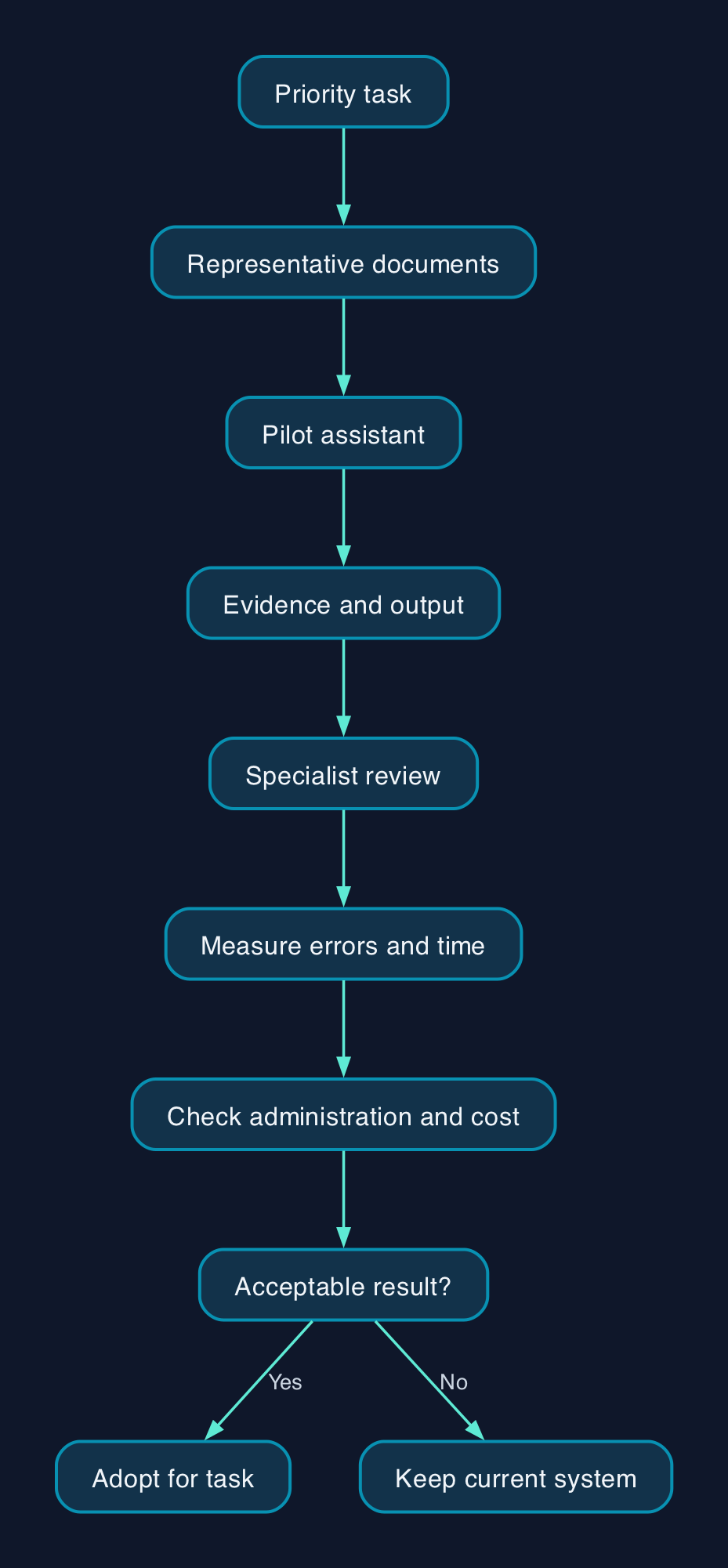
Use the same representative documents and questions for every shortlisted product. Include an obsolete policy, a conflicting statement and a question the sources cannot answer. Record factual errors, missing qualifications, citation failures, review time and whether the output is usable.
For a Google Workspace business, test its existing Gemini entitlement first. Add Claude or ChatGPT where a defined task justifies a separate subscription. For a business spread across several repositories, make retrieval quality and access administration the first selection gate.
Retaining the present document system is also a valid outcome. If staff cannot identify which policy is authoritative, assign ownership and correct the source collection before expanding the assistant rollout.
Sources
The article uses the supplied source extracts reviewed on 28 September 2026. Dates below are publisher dates visible within those extracts, where available; pages were not independently reopened for this article.
- Anthropic — Use Google Workspace connectors
- Anthropic — Claude can now create and edit files, published 9 September 2025, with an update dated 21 October 2025
- Anthropic — Claude Enterprise Plan
- OpenAI Academy — Apps, updated 4 September 2026
- OpenAI — Work smarter with your company knowledge in ChatGPT
- OpenAI Help Center — Projects in ChatGPT
- OpenAI Help Center — Deep research in ChatGPT
- OpenAI Help Center — Developer mode and MCP apps in ChatGPT
- Google Workspace Help — Google Workspace with Gemini
- Google Cloud — Gemini Enterprise app