


None of Civica Cx, Aareon QL or NEC Housing was built solely for Awaab's Law, and switching platform is rarely the fastest route to compliance by 30 November 2026. The real decision is whether your case management, contractor scheduling and audit trail can prove investigations finish within 10 working days and relevant safety work within five working days of the investigation concluding where a significant hazard is identified, and what configuring that costs.
Key pointers
- Phase 2 applies from 30 November 2026, with 10 working days to investigate potential significant hazards and five working days from investigation conclusion to complete relevant safety work where a significant hazard is identified; a written summary is due within three working days of conclusion unless all required safety and preventative works are completed within that period, in which case the tenant must still be informed of completion.
- NEC Housing lists £1.08 a unit a month on G-Cloud, while Civica's pricing schedule gives a 2026 entry-band starting price of £3,193 a month; no QL rate appears in the supplied Aareon product information.
- The pricing attachments explain property-based billing, with Civica's entry band covering 0–2,500 properties and 20 diaries, so get a written, like-for-like quote before comparing headline numbers.
- NEC says Awaab's Law case management is included in its platform, but the supplied Civica and Aareon pages do not establish equivalent inclusion or add-on pricing, so an RFP should test both configuration effort and licence scope.
- Ask each supplier for its Skills Framework for the Information Age (SFIA) day rate for implementation and data migration; NEC and Civica both publish one alongside their G-Cloud listing.
- The "all reasonable endeavours" defence requires evidence of the steps taken to meet the requirements, so audit trail export matters as much as ticketing speed.
- Budget for suitable alternative accommodation at the landlord's expense if relevant safety work cannot be completed within its deadline.
- Check exit terms now, including Civica's three months' notice and NEC's minimum two months' written notice for non-standard extraction, with NEC's fixed extraction quotation following a one-day scoping study.
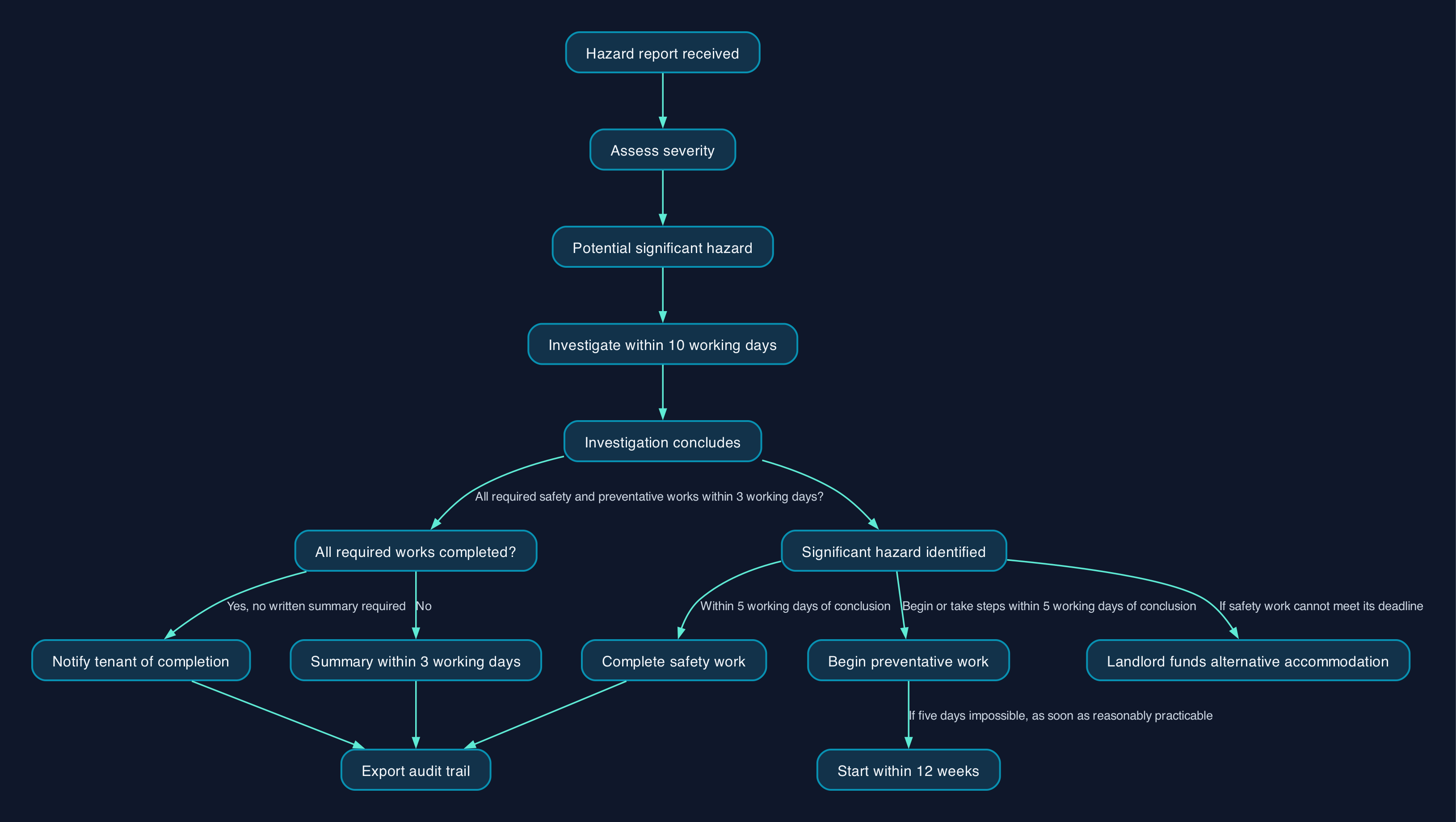
What Awaab's Law Phase 2 Means for a Repairs Team
Phase 1, live since 27 October 2025, covered all emergency hazards and significant damp and mould hazards. Phase 2 folds seven more significant-hazard categories into the same requirements: excess cold, excess heat, falls, structural collapse, fire and explosion risk, electrical hazards, and domestic hygiene (GOV.UK). For a repairs or asset management lead, every report needs to be logged and assessed, however it arrives, but not every reported problem qualifies as significant or emergency. The emergency 24-hour clock starts immediately on awareness; working-day deadlines normally count from the day after the triggering event, rather than waiting for a surveyor to open the job, as the Phase 2 guidance explains.
The duty applies to registered providers in England regardless of size, subject to the tenancy exclusions. For tenancies within scope, a housing association managing 2,000 homes carries the same statutory clock as one managing 20,000, under the Phase 2 guidance. That makes configuration, not raw platform capability, the deciding factor for a mid-sized association choosing between systems it may already own.
NEC frames this directly. Roger Birkinshaw, NEC's Executive Director for Government and Housing, describes case management and Awaab's Law compliance as included in NEC Housing, with requests, inspections, scheduling, communication and audit-ready evidence using a single source of data (NEC Software Solutions). The supplied Civica and Aareon pages describe repairs and housing management capabilities, but do not establish the same Awaab's Law-specific inclusion or configuration.
UK Compliance Mapping
Awaab's Law is a legal duty, not guidance. It was introduced by section 42 of the Social Housing (Regulation) Act 2023 and given effect through the Hazards in Social Housing (Prescribed Requirements) (England) Regulations 2025. Phase 2 also depends on the 2026 amendment regulations, applying from 30 November 2026. The requirements are implied into almost all social housing tenancies let by registered providers in England, with statutory exceptions; licences, long leaseholds and shared ownership are excluded, as set out in the government's Phase 2 guidance. This regime applies to registered providers of social housing, not private landlords. Separately, the government has announced that the new Decent Homes Standard will apply to both social and privately rented homes from 2035 in its policy statement.
A landlord in breach has one statutory defence: showing it used "all reasonable endeavours" to meet the requirements, as explained by RPC Legal. In practice that means being able to produce a timestamped record of when the hazard was reported, when the investigation started and finished, when the tenant was told, and when relevant safety work was completed, alongside steps taken to begin supplementary preventative work. A repairs system that cannot export that trail on demand weakens the defence regardless of how fast the underlying work was actually done.
This is not legal advice; consult your legal counsel.
How the Three Systems Handle a Hazard Report
Use the same workflow to test all three suppliers: a report arrives; staff assess its severity; a job or case receives an owner and the applicable deadlines; a contractor or in-house team is scheduled; the tenant is updated; and the completed work leaves an audit record. This is a demonstration requirement, rather than a verified description of an identical, ready-configured workflow in all three products.
Civica's Cx Contractor Workforce sits on the Cx Housing platform and manages "the lifecycle of responsive, planned, voids and cyclical works" including gas and electrical servicing, with a mobile app for operatives recording work and materials from the field, and management information to track job performance (Civica). The wider Cx platform adds CRM, communications and a customer portal (Civica).
Aareon QL lists Repairs and Maintenance as one of its core modules, alongside CRM and workflow, income management, voids and allocations, and contract and project management, with a hosted deployment, an API and Power BI reporting (Aareon). Aareon's wider portfolio also includes Aidenn Repairs, an AI and video diagnostics and triage tool aimed at improving first-time fix rates, which is relevant to completing safety work within the five-working-day window but is a separate product from QL itself.
NEC Housing is built around a "Golden Thread" of end-to-end information across rents, repairs, assets, risk and customer service (NEC), and its pricing document provides for private cloud or on-premise deployment. NEC states its case management and Awaab's Law compliance are included in the platform (NEC); that does not establish that every customer's configuration is already enabled or ready for Phase 2.
Pricing and Cost Model
Pricing basis: the supplied Digital Marketplace listings and pricing attachments, reviewed for this article as at 30 September 2026. All three are enterprise housing systems and do not publish a single all-in price; the G-Cloud figures cover one listed service line each, not necessarily the whole housing management suite.
| Supplier and product | Published rate | Deployment | What to confirm |
|---|---|---|---|
| NEC Housing (NEC Software Solutions UK) | £1.08 a unit a month on the G-Cloud 14 listing; the pricing attachment bases subscriptions on property numbers and sets out property bands | Private cloud or on premise | The applicable property band, service scope and current subscription quotation |
| Civica Cx Contractor Workforce | £2,899 a licence a month on the G-Cloud 14 listing, representing the entry-band 2024 starting price; the schedule gives £3,193 a month for a 2026 start | Public cloud | Entry band covers 0–2,500 properties and 20 diaries, not one named user; prices exclude VAT, with a four-year minimum and subscription charges from contract formation |
| Aareon QL (Repairs and Maintenance module) | No rate published in the supplied product information; request a quote | QL Hosted | No public benchmark in the evidence; request cost per property and per named user separately |
The attachments provide billing scope, so the issue is matching property bands, included modules and contract terms rather than guessing what a "unit" or "licence" means. Do not multiply NEC's £1.08 headline by 5,000 properties to produce a budget: its property-band schedule does not establish that calculation as the applicable subscription. Obtain a written quotation that reconciles the headline with the service and stock size being procured.
Beyond the headline rate, ask every supplier for the same four cost components: implementation and data migration, user training, integration with your existing asset register or CRM if it sits outside the platform, and support tier. NEC's pricing attachment excludes implementation, configuration, integration and migration from its standard hosting setup charge, with additional activities charged under its SFIA rate card; Civica's schedule includes a separate implementation charge covering a standard scope of project management, configuration consultancy and training.
Civica's G-Cloud listing sets phone support at 9am to 5pm UK time Monday to Friday with 24/7 ticketing. NEC's listing publishes phone availability of 09:00–17:00 UK time Monday to Friday, support response hours of 09:00–17:30 each business day, and online ticket logging 24/7.
Exit costs differ too. Civica requires three months' notice of termination and deletes live data and customer-specific backups afterwards, with an extra charge for individual backup services. NEC specifies deletion no earlier than ten working days after termination or expiry, unless otherwise agreed. For non-standard extraction, NEC requires at least two months' written notice, conducts a one-day scoping study and then provides a fixed SFIA-based quotation for the extraction; a separate scoping-day charge is not stated.
Vendor and Option Comparison
| Criterion | Civica Cx | Aareon QL | NEC Housing |
|---|---|---|---|
| Repairs module scope | Cx Contractor Workforce: responsive, planned, voids and cyclical works, gas and electrical servicing, mobile app for operatives | Repairs and Maintenance as a core QL module, alongside CRM, income, voids and contract management | Repairs sits within the Golden Thread alongside rents, assets, risk and customer service |
| Awaab's Law positioning | Supplied pages do not establish dedicated Awaab's Law inclusion or pricing; sold as a single housing and repairs platform | Supplied pages do not establish dedicated Awaab's Law inclusion or pricing; separate Aidenn Repairs AI triage tool available | Explicit vendor claim of built-in, end-to-end Awaab's Law case management and audit-ready evidence; customer configuration needs checking |
| Deployment | Public cloud | Hosted (QL Hosted) | Private cloud or on premise |
| Published G-Cloud price | £2,899 monthly headline is the 2024 entry-band starting price; £3,193 monthly for a 2026 start, covering 0–2,500 properties and 20 diaries, excluding VAT | No rate in the supplied product information | £1.08 a unit a month headline; attachment specifies property-based subscriptions and bands |
| Support hours (as listed) | Phone 9am to 5pm UK time Mon to Fri, ticketing 24/7 | Not confirmed in supplied public sources; ask directly | Phone 09:00–17:00 UK time Mon to Fri; support responses 09:00–17:30 each business day; online ticket logging 24/7 |
| Exit terms | 3 months' notice; data and backups deleted after termination; extra charge for individual backup services | Not confirmed in supplied public sources; ask directly | Deletion no earlier than 10 working days after termination, unless otherwise agreed; non-standard extraction needs at least 2 months' written notice, with a fixed extraction quotation following a one-day study |
None of the three is a universal winner. If you already run Cx and it covers your full repairs lifecycle, the Awaab's Law question is largely one of configuring triage rules and reporting, not procurement. If you already run NEC Housing, its vendor claims the compliance case management is included; test whether it is configured and working against your own hazard types in a live demo. If you are choosing fresh or reviewing at contract renewal, put the same four questions to all three: which billing band and service scope apply, what the implementation timeline looks like against the 30 November 2026 date, what audit evidence the system exports for the Housing Ombudsman or a court, and what it costs to leave.
Editorial analysis
The clearest signal from the primary sources is that government has treated Phase 2 as a test-and-learn extension of an existing duty, not a new one, and the housing sector's own representative bodies were consulted throughout drafting it. That reduces the risk of Phase 2 requiring a wholesale system change for most associations that already run a modern repairs platform. The bigger practical risk is timing: with the rule live from 30 November 2026, any configuration work, staff training or new triage categories need to be agreed, built and tested well before that date, and vendor implementation slots for housing sector deadlines of this kind tend to fill early. A repairs lead choosing between these three systems is better served asking each supplier for a dated implementation plan against the November deadline than asking which platform is theoretically best.
Sources
- Awaab's Law in the social rented sector, GOV.UK
- Awaab's Law Phase 2 guidance for social landlords, GOV.UK
- Issuing a written summary to tenants, GOV.UK
- Improving the safety and quality of social housing, UK Parliament
- Safer homes for 4m tenants with quicker action on dangerous homes, GOV.UK
- The new Decent Homes Standard policy statement, GOV.UK
- Awaab's law and its statutory defence, RPC Legal
- Awaab's Law compliance can't be bought, it must be lived, NEC Software Solutions UK
- Housing Management Solution for housing providers, NEC Software Solutions UK
- NEC Housing, G-Cloud service listing, Digital Marketplace
- NEC Housing G-Cloud pricing document
- Cx Contractor Workforce, Civica
- Civica Cx Contractor Workforce, G-Cloud service listing, Digital Marketplace
- Civica Cx Contractor Workforce G-Cloud pricing document
- Cx Social Housing Software, Civica
- QL HMS, Aareon UK