

ChatGPT Business merits a controlled pilot, but the available evidence does not justify approving confidential uploads on a UK residency promise alone. OpenAI’s Business storage guidance distinguishes where content is stored from where it is processed. Before buying, confirm that UK storage is available to your workspace, establish which information and features it covers, and check the contractual protections against your customer commitments.
What UK residency would need to mean for your business
Start with the customer requirement you are trying to satisfy. A request to keep stored documents in the UK differs from a requirement that every processing step takes place here.
OpenAI’s Business storage explanation supports that distinction. It describes regional storage of primary customer content but explicitly separates this from inference residency.
The evidence available for this guide consists of supplied OpenAI extracts, assessed on 28 September 2026. They do not identify the selectable Business regions, establish UK eligibility for a particular workspace, or provide complete confidentiality, retention, deletion and model-training terms. Full pages and contractual documents were not independently inspected.
That leaves a specific purchasing condition. Obtain confirmation of the UK option and its scope before treating “ChatGPT Business with UK data residency” as a verified offer.
Consider a hypothetical British consultancy drafting a proposal. Testing a document containing invented customer names and figures can help assess usefulness. Uploading the client’s acquisition plans requires a separate approval based on the actual information, contract and service terms. Success in the first exercise does not settle the second.
Contract and data handling checks
For confidential work, ask the person responsible for customer contracts to review the proposed use alongside the applicable service agreement and data processing terms.
Give that reviewer concrete questions.
- Does the customer permit this information to be handled by an external AI service?
- Does any location restriction cover storage, processing, support access or all three?
- What do the applicable terms say about model training and other uses of submitted content?
- Who can access content, for what purposes, and under what controls?
- What retention and deletion provisions apply, including after an employee leaves?
- Which features or connected services have different terms or location arrangements?
These are procurement questions, not conclusions about OpenAI’s terms. The supplied extracts do not answer them.
Keep contractual approval separate from statutory assessment. A customer’s confidentiality clause and the legal treatment of personal information require their own review; a storage setting cannot provide that review.
This is not legal advice; consult your legal counsel.
How the workspace and responsibilities fit together
A proposed rollout should follow the information from the employee’s source document through submission, processing, storage and use of the answer. Record which person owns each decision.
The table below is a suggested operating model, not a statement that ChatGPT Business supplies every listed control.
| Stage | Proposed responsibility | Evidence needed before confidential use |
|---|---|---|
| Select information | The document owner approves the material for the task | A written rule covering customer records, internal documents and excluded information |
| Grant access | A named workspace administrator manages membership and sign-in | Tested access arrangements and a documented leaver process |
| Submit and process | The service owner approves the workflow and enabled features | Confirmation of processing arrangements and any relevant location restrictions |
| Store content | The buyer checks the selected region and its coverage | Workspace-specific confirmation of region, covered data and exclusions |
| Review the answer | A named employee checks the output before using it | Acceptance criteria for accuracy, confidentiality and intended use |
| Retain or remove information | The records owner agrees how chats and outputs are handled | Confirmed retention, deletion and exit procedures |
OpenAI provides SSO setup guidance for Business. Use it to assess the sign-in arrangements available to your workspace, then test the procedures your administrator will actually follow.
Treat ChatGPT Sites as a separate approval decision. OpenAI’s launch documentation says Sites does not support data or inference residency. A workflow that needs a residency guarantee should therefore exclude Sites unless later, applicable documentation establishes suitable coverage.
Pricing and the full cost of adoption
The supplied Business FAQ gives the following US-dollar prices. These are the pricing inputs available for this guide’s 28 September 2026 assessment, not a verified UK checkout quotation.
| Seat | Monthly billing, per user per month | Annual billing, equivalent per user per month | Budget consideration |
|---|---|---|---|
| Standard | US$25 | US$20 | Assess whether this tier meets the pilot’s needs |
| Premium | US$125 | US$100 | Establish a usage requirement before paying for the higher tier |
Both rows use OpenAI’s Business FAQ. The annual figures are monthly equivalents under annual billing, not monthly contracts.
The extracts do not establish GBP checkout prices, VAT treatment, minimum seat quantities, regional charges or every usage exclusion. Confirm these before issuing a purchase order. No currency conversion is used here.
For a small business, the budget also needs to cover the work around the subscription.
| Cost component | What to include in the budget |
|---|---|
| Initial assessment | Time spent checking contracts, information categories and service terms |
| Workspace setup | Administrator time for membership, sign-in and feature configuration |
| Training | Practical examples of permitted uploads, prohibited material and output checks |
| Routine operation | Membership reviews, support, policy updates and employee questions |
| Output review | Staff time checking answers before they enter customer work |
| Exit | Keeping approved work products, closing access and following confirmed deletion procedures |
Prepare a 12-month budget using the quoted subscription charge plus these internal and external costs. Leave unknown inputs visible rather than presenting a licence subtotal as total cost of ownership.
Annual billing deserves attention if headcount is uncertain. OpenAI’s billing guidance says added seats remain committed until the current annual term ends. Consider monthly billing for a pilot while you establish how many employees need access.
Rollout checklist for a confidential-work pilot
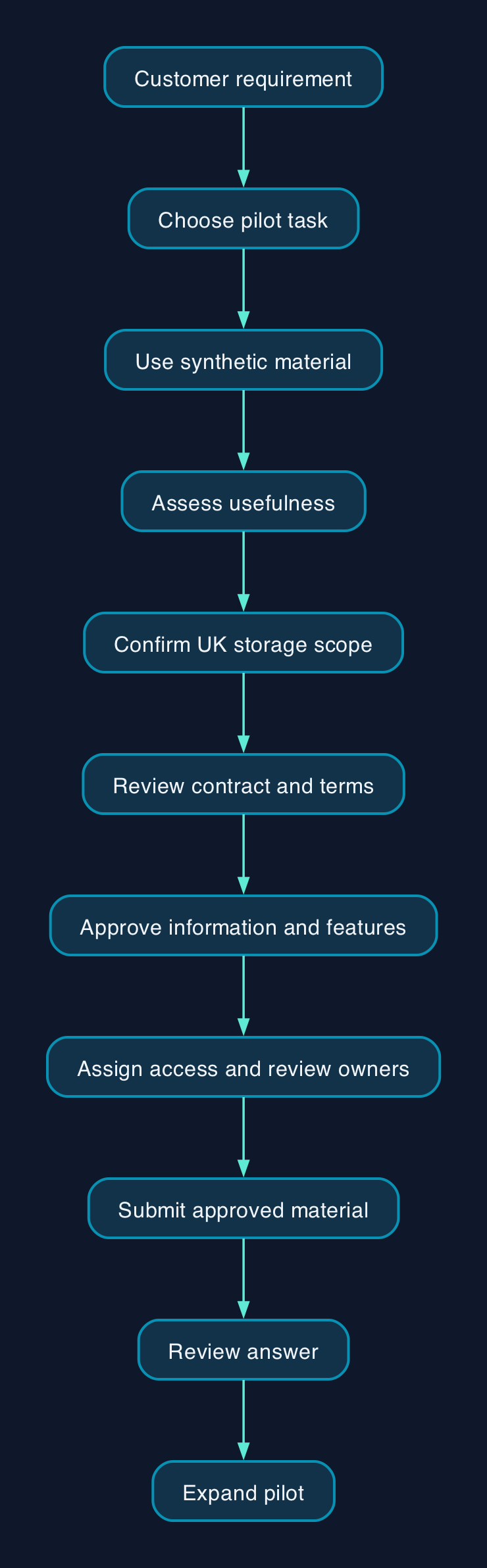
The following checklist sets proposed acceptance conditions.
- [ ] Choose one task. Record the expected output, the employee responsible and how usefulness will be assessed.
- [ ] Define the permitted information. Give staff examples of allowed material and a clear excluded list.
- [ ] Confirm the residency offer. Retain written confirmation of the region available to your workspace, covered content and exclusions.
- [ ] Complete the terms review. Record decisions on confidentiality, training use, access, retention and deletion before uploading real confidential material.
- [ ] Name an administrator and deputy. Test the membership and sign-in procedures they will use.
- [ ] Approve features individually. Record which functions the pilot needs and review their data handling.
- [ ] Start with synthetic material. Test usefulness without exposing customer information, then expand only within the approved scope.
- [ ] Set a human review rule. Assign someone to check each output before it enters a customer deliverable or business record.
- [ ] Preserve source documents. Keep the original business records in their existing approved location.
- [ ] Prepare a stop procedure. Document how to suspend the workflow, remove access and handle pilot content under the confirmed terms.
- [ ] Approve expansion against results. Assess useful output, review time, administrative effort and unresolved data questions before adding seats.
Avoid moving existing records or deleting source material as part of the initial pilot. Any later migration should have its own backup and acceptance checks.
Comparing the available approaches
The useful comparison is between ways of meeting the confidentiality requirement. Enterprise is a candidate for further assessment, not an automatic answer to a UK-only requirement.
| Approach | When to consider it | What the evidence establishes | What remains to resolve |
|---|---|---|---|
| ChatGPT Business for approved confidential tasks | You can define a permitted workflow and assign an administrator | Regional storage covers primary customer content; it does not include inference residency. Business storage guidance | UK availability for the workspace, complete terms, feature coverage and operating controls |
| ChatGPT Enterprise assessment | Processing location or additional administration requirements drive the purchase | Inference residency is available to eligible Enterprise customers in supported inference regions. Residency guidance | Whether the required region and workload qualify, plus price and contractual scope |
| ChatGPT Business restricted to non-confidential work | You want to test usefulness while the confidential-use assessment remains open | This is a proposed usage restriction, not a separate OpenAI plan | Whether staff can follow the restriction and whether the approved tasks justify the cost |
| Retain the existing approved workflow | The proposed service cannot yet demonstrate the required protections | This is an editorial purchasing option, not a product capability claim | Whether the value of AI assistance warrants further assessment |
Do not choose the unrestricted confidential-use approach if nobody owns membership, feature approval or output review. For a business without that capacity, a narrower task list is a practical starting point.
Editorial analysis
The purchasing question should be attached to a workflow. “Can our proposal team use approved customer material under these terms?” gives a buyer something concrete to accept or reject.
Our recommendation is to separate the trial decision from the confidential-use decision. A small pilot can establish whether the outputs justify the subscription and staff time. Contractual and technical evidence must establish whether the intended information belongs in that workflow.
Make the first purchase small enough to evaluate. Expand only when the named service owner can explain what staff may submit, where the relevant handling occurs and how access ends.
Sources
- OpenAI Help Center — Where your ChatGPT Business content is stored
- OpenAI Help Center — Data residency and inference residency for ChatGPT
- OpenAI Help Center — Creating and managing ChatGPT Sites
- OpenAI Help Center — Setting up single sign-on for ChatGPT Business
- OpenAI Help Center — ChatGPT Business general FAQ
- OpenAI Help Center — Managing billing and seats in ChatGPT Business