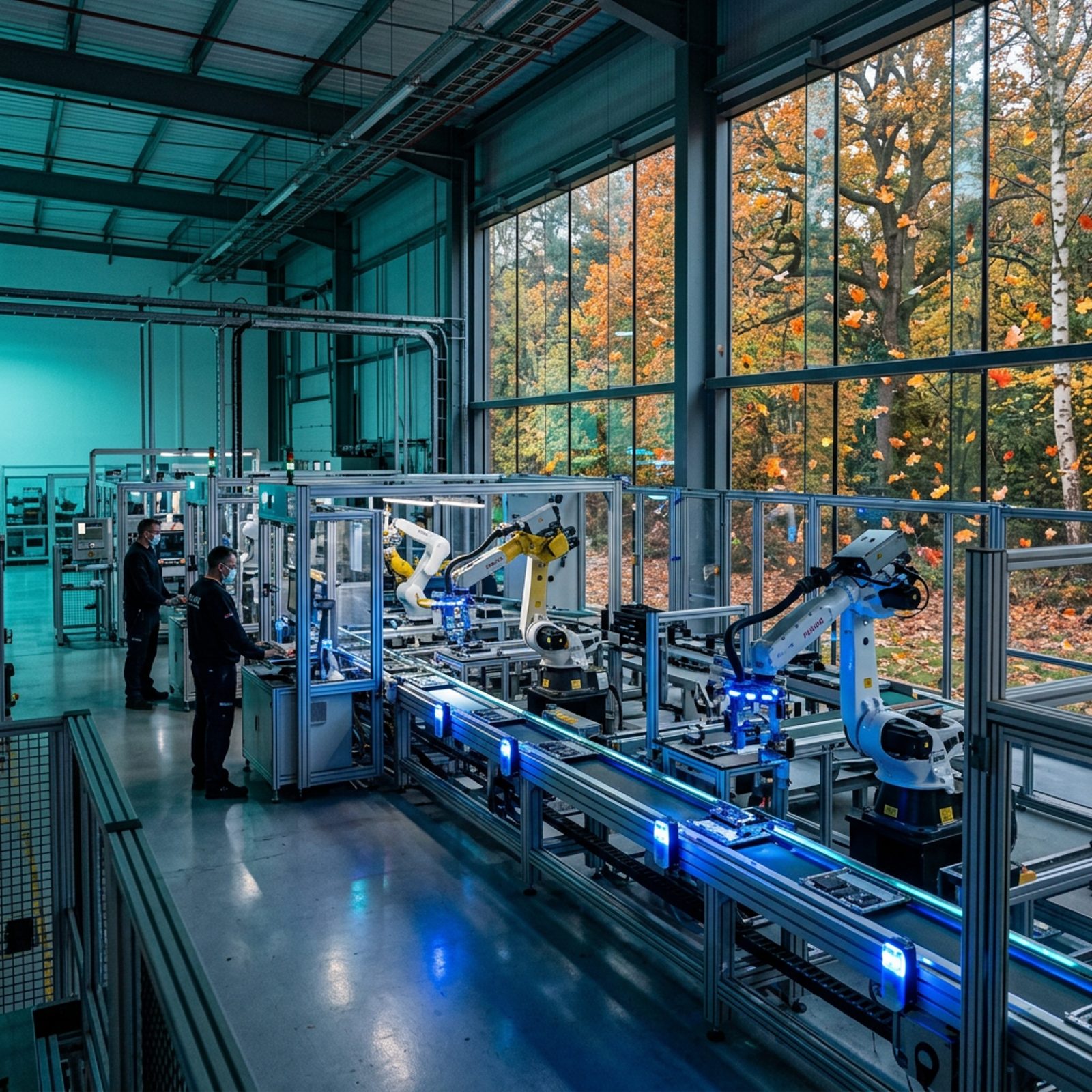
UK manufacturing AI adoption sits at somewhere between 19 and 26 per cent — roughly ten percentage points below the national average. In 2025, 42 per cent of UK companies scrapped nearly half of their AI projects outright, a 147 per cent jump on the year before. The production line, it turns out, is a brutally honest place to discover that your AI strategy was mostly PowerPoint.
Mistake One — Perpetual Piloting
The pattern is depressingly familiar. A mid-sized manufacturer runs a proof-of-concept with a vision inspection tool. It works on the test bench. Management commissions a second POC for a different line. Then a third. Then a fourth. Twelve months later, the company has run a dozen pilots and shipped precisely nothing into production.
An MIT study from 2025 found that just 5 per cent of generative AI pilots delivered measurable revenue impact. A separate industry survey put the number at four out of every 33 POCs reaching production — roughly 12 per cent. In the UK, the figure is worse: 46 per cent of proofs-of-concept were abandoned before they reached a live environment.
The fix is almost embarrassingly simple. Pick one line, one defect type, one shift. Get that working. Then expand. The Made Smarter programme, which has reached over 4,000 manufacturing SMEs since 2018, found that firms which started with a single focused use case were far more likely to report measurable gains — the independent North West pilot evaluation documented 6.5 per cent turnover growth among participants versus matched non-adopter cohorts.
Mistake Two — Treating Data Like an Afterthought
Here is a sentence that should be printed on every factory wall in Britain: your AI model is only as good as the photographs you feed it.
A visual inspection model trained on 200 images of a clean weld will not cope with the real world, where welds arrive covered in oil, at odd angles, under inconsistent lighting, on a line that vibrates. The UK's 46 per cent POC failure rate is largely explained by teams that discovered fundamental data quality problems only after committing budget and headcount to a particular AI platform.
The cost of getting this wrong is concrete. Every defect that escapes the line costs between two thousand and fifty thousand dollars in customer claims, reprocessing, or scrap. Every false positive — a good part flagged as bad — wastes between five hundred and five thousand dollars in unnecessary reinspection or downgrading. Legacy rule-based systems run false positive rates of 8 to 10 per cent. A properly trained AI model can bring that below 3 per cent. But "properly trained" means thousands of labelled images across every lighting condition, every product variant, and every shift pattern your line actually runs.
Mistake Three — The Big Bang Rollout
Some manufacturers decided that if AI was worth doing, it was worth doing everywhere at once. New cameras on every line. New edge compute hardware in every cell. New dashboards in every control room. The result, predictably, was chaos.
The companies that got it right picked a single bottleneck — typically the inspection station with the highest reject rate or the costliest false-positive problem — and proved the economics there first. Only once the return on that single station was documented did they expand.
This is not a technology problem. It is a change management problem. Make UK has stressed that the biggest barriers for SMEs are awareness and culture, not kit. When operators on the shop floor do not understand why the new camera is overriding their judgement, they find creative ways to work around it. Or they simply turn it off.
Mistake Four — Picking the Wrong-Sized Model
One of the more expensive lessons of 2025 was that bigger is not better. Companies that deployed frontier-scale models on narrow manufacturing tasks discovered three things very quickly: inference costs made production deployment uneconomical, latency was too high for real-time line speeds, and the model's general knowledge was irrelevant to their specific defect taxonomy.
A smaller, specialised model trained on your product does the job faster, cheaper, and with higher accuracy. Modern AI vision systems using focused models process up to 4,200 items per minute, detect surface defects as small as 0.1 millimetres with 99.8 per cent accuracy, and make pass-or-fail decisions in under 50 milliseconds — fast enough to reject inline without slowing the line.
There is an irony here. The companies that spent the largest sums on AI routinely got the worst results, because they assumed that paying for the biggest model was the safest bet. It was not.
Mistake Five — Betting on a Platform That Got Sunsetted
This one still stings. AWS discontinued Lookout for Vision in October 2025. Any manufacturer that had built their inspection pipeline around that service had to migrate — mid-production, mid-contract, mid-everything. Microsoft's Azure Custom Vision is now on a planned retirement path too, with full support ending in September 2028 and a recommended migration to Azure Machine Learning AutoML.
The lesson is not "avoid the cloud." The lesson is: understand the difference between a managed service that can vanish with a blog post and a model architecture you own. If your inspection model runs on your edge hardware with weights you control, a platform sunset is an inconvenience. If your entire pipeline depends on an API call to a service you do not own, a platform sunset is a production outage.
The Mistakes-and-Fixes Table
| Mistake | What Went Wrong | The Fix | |---|---|---| | Perpetual piloting | Dozens of POCs, nothing in production | One line, one defect, one shift — then expand | | Data afterthought | Model trained on 200 clean images | Thousands of labelled images across real conditions | | Big bang rollout | AI everywhere at once, chaos | Start at the highest-cost bottleneck, prove ROI first | | Wrong-sized model | Frontier model, high cost, too slow | Smaller specialised model, edge deployment | | Platform sunset | Built on a service that got discontinued | Own your model weights, run on your edge hardware |
Where the Numbers Actually Stand
Manufacturing AI adoption in the UK sits at 19 to 26 per cent against a national average of 35 per cent. The Made Smarter programme has committed £16 million for 2025-26 and is planning UK-wide expansion from 2026-27, targeting 2,500 or more additional SMEs each year. Over its first five years, the broader Made Smarter research and development programme engaged more than 800 organisations, invested £112 million in grant funding, secured over £200 million in industry co-investment, and supported the creation of 459 jobs.
These are not trivial numbers. But they also tell you that the majority of UK manufacturers have not started yet. For those firms, the advantage of being late is that somebody else has already made the expensive mistakes. The five listed above are the ones that keep repeating.
Ten-Point Checklist for Getting It Right on the Second Attempt
1. Start with one line and one defect type — prove the economics before expanding. 2. Collect at least 2,000 labelled images per defect class across real production conditions. 3. Test under every lighting, angle, and contamination scenario your line actually produces. 4. Measure false positive rates as seriously as you measure detection rates. 5. Deploy the smallest model that meets your accuracy and latency requirements. 6. Run inference on edge hardware you control — do not depend solely on a cloud API. 7. Check the vendor's product roadmap and sunset history before committing. 8. Bring operators into the project from day one — they will find edge cases your data scientists miss. 9. Set a hard deadline for the pilot: if it does not reach production within six months, kill it or fix it. 10. Apply through Made Smarter if you are eligible — £16 million in funding is available for 2025-26.