

Understanding Azure UK Data Residency
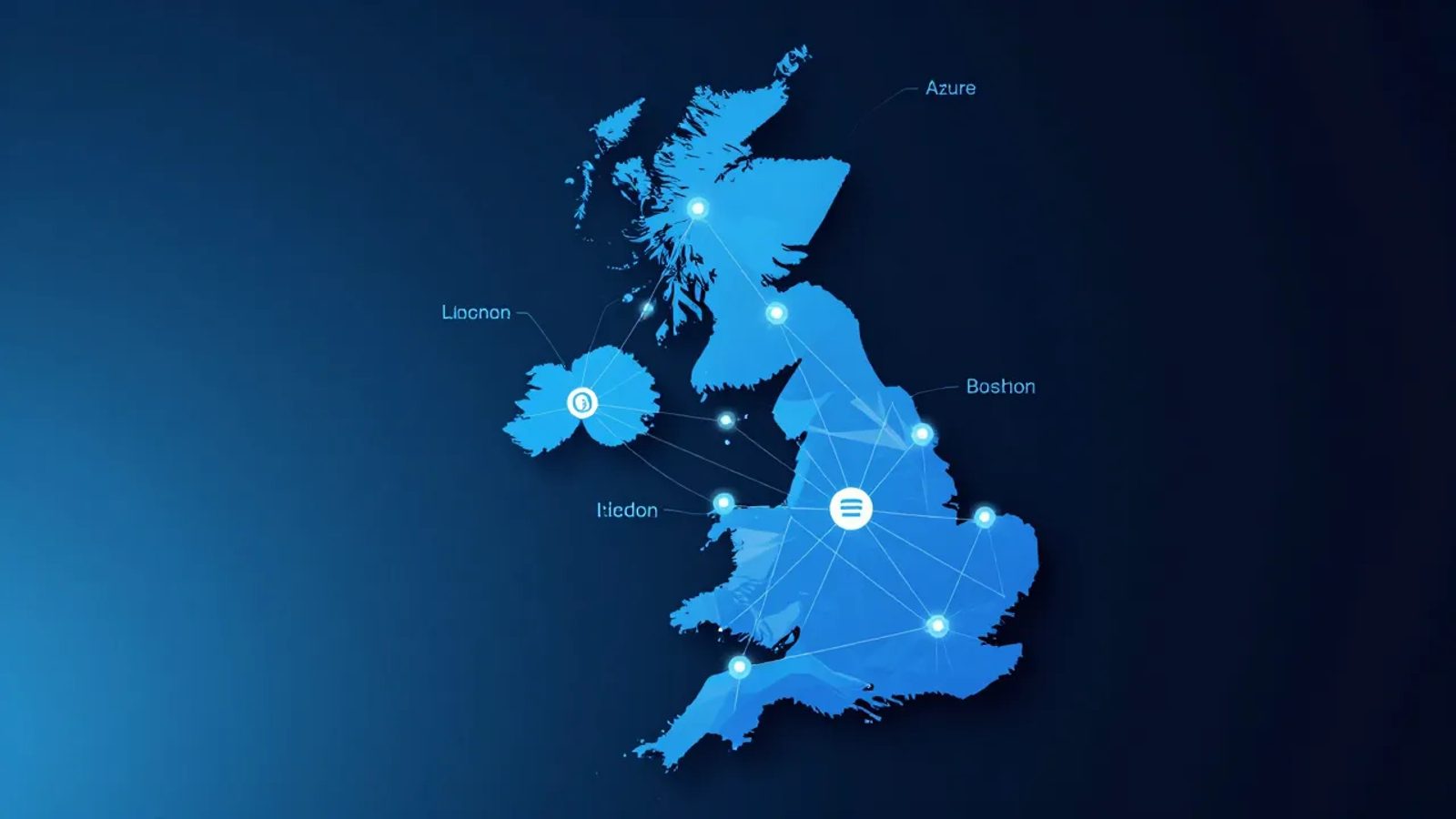
Microsoft Azure operates two UK regions—UK South (located in London) and UK West (located in Cardiff and Durham)—providing UK enterprises with data residency options that align with ICO guidance and UK GDPR requirements. UK South serves as the primary production region with three availability zones, whilst UK West functions as the paired disaster recovery region.
The distinction matters particularly for organisations handling personal data under UK GDPR and the Data Protection Act 2018. The ICO recommends that UK-based controllers and processors assess data residency as part of their Article 32 security measures and transfer impact assessments, especially following the Schrems II decision and subsequent UK adequacy arrangements.
Azure UK South launched in September 2016, making it one of the earliest hyperscaler deployments specifically designed for UK regulatory requirements. Today, it hosts over 60 Azure services, including Azure Virtual Machines, Azure SQL Database, Azure Kubernetes Service, and Azure AI services—all with data-at-rest storage within UK boundaries.
UK Region Architecture and Availability Zones
Azure UK South contains three physically separate availability zones, each with independent power, cooling, and networking. This architecture enables UK enterprises to deploy zone-redundant services that survive datacenter-level failures whilst maintaining single-digit millisecond latency between zones—critical for financial services applications requiring both resilience and low-latency performance.
NCSC's Cloud Security Principles, particularly Principle 4 (Governance Framework) and Principle 9 (Secure User Management), map directly to Azure's UK region capabilities. Zone-redundant storage (ZRS) and zone-redundant database configurations ensure that data remains within UK South even during failure scenarios, addressing the "data sovereignty during disaster" concern raised by UK regulators.
UK West, the paired region, provides geo-redundant backup but operates with two availability zones rather than three. Microsoft's regional pairing ensures that planned maintenance never affects both UK regions simultaneously—a design feature that satisfies the PRA's operational resilience requirements for UK financial institutions, which came into effect in March 2025.
ICO Compliance and UK GDPR Alignment
UK GDPR Article 28 requires data processors to implement "appropriate technical and organisational measures" to protect personal data. Azure UK regions directly support this obligation through region-locked deployments, encryption at rest using AES-256, and encryption in transit using TLS 1.2 or higher. However, the ICO's 2024 guidance on international transfers highlights a critical caveat: deploying to UK regions alone does not eliminate transfer risk if the cloud provider's support or management plane operates from outside the UK.
The Data (Use and Access) Act 2025, which came into force in June 2025, introduces new obligations for smart data schemes and digital verification services. Whilst primarily focused on consumer rights, the Act requires data processors to maintain audit logs of access to personal data—a capability Azure provides through Azure Monitor and Azure Policy, both of which can be configured to store logs exclusively in UK regions.
In October 2025, the ICO fined Capita £14 million for a data breach affecting 90,000 individuals, citing inadequate technical measures and delayed breach notification. The case underscores the importance of the 72-hour breach notification requirement under UK GDPR Article 33. Azure Security Center's threat detection and Azure Sentinel's SIEM capabilities can automate breach identification, but UK CISOs must still implement governance processes to meet the notification timeline.
Pricing Comparison — UK Regions vs Global
Azure UK South carries approximately a 10% premium over US East for core compute and storage services. This pricing differential reflects higher datacenter operating costs in the UK, including energy rates and property costs. For a medium enterprise workload—50 virtual machines, 10TB of storage, and standard networking—the UK region premium translates to roughly £4,800 annually compared to US East deployment.
Specific pricing examples as of December 2025:
- Azure Storage (Standard LRS): 10TB in UK South costs £174/month vs £158/month in US East
- D4s v5 Virtual Machine: £0.192/hour in UK South vs £0.175/hour in US East
- Azure SQL Database (8 vCores): £1,848/month in UK South vs £1,680/month in US East
Comparing Azure UK South to AWS London (eu-west-2) reveals competitive parity for compute but a cost advantage for storage: 10TB on Azure UK South costs £174 versus £217 on AWS S3 Standard in London. Google Cloud London (europe-west2) falls between these two, at approximately £196 for equivalent storage.
Azure's G-Cloud 14 framework pricing provides additional transparency for UK public sector organisations. Services procured through G-Cloud carry fixed pricing commitments, eliminating the surprise billing risk that plagued earlier cloud adoptions in UK government departments.
The Sovereignty Question — Limitations and Caveats
Despite Azure UK regions providing data-at-rest sovereignty, Microsoft cannot guarantee absolute UK sovereignty for all workloads. The Microsoft Online Services Terms acknowledge that support personnel may access customer data from global locations, and Microsoft may disclose customer data in response to lawful requests from government authorities—including those outside the UK.
This limitation stems from the US CLOUD Act, which grants US law enforcement authority to compel US-based cloud providers to produce data regardless of where it's stored. The UK-US Bilateral Data Access Agreement (2019) provides a legal framework for cross-border data requests, but it does not eliminate the risk that US authorities could access UK-stored data without UK court oversight in national security contexts.
For organisations requiring absolute sovereignty—such as defence contractors handling SECRET-classified material or critical national infrastructure operators—NCSC recommends considering UK-sovereign cloud providers like UKCloud or assessing Azure Stack Hub for on-premises deployment. Azure Stack Hub enables running Azure services on UK-controlled hardware, though at significantly higher capital and operational costs.
The NCSC's Cloud Security Guidance v2.0 (updated December 2024) explicitly states: "Using a cloud service does not automatically mean your data will be subject to laws in the country where the cloud provider is headquartered, but you should assess this risk as part of your supply chain security evaluation."
Implementation Checklist for UK CIOs
When deploying Azure workloads to UK regions, UK technology leaders should verify the following:
- Explicit Region Selection: Configure Azure Policy to prevent resource deployment outside UK South/UK West
- Backup Location Verification: Confirm Azure Backup and Azure Site Recovery store data within UK West (paired region)
- Log Storage Residency: Configure Azure Monitor Log Analytics workspace in UK South to prevent diagnostic data export
- Data Transfer Impact Assessment: Document ICO Article 28 processor assessment for Microsoft as data processor
- Encryption Key Management: Implement Azure Key Vault in UK South with customer-managed keys for sensitive workloads
- Breach Detection Configuration: Enable Azure Security Center with automated alerting to meet 72-hour notification timeline
- Third-Party Service Validation: Review Azure Marketplace services for UK region support and data residency guarantees
- Sovereignty Risk Register: Document CLOUD Act exposure and mitigation strategy for audit purposes
Looking Ahead — 2025 and Beyond
Microsoft announced in November 2024 that Azure UK South will receive GPU compute capacity in Q2 2025, enabling UK-resident AI model training and inference. This expansion directly addresses the growing demand from UK financial services and healthcare organisations that require AI capabilities without cross-border data movement—particularly relevant as the ICO develops AI-specific guidance expected in 2026.
The UK Government's National Data Strategy, updated in October 2025, emphasises "data infrastructure sovereignty" as a strategic priority. Whilst this policy primarily targets public sector deployments, it signals regulatory direction that may influence private sector compliance expectations. UK enterprises should anticipate potential new requirements around cloud provider transparency and UK-based support arrangements.
NCSC's 2025 Threat Assessment highlights ransomware and supply chain attacks as the primary risks to UK critical national infrastructure. Azure UK regions' integration with Microsoft Defender for Cloud and Microsoft Sentinel provides advanced threat detection, but these tools must be actively configured and monitored—technology alone cannot substitute for governance.
For UK CIOs evaluating Azure UK data residency in 2025, the decision framework should balance three factors: regulatory compliance (ICO and sector-specific requirements), commercial considerations (the 10% pricing premium), and sovereignty risk tolerance (CLOUD Act exposure). Organisations handling OFFICIAL-SENSITIVE or higher classifications should conduct a formal risk assessment before committing to any hyperscaler deployment, regardless of data residency features.