

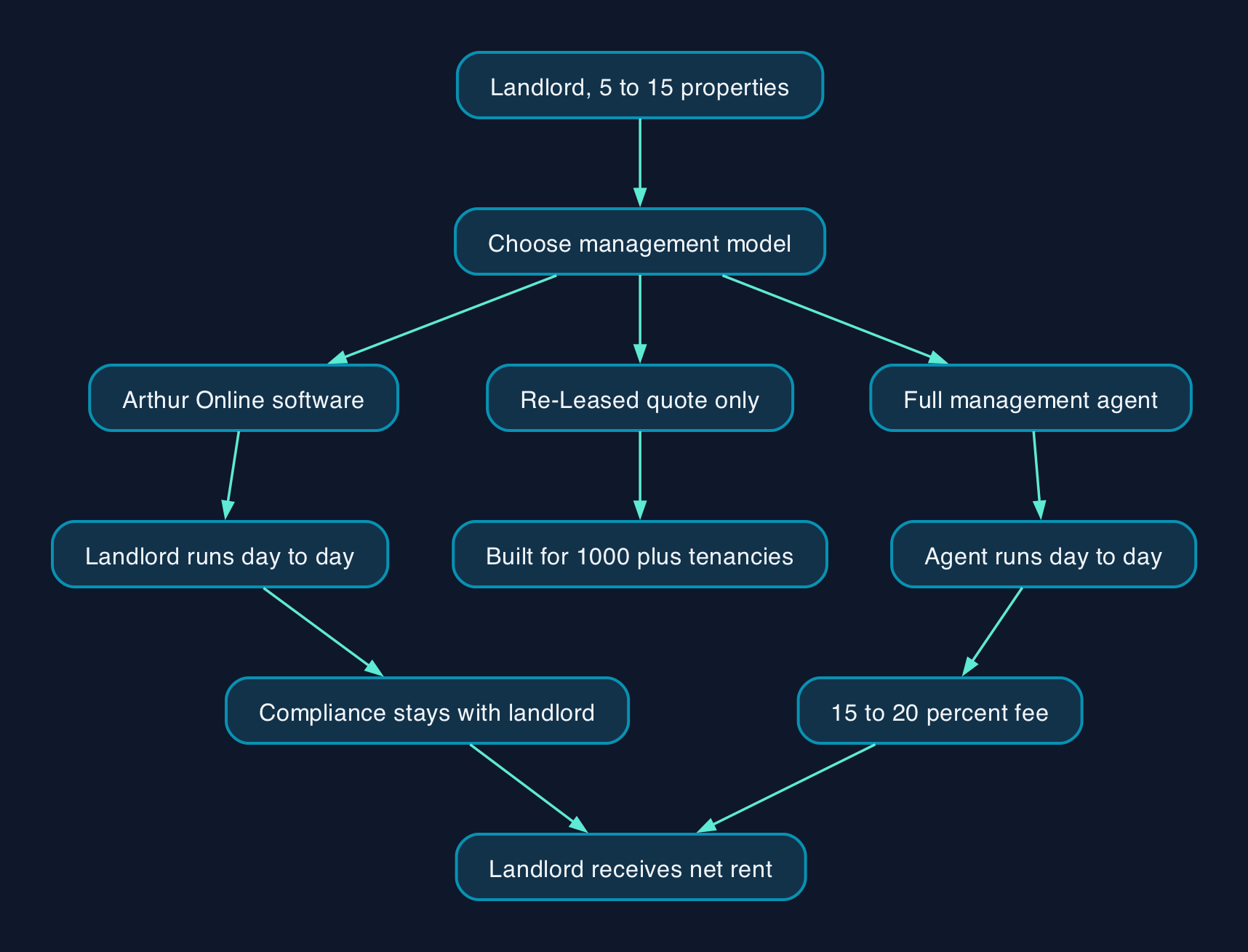
For a UK landlord with five to fifteen properties, Arthur Online is the cheaper route on paper, from £82.50 a month on its Standard plan, but you still do every viewing, repair call and compliance check yourself. Re-Leased is built for commercial portfolios and agents running over 1,000 tenancies, and publishes no price at all. A full-management letting agent costs around 15 to 20 percent of the monthly rent plus VAT, but transfers the work and most of the day-to-day compliance exposure.
Key pointers
- On a five to fifteen property portfolio, Arthur Online's Standard plan is £82.50 a month flat, but that buys software, not labour.
- Skip Re-Leased unless you are already commercial or heading well past 1,000 tenancies: it has no published UK price and is pitched at agents, not a single residential landlord.
- Budget 15 to 20 percent of monthly rent plus VAT for full management, and get at least three local quotes before signing.
- A letting agent must show its fee scale in branch or online by law, so compare the actual tariff, not just the headline percentage.
- You stay legally liable for compliance failures even after appointing a managing agent.
- Since 1 May 2026, Section 21 no-fault eviction is gone in England, so notices now go through the Renters' Rights Act process whoever manages the property.
- A hybrid works for many landlords in this bracket: run compliance and rent tracking through software, and pay an agent per job for the repairs you cannot cover locally.
Self-Managing or Outsourcing at Five to Fifteen Properties
Five to fifteen properties is the awkward middle of UK landlording. A spreadsheet and a shared inbox stop coping somewhere around property four or five: rent dates, gas safety renewals, deposit protection deadlines and maintenance requests start colliding. But the portfolio is still too small to justify hiring staff, and it is well short of the scale that commercial property software such as Re-Leased is built for.
That leaves two realistic paths. The first is to keep managing the portfolio yourself, using software such as Arthur Online to track tenancies, compliance dates, maintenance jobs and rent across every property in one place. The second is to hand the day-to-day running to a full-management letting agent and keep the strategic decisions, such as which properties to buy, sell or refinance, for yourself.
Both are legitimate. The right choice depends on how much of your own time you are willing to spend, how local you are to your properties, and whether you already have trades and contractors you trust. A landlord who owns eight terraced houses within a few miles of home, with a plumber and an electrician on speed dial, is in a very different position from one who owns twelve flats scattered across three cities and has a demanding day job.
What Arthur Online and Re-Leased Actually Do
Arthur Online is a self-management platform aimed at landlords and letting agents who want one system for compliance tracking, maintenance, tenant communication, finances and reporting. All three of its plans, Standard, Professional and Enterprise, include unlimited storage, a maintenance module, a finance module and compliance tracking as standard, with the tiers differing mainly by unit allowance and support level. Arthur's own pricing explainer confirms you pay per unit (the tenancy) rather than per property, so a single house is one unit but an HMO with five let rooms is five units, and there is no extra charge for additional users on your account.
Re-Leased sits in a different market. Its own pricing page describes it as software for "managing commercial property," built around integrated trust and client accounting, multi-owner and contractor disbursements, and management-fee handling designed for an agent running many owners' portfolios rather than one landlord's own stock. There is no published price for either the Core or Pro tier; both require submitting a form and waiting for a quote, and the Enterprise tier is explicitly scoped for "over 1,000 tenancies." For a landlord with five to fifteen residential properties, Re-Leased is worth a conversation only if you are already moving into commercial lets or plan to grow into a managing-agent business yourself; it is not a natural fit for day-to-day self-management at this scale.
UK Compliance Mapping
The compliance workload behind this decision changed materially in 2026. The Renters' Rights Act took effect in England on 1 May 2026, abolishing Section 21 "no-fault" evictions, moving tenancies onto rolling periodic terms, and bringing the Decent Homes Standard to the private rented sector to address hazards such as damp and mould, according to the NRLA's guide to managing agents. Whoever runs the day-to-day management, landlord or agent, now has to issue the correct notices under the new regime rather than the old Section 21 process, keep up with rolling-tenancy paperwork, and be able to evidence Decent Homes compliance if challenged.
Crucially, appointing a managing agent does not transfer legal liability. The NRLA states plainly that "the legal responsibility remains with you, meaning you are still liable for potential prosecutions or fines if your agent fails to comply with the law." A landlord using Arthur Online's compliance-tracking module is still the one who has to act on the alerts it generates; a landlord paying an agent 15 to 20 percent of rent is still the one who answers to a local authority if the agent drops the ball. This is not legal advice; consult your legal counsel.
How Each Option Handles the Day to Day
Under self-management with software, you (or a family member or business partner) are the one fielding tenant calls, arranging contractors, chasing rent arrears and keeping compliance certificates current; Arthur Online's role is to log, remind and centralise that work, not to do it. Under Re-Leased, in practice, the same is largely true unless you are running the software as a managing agent for other owners, because its accounting and disbursement tools assume someone is managing tenancies on a client's behalf.
Under a full-management agent, the agent finds tenants, signs them up, collects rent, chases arrears, arranges gas and electrical safety certificates, protects the deposit, organises repairs (sometimes within a pre-agreed spending limit before they need your sign-off), and handles check-in, check-out, inspections and deposit disputes, per Propertymark's breakdown of full management. You receive net rent after the management fee, and you are still the point of contact for anything the agent's agreement does not cover, such as major refurbishment decisions or selling a property.
Pricing and Cost Model
Arthur Online. Prices are per month, billed annually, and set by unit (the tenancy), not the property. All figures are as published on 29 September 2026.
| Plan | From (per month) | Units included | Extra unit price |
|---|---|---|---|
| Standard | £82.50 | 55 | £1.50 |
| Professional | £96.00 | 60 | £1.60 |
| Enterprise | £126.00 | 70 | £1.80 |
A landlord with five to fifteen properties sits well inside the 55-unit Standard allowance (unless most of those properties are large HMOs let room by room), so the monthly cost is simply the flat £82.50, with no per-unit overage to add.
Re-Leased. There is no published price. Both Core and Pro require a bespoke quote through a "Request Pricing" form, and the vendor's own copy positions the product around commercial and multi-owner portfolios rather than a single residential landlord's stock. If you do request a quote, ask specifically: is pricing per unit, per tenancy or a flat platform fee; is there a minimum tenancy count or contract length; and does the quote assume you are managing your own portfolio or acting as an agent for others.
Full-management letting agent. Propertymark's published service bands are a one-off tenant-find fee of around a month's rent, rent collection at around 5 percent of monthly rent, and full management at around 15 to 20 percent of monthly rent. Published UK agent tariffs generally quote that percentage before VAT.
Worked example (assumptions). Take a ten-property portfolio, each let at the UK's average monthly private rent of £1,400 (the average for the 12 months to August 2026). Total monthly rent is £14,000, or £168,000 a year.
- Arthur Online Standard software: £82.50 a month x 12 = £990 a year.
- Full management at 15 percent: £14,000 x 15% = £2,100 a month before VAT, £25,200 a year before VAT, £30,240 a year once 20 percent VAT is added.
- Full management at 20 percent: £14,000 x 20% = £2,800 a month before VAT, £33,600 a year before VAT, £40,320 a year once VAT is added.
That is roughly a £29,000 to £39,000 a year gap between running the portfolio yourself with software and paying an agent to run it for you. The software figure buys none of the labour, so it is not a like-for-like comparison; it is the price of doing the work yourself with better tools, against the price of not doing the work at all.
Migration and Rollout Checklist
- Log every current tenancy, deposit scheme reference, gas and electrical certificate expiry date and outstanding repair before you switch either way.
- If moving to software, import or re-key that data into Arthur Online (or your chosen platform) and check every compliance date has carried across correctly before relying on its reminders.
- If moving to a full-management agent, get the fee, VAT treatment, notice period and what counts as an "emergency repair" you don't get consulted on in writing before signing.
- Confirm who holds the deposit and through which scheme, and get written confirmation of the handover once transferred.
- Tell existing tenants in writing who to contact for repairs and rent queries from the changeover date, and keep the old contact live for a short overlap period.
- Run a one-property or one-block pilot for at least one full rent cycle before moving your whole portfolio, whichever direction you are switching.
- Set a calendar reminder to review the arrangement against at least one alternative quote or product at renewal, rather than rolling over by default.
- Before ending an agent's contract or cancelling a software subscription, confirm exactly what records, documents and compliance history you are entitled to take with you, in what format, and by when.
Vendor and Option Comparison
| Criteria | Arthur Online | Re-Leased | Full-management agent |
|---|---|---|---|
| Published UK price | From £82.50/month, billed annually | Not published; quote only | Not a fixed price; around 15 to 20% of rent plus VAT (Propertymark) |
| Best-suited portfolio | Small to mid-size residential, including HMOs | Commercial, multi-owner, 1,000+ tenancies | Any size, especially remote or time-poor landlords |
| Who does the day-to-day work | You | You (or, if you act as an agent, your clients' portfolios) | The agent |
| Compliance ownership | You, using the tool's tracking | You | You legally, agent operationally |
| Estimated annual cost, 10 properties at £1,400 rent | £990 | Not published | £30,240 to £40,320 (15% to 20%, incl. VAT) |
| Exit | Monthly-rolling access per Arthur's support documentation; annual billing cycle | Contract terms set at quote | Contract notice period varies by agent; agree in writing before signing |
No option is a universal winner. Arthur Online suits a landlord who wants to keep control and has the time or local contacts to do the work. A full-management agent suits a landlord who is short on time, lives away from the portfolio, or wants the compliance and tenant-facing work off their desk, and is willing to pay for that. Re-Leased is unlikely to make sense for either group at this portfolio size.
Editorial Analysis
The clearest signal in this decision is not the software feature list, it is the portfolio size and the landlord's own time. At five properties, most landlords who already have reliable local contractors will find Arthur Online's £82.50-a-month Standard plan the more efficient spend: it replaces the spreadsheet and the shoebox of certificates without adding meaningful cost. At the top of the range, fifteen properties with several HMOs, the calculus shifts, because the volume of compliance dates, repair calls and rent chasing starts to resemble a part-time job in its own right, and the 15 to 20 percent agent fee starts to look like a reasonable price for buying back that time. Re-Leased's absence of a published price, and its own positioning around commercial and multi-owner portfolios, makes it a poor starting point for this reader; it is built to be evaluated against other commercial platforms, not against a landlord's choice between a software subscription and an agent's percentage fee.
Sources
- Arthur Online pricing - Arthur Online
- Understanding the pricing model - Arthur Online support
- Re-Leased UK pricing - Re-Leased
- What does a letting agent do for a landlord? - Propertymark
- What is a Managing Agent: A Guide for Landlords - National Residential Landlords Association
- Private rent and house prices, UK: September 2026 - Office for National Statistics
- UK letting agent fees 2026, by service, region and hidden costs - LetCompliance