

For most UK small offices, TP-Link Omada and Ubiquiti UniFi cost far less than Cisco Meraki once you look past the hardware sticker price, because every current Cisco Meraki access point requires an active annual licence just to pass traffic, while Omada and UniFi hardware works indefinitely with no recurring fee (Cisco Meraki, MR licensing guide). Meraki still wins where a compliance framework or head-office IT policy specifically mandates the Meraki dashboard.
Key pointers
- Budget roughly £207 to £316 in one-off hardware for three access points on UniFi or Omada, with nothing further to pay.
- A Cisco Meraki MR28, the cheapest current Meraki AP, needs a separate Enterprise licence bought per device, per year, or it will not pass client traffic at all.
- Meraki Go, Cisco's old licence-free small business line, stopped being sold new after 29 April 2025, so a fresh Meraki quote today is the full, licensed MR range.
- Ask any Meraki reseller for the exact price: list RRP and street price for the same access point can differ by roughly two to one.
- TP-Link's on-premises Omada controllers, hardware or free software, carry no recurring fee at all.
- Ubiquiti's cheapest gateway, the UCG-Ultra, doubles as the site controller, so there's no separate controller line item to budget for.
- Cisco's own documentation states a lapsed Meraki licence stops the access point passing traffic to the internet, not just losing cloud features.
- Get any quote in writing showing the licence term (1, 3 or 5 years): the per-year Meraki cost roughly halves on a 5-year term versus paying annually.
Comparing three approaches to office Wi-Fi
An office Wi-Fi upgrade is really two purchases bundled together: the physical access points that broadcast the signal, and the software that configures, monitors and secures them. Ubiquiti UniFi, TP-Link Omada and Cisco Meraki all sell both halves, but they charge for the software half in completely different ways.
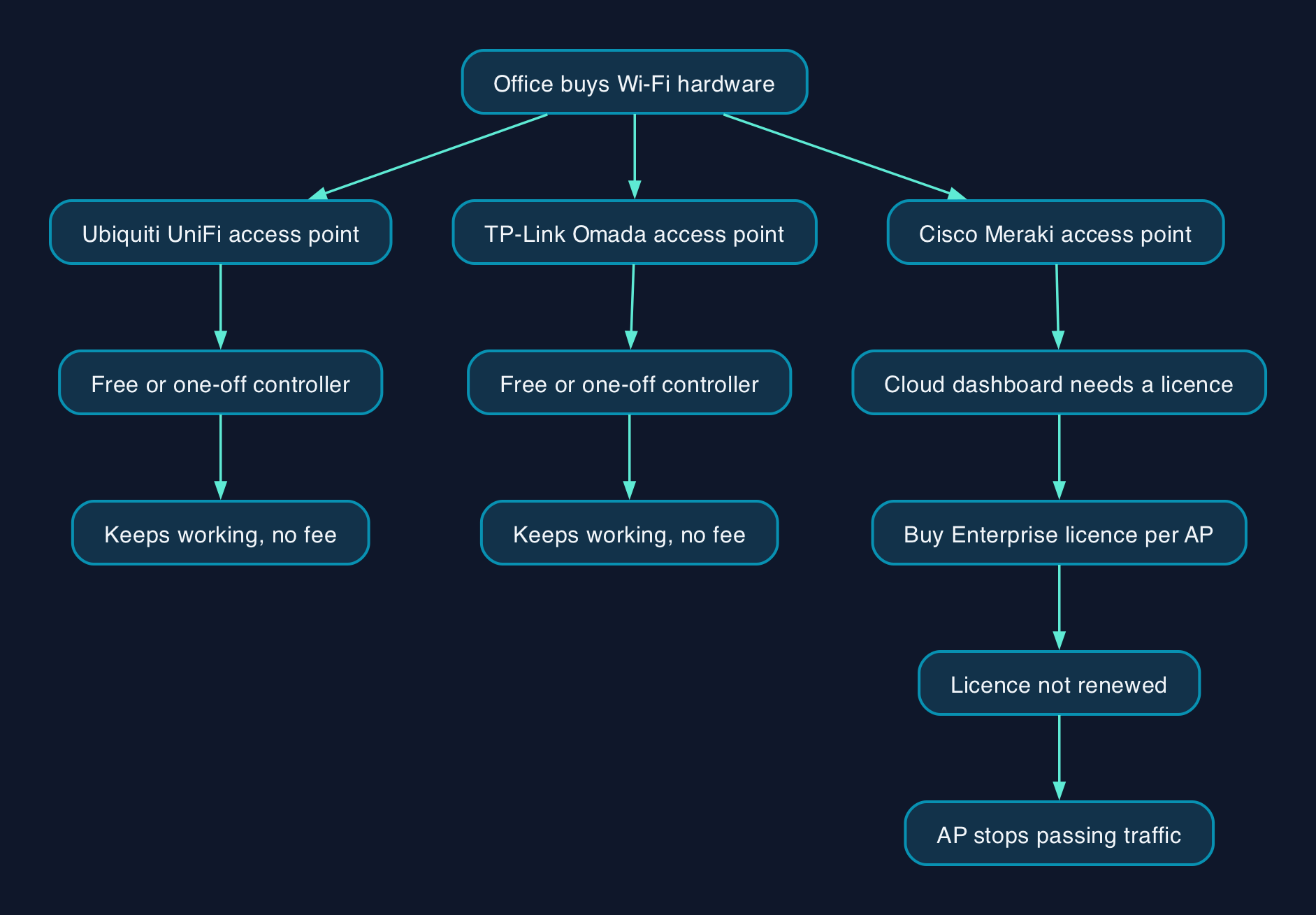
UniFi and Omada sell you the management software once, bundled into a piece of hardware you buy outright (or, in Omada's case, as a free download), and it keeps working indefinitely. Cisco Meraki treats the management dashboard as a subscription: the access point hardware is inert on its own, and you rent access to the cloud dashboard that makes it work, for as long as you own the device.
None of this makes any of the three platforms wrong. A company with an existing Cisco estate and an IT team that already knows the Meraki dashboard has good reasons to stay on Meraki, and Meraki's support and RMA cover are genuinely part of what that annual fee buys. But for an office manager comparing three unfamiliar brands purely on what an upgrade will cost over the life of the equipment, the licence is the number that changes the answer.
What small business access points look like on each platform
All three vendors sell a Wi-Fi 6 access point aimed at a small office, in roughly the same price bracket before you factor in licensing:
- Ubiquiti's U6+ is explicitly described by Ubiquiti as "ideal for small and medium-sized businesses" and costs £79 ex VAT on the official UK store (Ubiquiti Store).
- TP-Link's Omada EAP610 is a dual-band Wi-Fi 6 ceiling or wall-mount AP currently priced around £69.16 ex VAT, as cited above.
- Cisco Meraki's MR28 is the current entry point into the Meraki wireless range and the recommended replacement for Cisco's own discontinued small-business Meraki Go access points (Cisco Meraki community, Meraki Go end of sale); current UK reseller pricing has it around £269.85 ex VAT, as cited above.
That price gap on hardware alone is real, but it's the smaller part of the story. The bigger difference is what happens after you've bought the box.
How each platform is managed
UniFi's controller software, the piece that lets you see and configure every access point, runs on a UniFi gateway you already need for internet routing (the UCG-Ultra costs £79 ex VAT), or as a free download on your own PC or server. Multi-site oversight through UniFi's Site Manager is included at no extra charge, which Ubiquiti markets directly as "license-free networking" (Ubiquiti, How It Works; Ubiquiti, UniFi Fabrics).
TP-Link Omada gives you a one-off hardware controller (the OC200, currently around £93.33 ex VAT RRP, as cited above) or a free software controller you install on a spare PC, and either way carries no ongoing licence fee, as TP-Link's own product listing confirms. TP-Link does also sell an optional cloud-hosted controller tier billed on a device licence basis, which is worth knowing about if you want TP-Link to host the controller for you, but it isn't required to run Omada hardware.
Cisco Meraki has no free or one-off option. Every access point is managed exclusively through the cloud-hosted Meraki dashboard, and Cisco is explicit that this requires an active licence: "all Cisco Meraki access points require valid licensing to operate." If that licence lapses, Cisco's own support documentation states the hardware becomes non-compliant and, after a grace period, "will no longer allow traffic to pass to the Internet" (Cisco Meraki, MR licensing guide; Cisco Meraki licensing FAQ). The licence isn't padding, either: Cisco's Enterprise MR licence bundles in cloud management, zero-touch firmware upgrades and 24x7 enterprise support, which UniFi and Omada charge for separately or leave to a reseller.
What happened to Meraki Go
Cisco used to sell a genuinely licence-free small-business line called Meraki Go, aimed squarely at the kind of buyer this article is written for. Cisco stopped selling new Meraki Go hardware after 29 April 2025, telling its community that existing devices "will continue working indefinitely" but that new customers should move to the full, licensed Meraki range instead. Cisco's own migration guidance maps the old Meraki Go access points directly onto the current MR line, and states plainly that Cisco Meraki devices "are managed separately from Meraki Go devices... and require software licensing to be operable" (Cisco Meraki community, Meraki Go end of sale). A handful of Meraki Go units are still available through Amazon and a few partners while stock lasts, but any fresh Cisco Meraki quote for a UK small office today is, by default, a licensed one.
Pricing and cost model
Comparing hardware price alone understates the gap, because it leaves out the one recurring cost that only affects one of these three platforms. The table below prices a representative small-office upgrade: one gateway or controller, plus three Wi-Fi 6 access points, over three years, all ex VAT.
| Cost item | Ubiquiti UniFi | TP-Link Omada | Cisco Meraki |
|---|---|---|---|
| Access point (each, Wi-Fi 6) | £79 (U6+) | £69.16 (EAP610) | £269.85 (MR28) |
| Gateway or controller | £79 (UCG-Ultra, doubles as gateway) | £93.33 RRP (OC200) or £0 (free software controller) | Not applicable (cloud dashboard) |
| Mandatory licence, per AP | £0 | £0 | around £380 for a 3-year Enterprise term |
| Three APs, 3-year hardware total | £316 | £301 (with OC200) or £207 (free software controller) | £810 |
| Three APs, 3-year hardware and licence total | £316 | £301 or £207 | £1,950 |
Sources: Ubiquiti pricing from the official Ubiquiti UK store; Omada hardware and licensing model as cited in the sections above; Meraki hardware and licence figures as cited above and in Fast Facts. Cisco Meraki hardware and licences are sold only through Cisco partners rather than at a public list price, so treat the Meraki figures as indicative reseller quotes rather than a fixed catalogue price, and get an actual quote before budgeting.
Two things push that Meraki total around, in either direction. First, list RRP and street price genuinely diverge, by roughly two to one on the numbers above, so it's worth getting quotes from more than one Cisco partner. Second, a longer licence term brings the per-year cost down sharply: Cisco's own multi-year pricing structure means a 5-year MR28 Enterprise licence works out cheaper per year than a 1-year term, even though the upfront outlay is larger.
Vendor and option comparison
| Criterion | Ubiquiti UniFi | TP-Link Omada | Cisco Meraki |
|---|---|---|---|
| Upfront hardware cost | Low to moderate | Lowest of the three | Highest of the three |
| Recurring cost | None for core features | None for on-premises controllers; optional cloud-hosted controller tier is a paid add-on | Mandatory, per access point, per year |
| Setup and admin skill needed | Moderate; controller-based, well documented | Low to moderate; hardware or free software controller | Low day-to-day (cloud dashboard), but licence and renewal admin is an ongoing task |
| Support model | Community and reseller support; no bundled phone support | Community and reseller support; no bundled phone support | 24x7 Cisco enterprise support bundled into every licence |
| Compliance and accreditation fit | Works for most SME needs; no built-in compliance certifications | Works for most SME needs; no built-in compliance certifications | Best fit where an existing Cisco estate or a named IT policy specifically calls for Meraki |
| Exit and resale | Hardware keeps working and keeps its resale value if you move on | Hardware keeps working and keeps its resale value if you move on | Hardware is inert to a buyer without an active licence, which limits resale value |
None of the three is a universal winner. A business that is happy to self-manage a controller and wants the lowest running cost should look hardest at Omada or UniFi. A business that already has Cisco kit elsewhere, wants bundled 24x7 support, or is told by an auditor that Meraki specifically is required, should budget for the licence rather than trying to avoid it.
Editorial analysis
The mandatory-licence model isn't unique to Meraki among enterprise vendors, and it isn't inherently poor value: it converts an unpredictable "call an engineer when it breaks" cost into a fixed annual line, and it buys real support. Where it catches small businesses out is when a like-for-like hardware comparison is made without pricing in the licence, or when Meraki Go pricing, now effectively unavailable to new buyers, is quoted as if it still applied to the current MR range. Neither the subscription model nor the one-off model is wrong; the mistake is not knowing which one a quote is actually offering before you sign it, especially since Cisco's own hardware and licence pricing only appears through a partner quote rather than a public price list.
Sources
- Cisco Meraki, MR License Guide
- Cisco Meraki, General Licensing FAQs
- Cisco Meraki community, Meraki Go end-of-sale announcement
- Ubiquiti Store UK, WiFi category
- Ubiquiti Store UK, U6+ access point
- Ubiquiti Store UK, UCG-Ultra gateway
- Ubiquiti, How It Works
- Ubiquiti, Introducing UniFi Fabrics
- TP-Link Omada, OC200 hardware controller product page
- ProVu Communications, Omada controller pricing
- NetXL, TP-Link EAP610 access point
- Cloudse, Cisco Meraki MR28
- CloudSwitched, Meraki Licensing Cost in the UK 2026 Pricing Guide
- Compare the Cloud, Wi-Fi setup guide for small offices