
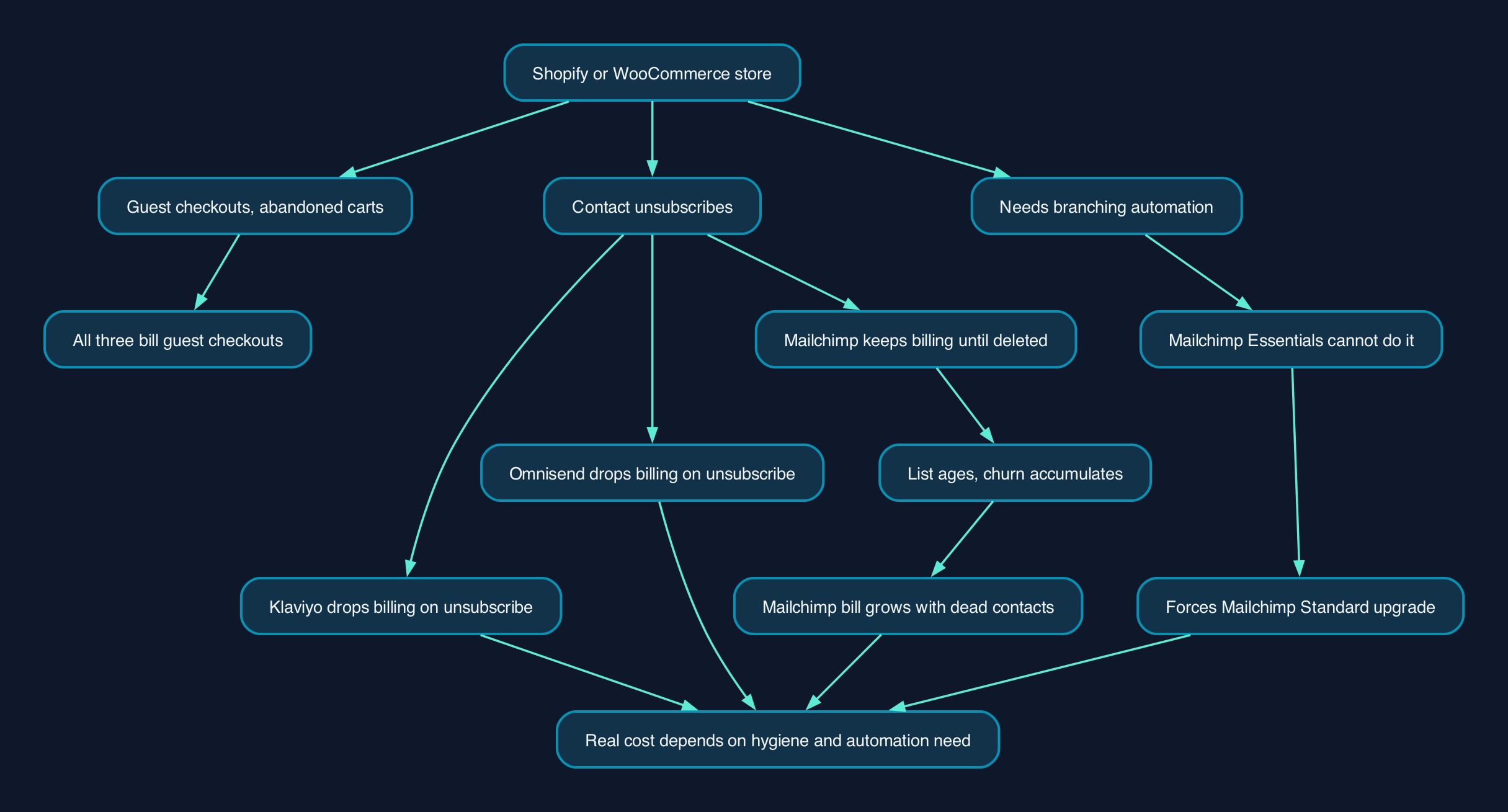
For a small UK Shopify or WooCommerce store, Mailchimp is usually the cheapest way in and Klaviyo the most expensive, but that ranking does not hold once a list carries real trading history. All three vendors bill you for guest checkouts and abandoned carts, not just newsletter subscribers. Klaviyo and Omnisend both drop a contact from billing automatically the moment they unsubscribe; Mailchimp keeps charging for them until you take a separate, manual step to archive, clean or delete the contact.
Key pointers
- Compare entry plans on what they actually do, not just price. Klaviyo and Omnisend both allow branching, conditional-split automation on their entry paid plan; Mailchimp's Essentials plan caps automation at four steps from a single trigger with no branching, and the fuller Journey Builder only arrives on Standard.
- Your billable contact count on any of these three platforms is likely higher than your marketing subscriber count. Klaviyo, Omnisend and Mailchimp all bill for guest checkouts and abandoned-cart contacts who shared an email address at your Shopify or WooCommerce checkout without ticking the marketing box.
- The real gap opens on unsubscribes, not guest checkouts. Klaviyo and Omnisend both stop billing for a contact automatically once they unsubscribe; Mailchimp keeps billing for them until you separately archive, clean or delete the contact, an extra manual step the other two do not require.
- Klaviyo, Omnisend and Mailchimp all offer a permanent free plan capped at 250 contacts and 500 email sends a month; treat all three as trial tiers, not a place to run a store from.
- All three vendors price primarily in US dollars; any pound figure quoted for any of them, including on Mailchimp's own pricing page, is described by the vendor as an estimate that can move with the exchange rate at the time you pay.
- If SMS matters, check the plan it sits on. Klaviyo no longer sells a fixed-price combined Email and SMS plan, and instead charges for SMS per send as a mobile-messaging add-on on top of its Email plan; Omnisend only sells SMS as an add-on, and only on its Pro plan, for anyone who signed up from 4 May 2026; Mailchimp sells it as a separate add-on on Essentials or higher, not on the Free plan.
- Ask any vendor for a quote at your actual, cleaned contact count rather than trusting a homepage headline price, because all three step the price up in bands as your list grows.
- If you are VAT-registered, Klaviyo's dollar price is the number that matters, since VAT is added as a reverse charge on your invoice rather than baked into the headline price.
What Counts as a Contact Decides the Winner
The single most useful fact in this decision is not the headline price. It is what each vendor counts as a billable contact, because that is what determines whether the entry-price ranking survives contact with a real, trading Shopify or WooCommerce store.
Klaviyo's own help centre is explicit that consent is not the test: "Any profile, regardless of consent status, that can be emailed through Klaviyo is considered an active profile. This includes your subscribers and those who are added by general engagement (such as sharing their email on a store's checkout page but not actually opting in)." Shopify and WooCommerce syncs can add both kinds of profile. What does come off the bill is a profile that becomes suppressed, unsubscribed or deleted; Klaviyo's help centre confirms suppressed profiles "do not contribute towards your billing plan's profile count."
Omnisend draws the line in almost the same place. Its own support documentation defines a billable contact as subscribers plus "non-subscribers", meaning "customers who provided their email/phone through placing an order, abandoning a cart, etc., but never opted in to marketing", because Omnisend can still send them automated order confirmations and cart-recovery messages. Only contacts who actively unsubscribed are excluded.
Mailchimp is the outlier, and the more inclusive of the three. Its own help documentation states plainly: "Subscribed, unsubscribed, and non-subscribed contacts are included in your contact count." A shopper who unsubscribed from your newsletter three years ago still occupies a paid seat on your Mailchimp bill until you separately archive, clean or delete them; Mailchimp's own definitions confirm that "archived, cleaned, and deleted contacts don't count toward your contact total," but unsubscribing by itself is not one of those three actions, unlike Klaviyo and Omnisend, where unsubscribing removes the charge automatically.
For a young store with a small, freshly imported list, none of this matters much. For a growing independent retailer with real trading history and several years of normal unsubscribe churn it never went back and archived or cleaned, the practical effect is that Mailchimp's bill keeps carrying that dead weight while Klaviyo's and Omnisend's do not, because both of the latter drop a contact from billing the moment they unsubscribe, with no separate clean-up step required.
Entry Plans and What They Actually Cost
All three vendors price on a band system: you pick (or are placed into) a contact-count band, and the monthly price is fixed for that band regardless of how many emails you actually send within the included allowance.
At the smallest paid band, Klaviyo's Email plan costs $20 a month, which converts to roughly £15 at current exchange rates, for 251 to 500 active profiles. That is the entry point most relevant to a small store moving off Klaviyo's free plan. If you also want SMS inside the same flows, Klaviyo no longer offers a fixed-price combined Email and SMS plan; you add mobile messaging to the Email plan and pay $0.061 per UK text plus provider fees, about 5p a send, so the SMS bill depends on how many texts you send.
Omnisend's equivalent entry plan, Standard, has a standing full price of $16 a month for up to 500 contacts and 6,000 monthly email credits, which is roughly £12. New customers who pay three months upfront get 30 percent off for that introductory period, which brings the monthly cost to $11.20; budget on the full $16 rate for anything you plan to keep running once that first three months ends, and check your own billing history for when it does, since Omnisend's own support pages warn the price rises automatically at that point. Omnisend's next tier up, Pro, has a standing full price of $59 a month for up to 2,500 contacts (the same introductory discount brings it to $41.30), and Pro is the only plan on which SMS is available at all for anyone who signed up from 4 May 2026, bought separately as a volume-priced add-on from $0.007 a message.
Mailchimp does not publish its entry price as static page text; the figure only appears once you move a slider on its interactive pricing page, which our researchers could not execute directly. As set out in Fast Facts above, a UK price-tracking comparison site put Mailchimp's Essentials plan at about £10 a month for its first 500 contacts when checked against Mailchimp's live calculator in August 2026, corroborated by several other independent UK pricing trackers at the same order of magnitude, and it sits below both Klaviyo's and Omnisend's entry prices. If automation is the reason you are buying an email tool rather than price alone, note that Mailchimp's Essentials plan does include automation flows of up to four steps, but only from a single trigger and without conditional branching; the branching, condition-based journeys that Klaviyo and Omnisend both include on their entry paid tier only arrive on Mailchimp's Standard plan and above.
<a id="pricing-and-cost-model"></a>
Pricing and Cost Model
Reading a comparison chart across all three suppliers, this is what a small UK independent retailer commonly ends up choosing between at the point they outgrow a free plan.
| Plan | Contacts included | Monthly price | Billing currency | Automation on this tier |
|---|---|---|---|---|
| Klaviyo Email | 251 to 500 active profiles | $20 (about £15) | US dollars, plus UK VAT added separately | Full flow automation, every paid plan; no SMS included, per-send mobile-messaging add-on |
| Klaviyo Email plus mobile-messaging add-on | 251 to 500 active profiles | $20 plus $0.061 per UK SMS plus provider fees (about 5p a send) | US dollars, plus UK VAT added separately | Full flow automation plus SMS in the same flows |
| Omnisend Standard | Up to 500 contacts (subscribers plus non-subscribers) | $16 standing price, $11.20 for new customers' first 3 months (about £12) | US dollars | Multi-step automation; no SMS |
| Omnisend Pro | Up to 2,500 contacts (subscribers plus non-subscribers) | $59 standing price, $41.30 for new customers' first 3 months (about £45) | US dollars | Multi-step automation; the only Omnisend plan where SMS is available for customers who signed up from 4 May 2026 |
| Mailchimp Essentials | Up to 500 contacts (all contacts, including unsubscribed) | From about £10 (about $13), third-party estimate, Aug 2026 | Estimate shown in GBP; Mailchimp's own disclaimer says the amount charged depends on the exchange rate at payment | Automation flows up to 4 steps, single trigger only |
Two structural points sit underneath that table and matter more than any single row. First, none of the three vendors' own pages confirm true native GBP invoicing: Klaviyo quotes US dollars only and adds UK VAT separately at checkout, Omnisend's support documentation prices everything in dollars, and Mailchimp's own pricing page carries a disclaimer that non-dollar prices are estimates based on the exchange rate at the time you pay. Treat every pound figure in this article as an estimate rather than the exact amount your card is charged, and get a live quote before you commit. Second, every plan here is a banded price, not a metered one: you pay the same $20, $16 or roughly £10 whether you use 10 percent or 100 percent of the included send allowance, so an inactive segment you never clean out is pure waste inside your contact count.
How the Ranking Flips as Your List Grows
Two mechanisms work together to change which platform is cheapest once a list moves from a few hundred contacts to a few thousand.
The first is unsubscribe handling. Klaviyo and Omnisend both drop a contact from billing automatically the moment they unsubscribe or are suppressed. Mailchimp does not: it keeps a contact on your bill after they unsubscribe, and only a separate step, archiving, cleaning or deleting them, removes the charge. A store that has been trading for a couple of years and has never gone back to run that clean-up will see its Mailchimp bill carrying dead weight that costs Klaviyo or Omnisend nothing.
The second is what each entry plan can actually do. Klaviyo and Omnisend both allow branching, conditional-split flow automation on their entry paid plan. Mailchimp's Essentials plan includes automation flows of up to four steps but only from a single trigger and with no conditional branching; the branching journeys that recover abandoned baskets across multiple conditions arrive on Mailchimp's Standard plan, and Mailchimp's headline price advantage narrows once you make that like-for-like comparison instead of comparing Essentials against Klaviyo's or Omnisend's entry plan.
Put together, a UK retailer with a small, freshly built list usually finds Mailchimp cheapest to start, provided single-trigger automation is enough for now. A retailer whose list carries several years of unremoved unsubscribes, or that needs branching automation from day one, should price Klaviyo and Omnisend against their actual billable-contact count and Mailchimp against its Standard plan rather than Essentials, before assuming the cheaper headline plan is the cheaper real choice.
Automation, SMS and Store Integration
All three platforms connect natively to Shopify and WooCommerce, so store sync is not the differentiator; what you get once the sync is live is.
Klaviyo builds every paid plan around behavioural triggers: what a shopper browsed, added to basket or bought, feeding predictive segmentation and revenue-attributed reporting from day one of a paid plan. Its UK SMS, added to any paid plan as a mobile-messaging add-on, runs inside the same flows, so a text message can sit as one step in a wider sequence rather than a separate campaign, and Klaviyo quotes $0.061 plus provider fees per UK SMS send.
Omnisend follows a similar behavioural-automation model to Klaviyo but has moved SMS so that only its Pro plan can buy it at all, for anyone signing up from 4 May 2026; Standard gets the multi-step email automation without any text-message option. Customers who subscribed before that date could still buy SMS credits separately on Standard at legacy rates, but that route is closed to new sign-ups.
Mailchimp's Essentials plan supports single email automations and flows of up to four steps, but only from one trigger, such as a welcome sequence started by a signup. The branching, multi-trigger Journey Builder that behaves more like Klaviyo's and Omnisend's flows only appears from Standard upward, and SMS on Mailchimp is a separate paid add-on layered on top of whichever paid email plan you hold (Essentials or higher), rather than something built into the flow builder.
A retailer already budgeting for the wider cost of running a Shopify store, including the app-store spend that a typical UK direct-to-consumer brand carries on top of its core platform fee, should weigh the email tool against that same total, not in isolation.
Vendor and Option Comparison
| Criterion | Klaviyo | Omnisend | Mailchimp |
|---|---|---|---|
| What counts as a billed contact | Any emailable profile, including guest checkouts; unsubscribing removes it automatically | Subscribers plus non-subscribers (guest checkouts, abandoned carts); unsubscribing removes it automatically | All contacts, including guest checkouts and unsubscribed; you must separately archive, clean or delete to stop the charge |
| Entry price for a small list | $20/mo (about £15) at 251 to 500 profiles | $16/mo full price (about £12) at up to 500 contacts | From about £10/mo at up to 500 contacts (third-party estimate, Aug 2026) |
| Multi-step automation | Branching, conditional-split flows on every paid plan | Branching, conditional-split flows from the entry Standard plan | Essentials caps at 4 steps, one trigger, no branching; branching journeys need Standard |
| SMS | Per-send mobile-messaging add-on on any paid plan, $0.061 plus provider fees per UK send | Only available on Pro (as a paid add-on) for anyone who signed up from 4 May 2026; not available at all on Standard | Separate paid add-on on Essentials or higher; not on Free |
| Billing currency | US dollars, plus UK VAT added separately | US dollars | Shown in GBP as an estimate; vendor's own page says the charge depends on the exchange rate at payment |
| Free plan | 250 profiles, 500 sends/mo, $5 mobile-messaging credit | 250 contacts, 500 emails/mo, 500 web push/mo | 250 contacts, 500 sends/mo, 250/day cap |
| Who it suits | A store where email and SMS revenue attribution justifies deeper setup, and where unremoved unsubscribes are a known risk | A store that wants Klaviyo-style branching automation at a lower entry cost and does not need SMS immediately | A store, or any business, that wants the cheapest working start, has good list hygiene, and can live with single-trigger automation until it upgrades |
| Who should not choose it | A business that only sends an occasional newsletter and will not use the store-behaviour features | A store that needs SMS from day one, since that means jumping straight to Pro | A store with years of unremoved unsubscribes, or that needs branching automation now, since either forces an early move off Essentials |
No single platform wins outright. A brand-new store with a small, unproven list has the least to lose by starting on Mailchimp's cheaper entry plan and migrating later if the automation ceiling becomes a real constraint. A store that already knows abandoned-basket recovery and post-purchase flows drive meaningful revenue, and expects to run a five-figure contact list within a year or two, has a reasonable case for starting on Klaviyo or Omnisend rather than migrating a live, revenue-generating automation setup mid-growth, since flow migrations between platforms are real, unpaid work.
Editorial Analysis
The three-way comparison is easier to reason about once you separate the entry-price question from the total-cost-at-scale question, because they have different answers.
On entry price alone, for a small, clean list, Mailchimp is the cheapest of the three by a meaningful margin, and that is a fair reason to start there if budget is the binding constraint and a single-trigger, four-step automation flow covers what you need for now. But entry price is a snapshot of month one, on a freshly imported list, before normal unsubscribe churn sets in and before you decide whether branching, purchase-triggered automation is worth paying for.
The more durable question is which vendor's pricing mechanics match how your list will actually behave. If you expect meaningful unsubscribe churn over a few years and are not disciplined about archiving or cleaning dead contacts, Klaviyo's and Omnisend's billing are both structurally kinder to you than Mailchimp's, since both stop billing a contact automatically the moment they unsubscribe rather than requiring you to take a further clean-up step. If you know you will lean hard on branching, purchase-triggered automation from early on, comparing Klaviyo's or Omnisend's entry plan against Mailchimp's Essentials plan is not a fair like-for-like price comparison, because Essentials cannot do what the other two do out of the box; the honest comparison is against Mailchimp's Standard plan.
Our judgement, based on the vendors' own published mechanics rather than a single headline number: a UK retailer under roughly a thousand contacts with a simple newsletter-and-promotion habit and reasonable list hygiene is well served starting on Mailchimp's or Omnisend's entry plan; a retailer whose list already carries years of unremoved unsubscribes, or that already knows its abandoned-basket and post-purchase flows matter to revenue, should price all three properly against their own billable-contact count before assuming the cheaper headline plan is the cheaper real choice.
Sources
- Klaviyo Pricing - Klaviyo UK
- Understanding tax with Klaviyo - Klaviyo Help Center
- Understanding active profile management in Klaviyo - Klaviyo Help Center
- Official Omnisend Email & SMS Pricing Plans
- Understand Your Omnisend Paid Plan Charges - Omnisend Support
- About Mailchimp Pricing Plans - Mailchimp Help
- About SMS Marketing with Mailchimp - Mailchimp Help
- Mailchimp Marketing Platform Pricing (UK)
- Klaviyo vs Mailchimp (2026): Ecommerce vs All-Rounder - SMECompare
- Shopify vs WooCommerce vs BigCommerce for a UK DTC Brand - Compare the Cloud
- The Honest Truth About AI Demand Forecasting for UK Indie Retailers - Compare the Cloud