
Clio publishes its UK Core plan price openly at £69 per user per month billed annually, or £79 billed monthly. LEAP publishes no price at all; you request a quote, and independent listings put its starting point at around £129 per user per month. Both platforms build SRA-compliant client accounting into the core product, so the real decision turns on cost transparency, contract flexibility and how each firm's caseload actually works day to day.
Key pointers
- Clio's Core plan starts at £79 per user per month, or £69 per user per month on annual billing; Signature and Elite tiers are quote-only.
- LEAP has no published price anywhere on its site; ask for a written quote and a breakdown of any one-off setup fee before you sign anything.
- Get LEAP's contract length in writing. Independent reviews describe multi-year commitments as a trade-off for LEAP buyers, so check the minimum term against Clio's month-to-month option.
- Both platforms build SRA Accounts Rules client and office ledgers, bank reconciliation and an audit trail into the core product, not as a bolt-on.
- If your firm runs on Mac, test LEAP's desktop component before you commit; it is built for Windows and Mac users typically need a virtual Windows environment.
- Ask both vendors exactly what data migration and staff training cost and who does the work, since this is where quote-only pricing hides real spend.
- Both vendors support legal aid billing to the Legal Aid Agency; if you do legal aid work, confirm which plan tier includes it and how each handles your specific practice areas (criminal, civil or Crown Court).
What the Decision Actually Involves
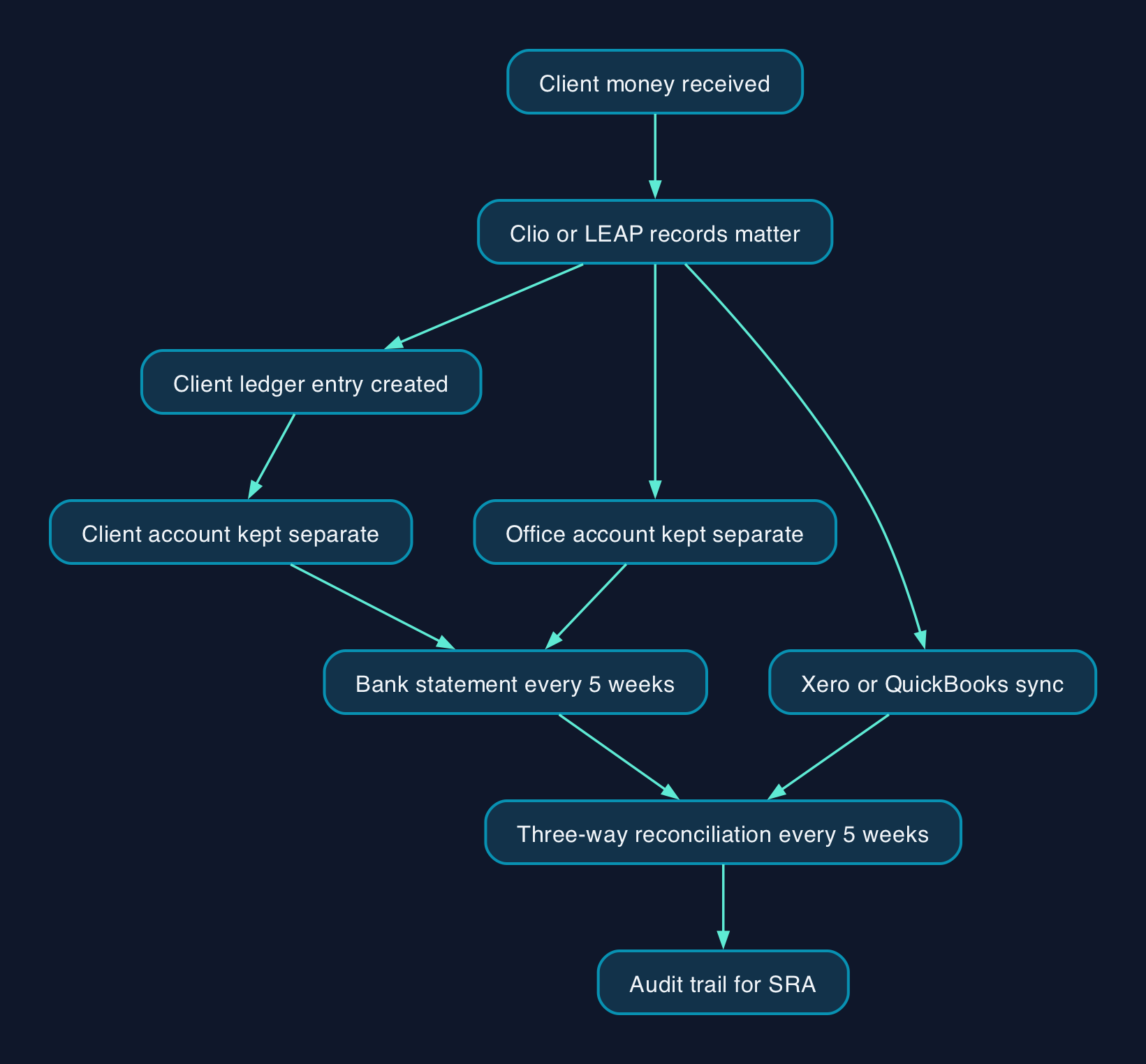
A small UK law firm choosing between Clio and LEAP is really choosing two things at once: a case management system to run matters, and a client accounting system to hold and reconcile money under the SRA Accounts Rules. Both vendors sell these as one product rather than two, which matters because bolting a case management tool onto separate accounting software (or onto Xero alone) does not satisfy the SRA's rules on its own. Xero and QuickBooks are general business accounting tools; they cannot maintain the client-and-office ledger split, matter-level client ledgers, or the five-weekly three-way reconciliation the SRA requires without a legal practice system sitting in front of them.
Clio is the newer entrant to the UK market, built around a modern browser-based interface with an increasingly AI-led feature set (Clio Duo, Clio Work) layered on top of matter management, billing and client accounting. As with any AI feature in a regulated practice, the SRA expects the firm's compliance officer to understand what that AI is doing with client data before it is relied on. LEAP has been selling into UK law firms considerably longer and is built specifically around UK and Irish practice, with a Windows desktop component alongside its cloud back end. Neither difference is inherently better; it depends on how your fee earners actually work, whether you are a Mac-first office, and how much you value transparent self-serve pricing over a sales-led quote process. If your firm also needs a dedicated document management system alongside case management, that is a separate purchase with its own comparison.
Pricing and Cost Model
Clio's UK pricing page states that Core starts at £79 per user per month, with no minimum number of users stated on the public pricing page. Clio's own comparison page breaks that figure down further, putting Core at £69 per user per month on annual billing, or £79 per user per month billed monthly. The Signature and Elite tiers, which add unlimited custom roles, AI-built reporting, multi-currency billing and (at Elite) the Clio Grow client-intake product, are quote-only, so a firm needing those features cannot get a final number without talking to sales.
LEAP takes the opposite approach. Its UK pricing page describes a single all-in-one plan with "no hidden costs or complex pricing tiers," but does not publish a number anywhere; you complete a form to get pricing. LEAP also flags that "a one-time setup fee may apply to cover data migration, software configuration, and onboarding," which is a cost Clio folds into its subscription rather than billing separately. An independent software marketplace listing for LEAP gives a third-party starting-price estimate of around £129 per user per month, roughly double Clio's published Core price, though neither LEAP nor that marketplace confirms exactly what the figure includes or which edition it applies to.
| Cost element | Clio | LEAP |
|---|---|---|
| Entry price | £69/user/month (annual) or £79/user/month (monthly), published | Not published; third-party estimate around £129/user/month |
| Higher tiers | Signature and Elite, quote-only | Single plan, "unlimited capability," quote-only |
| Setup/onboarding | Included in subscription | One-time setup fee "may apply" |
| Billing commitment | Month-to-month or annual, your choice | Not published; confirm in writing |
| Minimum contract term | None stated; no penalty for reducing licences | Not published; independent reviews note some LEAP contracts run multi-year |
| VAT treatment | Not stated on pricing page | Not stated on pricing page |
Treat both sides of that table as a starting point for negotiation, not a final bill. Because neither vendor states whether quoted figures include VAT, add that question to your supplier checklist along with what a mid-year headcount change does to the price, and whether add-ons like Clio Grow, Clio Draft or LEAP's AI tools are bundled or extra.
Vendor and Option Comparison
Both platforms build SRA-compliant client accounting into their core product: separate client and office ledgers, bank reconciliation, and an audit trail. Clio's client accounting features include reconciliation directly against a bank statement inside the Accounts tab, low-balance alerts, and integration with Xero, QuickBooks Online and Klyant for the general ledger. LEAP's accounting features add a Transaction Request approval workflow, where a fee earner requests a payment and a designated approver authorises it before it leaves the firm, plus integration with Xero and QuickBooks Online.
| Criterion | Clio | LEAP |
|---|---|---|
| Deployment | Browser-based, any device including Mac; iOS/Android app | Cloud back end plus a Windows desktop component; Mac users typically need a virtual Windows environment |
| SRA client accounting | Built in, part of Core plan | Built in, part of the single plan |
| Reconciliation workflow | In-app matching against bank statements | Automated bank reconciliation plus transaction approval workflow |
| General ledger integration | Xero, QuickBooks Online, Klyant | Xero, QuickBooks Online |
| Free trial | 7 days, no card required | Demo on request, no self-serve trial |
| Pricing transparency | Core price published; higher tiers quote-only | Fully quote-only |
| Contract flexibility | Month-to-month or annual, no minimum term stated | Not published; confirm minimum term and setup fee in writing |
Clio suits a firm that wants a published starting price to plan against, is comfortable working entirely in a browser, and wants Xero, QuickBooks or Klyant to handle general business accounting alongside client funds. It is a weaker fit if your fee earners rely heavily on document automation that assumes deep Microsoft Word integration, since Clio's document tools sit behind the separate Clio Draft add-on. LEAP suits a firm already committed to a Windows desktop environment, that values a longer UK track record and wants document automation, time recording and accounting tightly bound together from day one; it is a weaker fit for a Mac-first office or a firm that wants to know its monthly cost before booking a sales call. Neither vendor's accounting module replaces a bookkeeper for VAT returns, payroll or year-end accounts; both still hand that work to Xero or QuickBooks Online.
Editorial Analysis
Cost transparency should carry real weight in this decision precisely because both products do the compliance-critical job (SRA-compliant client accounting) adequately. Clio's willingness to put a number on its website, even for just the entry tier, gives a small firm something to budget against before a sales conversation starts. LEAP's insistence on a quote for every enquiry is a common pattern in legal software, but it shifts negotiating leverage toward the vendor and makes it harder to compare like for like across suppliers without doing the legwork this article has done. A practice manager evaluating either system should ask for the full quote, including setup fees and the minimum contract term, in writing before assuming the published or estimated starting price is what the firm will actually pay in year one.
Sources
- Clio UK Pricing - Clio
- Clio UK Pricing Packages - Clio
- LEAP UK Pricing - LEAP Legal Software
- Clio vs LEAP - Clio
- Client Accounting Software for UK Law Firms - Clio
- Clio Legal Aid - Clio
- Law Firm Accounting Software - LEAP Legal Software
- LEAP Criminal Legal Aid Case Management - LEAP Legal Software
- LEAP Legal Aid - LEAP Legal Software
- SRA Accounts Rules - Solicitors Regulation Authority
- SRA Regulated Population Statistics, Solicitor Firms - Solicitors Regulation Authority
- LEAP Legal Software Review - Legal Bookkeeping
- iManage vs NetDocuments vs SharePoint for a UK Law Firm - Compare the Cloud