


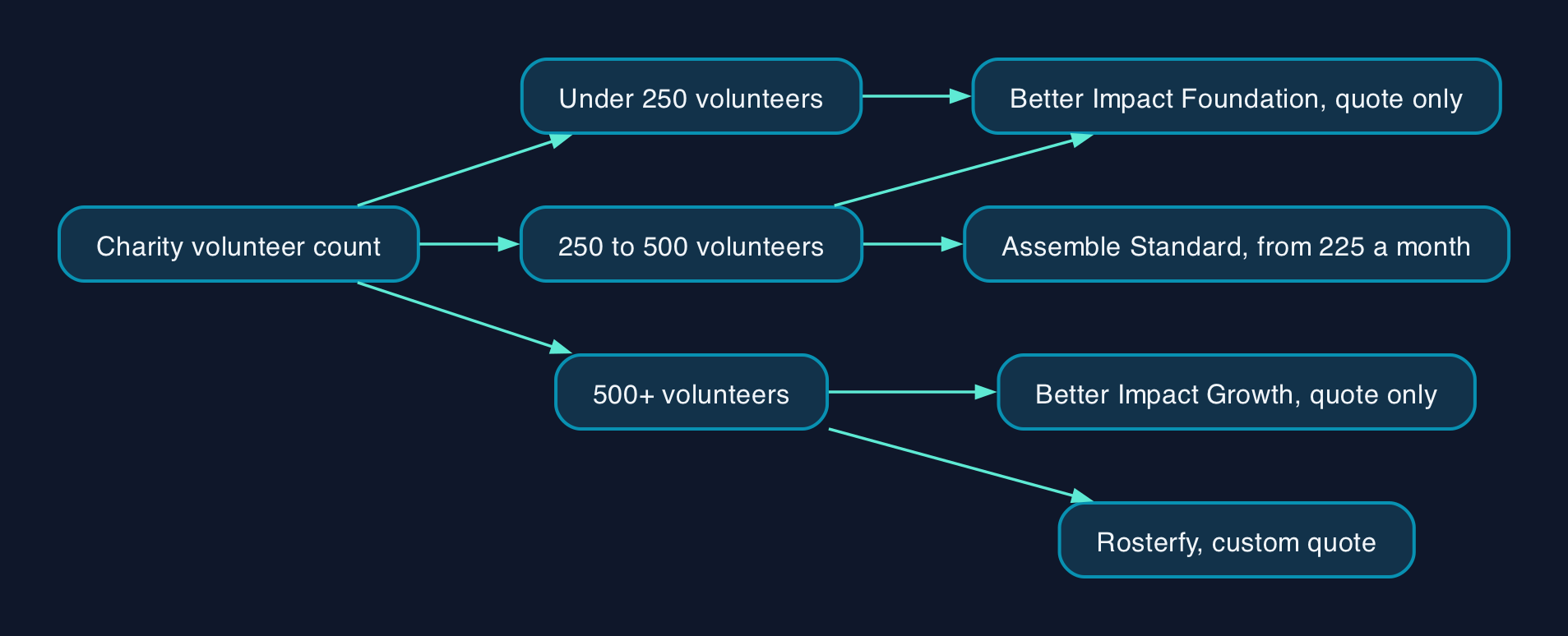
For a UK charity under 500 volunteers, Better Impact's Foundation plan is the only one of the three explicitly sized for that scale, capped at 500 volunteers, though its price is quote-only. Access Assemble's cheapest published tier, Standard, starts at £225 a month but is pitched at 250 or more volunteers, with no cheaper published option below that band. Rosterfy is priced and positioned for programmes of 500 or more volunteers, so it rarely fits at this scale.
Key pointers
- Access Assemble currently publishes two tiers only, Standard (from £225 a month, 250+ volunteers) and Enterprise (price on application, 2,000+ volunteers); there is no published tier below 250 volunteers.
- Better Impact's Foundation plan covers up to 500 active volunteers with 3 admin accounts; no price is published, so ask for a written quote.
- Rosterfy's own comparison page recommends itself for 500-plus volunteers and says Better Impact suits smaller charities with a lower entry price.
- A UK software marketplace lists Rosterfy's starting contract at roughly $7,000 (about £5,284) a year, well above Access Assemble's published entry price.
- Access Assemble says it "normally" recommends its software for charities with at least 200 volunteers to see the best return on investment, a useful marker for a very small charity weighing it up.
- Check DBS (Disclosure and Barring Service) tracking before you sign: Access Assemble tracks DBS status and expiry natively, Better Impact relies on custom fields, and Rosterfy adds DBS ordering through a separate uCheck integration.
- From 5 October 2026 the government DBS fee itself changes, so build the new figures into any rollout budget rather than the old ones.
- Get a demo quote from at least two suppliers before committing, since none of the three publishes a figure that will exactly match your volunteer count and feature list.
What Volunteer Management Software Means for a Small Charity
A volunteer management system replaces the spreadsheet, the shared inbox and the paper sign-in sheet with one record per volunteer: contact details, availability, role history, training completed and, where it matters, DBS (Disclosure and Barring Service) status. For a charity moving off spreadsheets, the real decision is not which platform has the most features. It is which platform's pricing tier, admin-account limit and volunteer cap actually match the size of the programme today, without locking the charity into paying for enterprise tools it does not need.
All three products named in this guide, Better Impact, Access Assemble and Rosterfy, do the core job: online applications, a volunteer database, scheduling and communication. Where they differ is scale and cost structure. Access Assemble's only published pricing starts at the 250-volunteer band. Better Impact sells a Foundation tier capped at 500 volunteers but does not publish a price. Rosterfy builds every quote from scratch and, by its own account, is priced for programmes with 500 or more volunteers.
A volunteer coordinator with, say, 120 volunteers and one with 400 are in different buying positions even though both count as "under 500". Below roughly 200 to 250 volunteers, Better Impact's Foundation plan is the only one of the three with a tier explicitly aimed at that size, since Access Assemble's cheapest published option starts at the 250-volunteer band and Rosterfy is not built for this scale at all. Between 250 and 500 volunteers, Access Assemble's Standard tier and Better Impact's Foundation plan both become realistic options, and Rosterfy remains a stretch until the programme approaches or exceeds 500.
Pricing and Cost Model
Pricing is the clearest point of difference between the three, though only one supplier publishes a full set of figures. Access Assemble publishes two tiers. Better Impact and Rosterfy publish none, so any figure quoted for those two needs a caveat about where it comes from.
Access Assemble sells two published tiers. Standard covers 250 or more volunteers, priced from £225 a month, billed annually at £2,700 a year; there is no cheaper published tier for a charity below that band. Enterprise, for 2,000 or more volunteers, is price on application. Neither tier states a manager or admin-account limit on the current pricing page, and neither states whether the figures include VAT.
Better Impact does not publish a price for any tier. Its own features page sets out three plans by volunteer cap and admin-account count: Foundation for up to 500 active volunteers with 3 admin accounts, Growth for up to 1,000 active volunteers with 10 admin accounts and background-check integration, and an unlimited Impact Plan with single sign-on and a REST API. Better Impact's FAQ confirms billing is based on accepted and inactive volunteer profiles, not applicants, so a charity is not charged for people still going through recruitment. A charity under 500 volunteers should ask for a Foundation-tier quote specifically, since Better Impact's sales process is consultative and starts with a demo call rather than a self-serve checkout.
Rosterfy also has no published price list; its UK pricing page routes straight to a custom-quote form built around administrator numbers, onboarding needs and customer success support. On its own comparison page, Rosterfy states plainly that it is "the stronger choice for organisations managing 500+ volunteers" and that "Better Impact suits smaller nonprofits with simpler volunteer programme needs and a lower entry price point." That is a supplier's own assessment, not independent testing, but it lines up with an independent listing: software marketplace Capterra puts Rosterfy's starting price at US$7,000 a year, usage-based. Converted at the mid-market USD/GBP rate of 0.75489 on 29 September 2026 (source: Frankfurter.app, European Central Bank reference rates), $7,000 works out at roughly £5,284. That figure is a marketplace-reported starting contract value, not a UK-specific quote from Rosterfy, and actual pricing depends on volunteer count and the modules a charity needs.
Assumptions
- Rosterfy's £5,284 figure is calculated from a software marketplace's published US$7,000 starting price using the 29 September 2026 mid-market exchange rate; it is not a price Rosterfy itself has quoted in GBP.
- Access Assemble's £225-a-month figure is its own published Standard-tier starting price, confirmed directly on the live pricing page; there is currently no cheaper published tier for a charity below 250 volunteers.
- None of the three suppliers' pages confirms VAT treatment, so all figures here should be treated as ex-VAT until a quote says otherwise.
Vendor and Option Comparison
| Criteria | Access Assemble | Better Impact | Rosterfy |
|---|---|---|---|
| Volunteer cap on entry tier | 250+ (Standard is the cheapest published tier) | 500 (Foundation) | No published cap; sized for 500+ |
| Published price | Standard from £225/month (£2,700/year); Enterprise POA | Not published | Not published |
| Admin accounts on entry tier | Not stated on the current pricing page | 3 (Foundation) | Not published; quote-based |
| DBS tracking | Built-in status field with expiry alerts | Custom field, no native UK DBS integration | Via uCheck integration, UK customers only, extra cost possible |
| Contract term | Standard and Enterprise: annual | Not published; typically annual for SaaS of this type | Annual, quoted |
| Best fit | A charity already at or approaching 250 volunteers that wants a fixed, published price | A charity well under 500 volunteers wanting a plan sized and priced for that scale | Large-scale or multi-entity programmes, national campaigns, big one-off events |
| Who should not choose it | A charity well under 250 volunteers is paying the 250-volunteer Standard price for a smaller headcount, so get a Better Impact quote first | A charity already committed to Access's wider Charity Suite (CRM, fundraising) may prefer Assemble for the tighter integration | A charity under roughly 250 to 300 volunteers is likely paying for scale and automation it will not use |
Access Assemble's advantage for a small UK charity is that its Standard tier is a fixed, published price a coordinator can budget against today, even though it is pitched at 250 or more volunteers. Better Impact's advantage is that its Foundation plan is explicitly sized for under-500-volunteer charities and the platform has a long international track record, though one UK-focused comparison notes it was "not built specifically for the UK market" and that DBS workflows need custom fields rather than a native check. Rosterfy's advantage only shows up once a charity is managing multiple sites, large one-off events or several hundred volunteers with complex compliance rules, which is not the scenario in the query this guide answers.
Migration and Rollout Checklist
- Export the current volunteer spreadsheet or database and confirm every field (name, contact details, DBS status and expiry date, role history) has a matching field in the new system before importing.
- Count active volunteers precisely, including anyone inactive but not yet archived, since Better Impact bills on "accepted and inactive" profiles and Access Assemble's tiers are volunteer-banded.
- Decide who holds admin access. Better Impact's Foundation plan caps out at 3 admin accounts; confirm Access Assemble's current admin allowance directly with its sales team, since the live pricing page does not state one for Standard.
- Ask each shortlisted supplier for a written quote against your actual volunteer count, not the headline tier price, and get the contract term and cancellation notice in writing.
- Confirm how DBS status and expiry will be tracked from day one: a built-in field (Access Assemble), a custom field you configure yourself (Better Impact) or a paid integration (Rosterfy's uCheck).
- Run a pilot with one team or site before migrating every volunteer record, and keep the old spreadsheet read-only as a fallback until the pilot is signed off.
- Train the volunteer-facing side too: check whether volunteers self-register through a portal or app before rollout day, so applications do not pile up in an old inbox.
- Set a rollback point. Agree with your team a date by which, if the new system is not working, you revert to the spreadsheet rather than running two systems in parallel indefinitely.
Expert Commentary
Editorial analysis. Access Assemble has previously marketed a lower-cost Starter package for charities under 250 volunteers at £75 a month, and some indexed copies of its pages still describe it. Checked directly in a browser on 29 September 2026, though, Access Assemble's live pricing page lists only two tiers: Standard from £225 a month and Enterprise on application, with no sub-250-volunteer option and no manager-count figure attached to either. A charity that has seen a £75 figure quoted elsewhere should ask Access Assemble's sales team to confirm what it can currently offer at their volunteer count, rather than assume an older headline price still applies. That leaves Better Impact's Foundation plan, capped at 500 volunteers and priced individually by quote, as the option explicitly built for a smaller charity's scale, and Access Assemble's Standard tier as the fixed-price option once a charity is at or nearing 250 volunteers. Rosterfy remains a poor fit below 500 volunteers on the evidence available: its own comparison content, aimed at buyers weighing it against Better Impact, says as much.
Sources
- Access Assemble pricing packages — The Access Group
- What a Volunteer Management Information System improves — The Access Group
- Access Assemble volunteer management software overview — The Access Group
- Better Impact features and plans — Better Impact
- Better Impact features (volunteer and admin caps) — Better Impact
- Rosterfy UK pricing — Rosterfy
- Rosterfy vs Better Impact comparison — Rosterfy
- Rosterfy uCheck integration — Rosterfy Help Centre
- Rosterfy pricing listing — Capterra
- DBS reduces fees for checks and Update Service from 5 October 2026 — GOV.UK / Disclosure and Barring Service
- DBS check application process for volunteers — GOV.UK / Disclosure and Barring Service
- Best volunteer management software for UK charities — Plinth
- Live USD/GBP exchange rate — Frankfurter.app, European Central Bank reference rates